 Retro Replay Retro Gaming History, Reviews & Emulation
Retro Replay Review
Gameplay
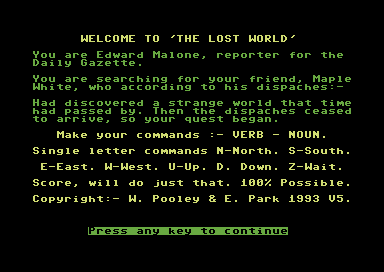
The first stretch gives you a clear job rather than dropping you into aimless command-guessing. Maple White’s death and the inaccessible plateau put two questions in front of you: what happened to him, and how do you get up there? That is a sturdy foundation for a text adventure, because even small discoveries feel connected to the larger expedition.
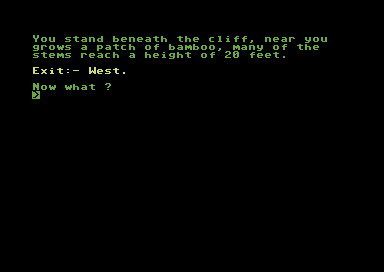
You interact entirely through typed commands, reading descriptions of your surroundings and deciding what to investigate next. That makes The Lost World a game of attention and patience. You are not being carried by action or imagery; you are doing the mental work of turning a written location into a place you can navigate. When the wording points you toward a solution, that can be satisfying in the particular, private way good interactive fiction often is.
The trade-off is immediate: progress depends on how readily you can translate your ideas into commands the game accepts. A player who enjoys trying possibilities, taking notes, and sitting with a problem will get more from it than someone looking for a breezy adventure. Give it a chance if the prospect of working out a route up those cliffs sounds inviting in itself. If that sounds like a hurdle before the real game starts, it probably is not for you.
Graphics
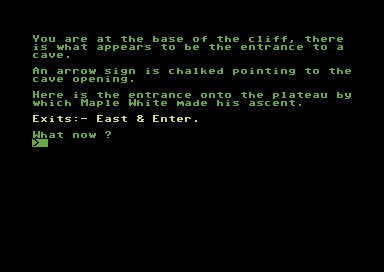
There are no graphics. The screen is devoted to written descriptions and the commands you type, so every location, cliff, and discovery has to take shape in your imagination.
Story
The mystery has a strong pulp-adventure pull. Malone is not merely sightseeing: his friend’s dispatches have stopped, the expedition has gone wrong, and Maple White is already dead when you arrive. That gives the opening more tension than a simple treasure hunt.
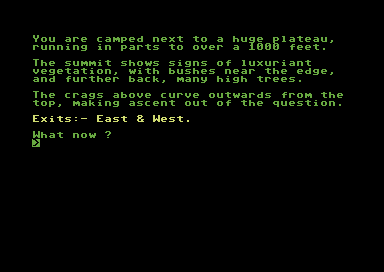
The lost plateau is also a good central image because it is both the destination and the obstacle. You know where the answers are supposed to be, but not how to reach them. The story’s momentum comes from closing that distance and exploring the strange land beyond.
Do not expect the game to deliver its story through cutscenes or character performances. It is a written investigation, and its impact depends on whether you enjoy reading closely and building the atmosphere for yourself. The premise is compelling enough to reward that investment, especially if classic expedition fiction is already your kind of thing.
Overall Experience
The Lost World is a narrow, earnest piece of Commodore 64 interactive fiction: no visual distraction, no shortcut around its prose, and a mystery that asks you to earn each step forward. Its best quality is that it gives your exploration a purpose from the outset. You are not just looking around; you are following the trail of a dead friend into an unreachable world.
That same austerity makes it a selective recommendation. Fans of parser adventures can find a focused little expedition here, while newcomers may find the typed-command format less forgiving than the premise deserves. For a very different take on the Lost World name, see The Lost World: Jurassic Park; this game is for the mood of reading, probing, and slowly finding your way rather than immediate action.
Worth trying if you want an old-fashioned text mystery with a clear objective and are ready to meet it on its own terms. The payoff is the gradual sense that you have pushed past the base camp and into a place that had initially existed only as a few worrying messages and a wall of cliffs.


Reviews
There are no reviews yet.