 Retro Replay Retro Gaming History, Reviews & Emulation

Retro Replay Review
Gameplay
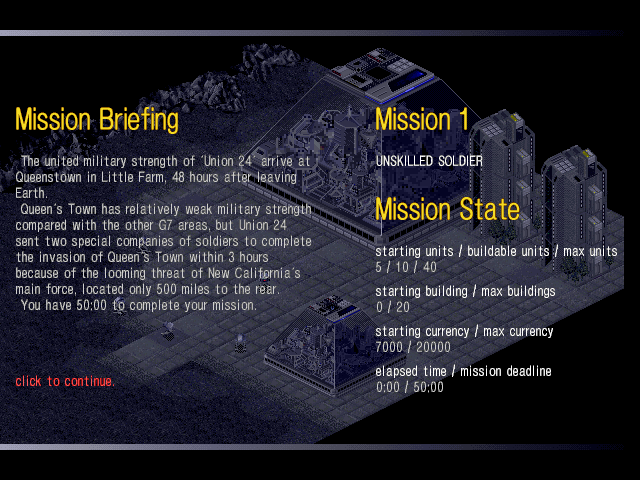
The first few minutes of Armored Moon feel less like building an empire and more like being handed a thin lifeline. You have starting funds, a limited stock of units, and enemy-held cities standing between you and victory. Since you cannot manufacture replacements in the usual RTS fashion, calling in a mech is a decision with consequences. Lose too many and the mission is over, no matter how much ground you have managed to take.
That constraint is the game’s strongest idea. Friendly cities produce money at intervals, so expansion does matter, but it is not a race to strip a map of raw materials. You are fighting to secure income, places to build near, and extra units added to your stock when a city falls. The result is a more deliberate real-time game than its basic conquer-every-city objective first suggests. A successful push is one where you keep enough force alive to hold momentum rather than merely trade units.
Experience adds another reason to protect veteran mechs, and the recharge system gives damaged units a second life when you plan around it. A dedicated unit and a structure can repair nearby forces with energy bolts, making positioning and retreat part of the battle instead of an admission of defeat. When this starts clicking, you stop treating every damaged mech as expendable and start shaping attacks around what can be kept operational.
The hard edge comes from the computer opponent’s unlimited unit supply and regular attacks. Your own reserves are finite, so an ugly fight can unravel quickly; if the stock is empty, you restart. The escalating ten-mission structure suits that uncompromising design, but it will frustrate anyone who expects a campaign to smooth over mistakes. Armored Moon asks you to replay, preserve units, and learn the map’s pressure points. If that sounds satisfying rather than exhausting, its tactical economy has real teeth.
Graphics
The action is presented in an isometric view, with bipedal mechs, cities, and weaker cyborg defenders laid out across each battlefield. The angled battle screens make the basic flow easy to parse: you can follow a force moving between cities and see where the next territorial fight is forming.

Story
Set in 2040 after Earth has exhausted its resources, Armored Moon sends a rebel force to reclaim the Moon from corporations trying to seize its remaining valuables. It is a direct sci-fi conflict, built around a clear enemy and a clear objective rather than moral uncertainty.
The lunar resource crisis works well because it matches the campaign’s mechanical sting. Money arrives through captured cities, replacement troops are limited, and control of territory feels like the actual subject of the war rather than a checkbox pasted onto combat.
Across ten increasingly difficult missions, the story’s main function is to keep the pressure moving forward: take control of the Moon one hostile city at a time. That simplicity is effective here. You are not distracted from the central fantasy of leading an under-resourced rebellion against a better-supplied opponent.
Overall Experience
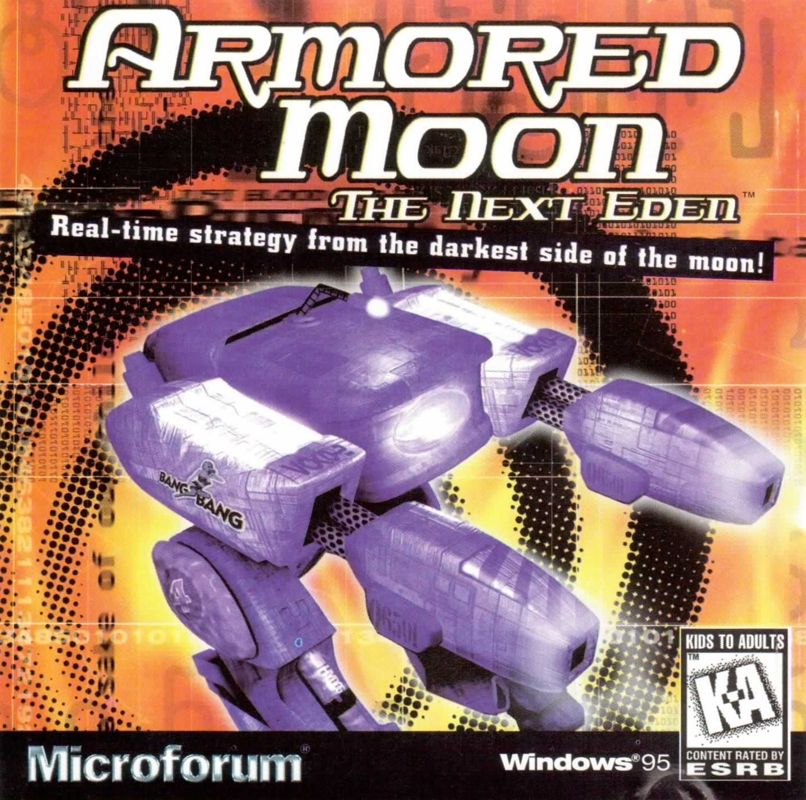
Armored Moon: The Next Eden is a tough, focused RTS whose best moments come from turning a small surviving force into a workable offensive. The lack of resource harvesting and conventional unit production makes it stand apart from more familiar base-building strategy games. Every city capture changes your options, every veteran is worth protecting, and every repair can be the difference between a recovery and a restart.
Its limitations are also inseparable from that identity. The fixed stock system gives failure real weight, while an enemy with endless replacements can make the time limit and repeated attacks feel harsh. This is not a relaxed conquest game where you can recover from careless losses by outproducing the opposition.
Give it a chance if you enjoy real-time tactics that reward restraint, careful reinforcement spending, and replaying a mission until your approach is efficient. Skip it if you want sprawling economic development or a forgiving campaign. For the right strategy fan, Armored Moon’s pressure-cooker battles are more memorable than its modest premise initially suggests.


Reviews
There are no reviews yet.