 Retro Replay Retro Gaming History, Reviews & Emulation
Retro Replay Review
Gameplay
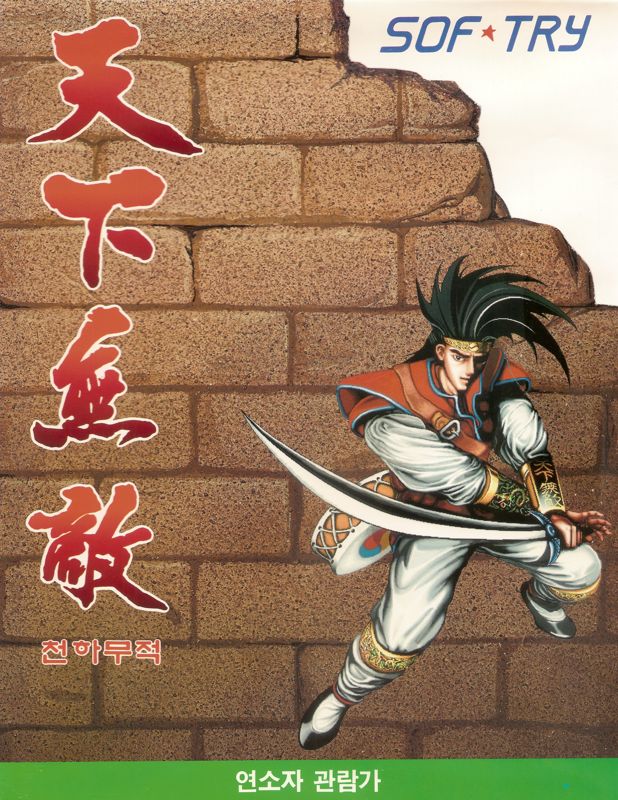
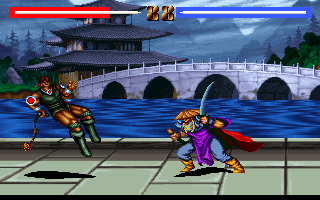
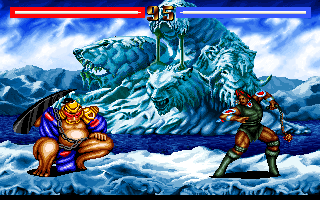
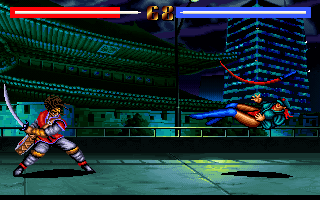
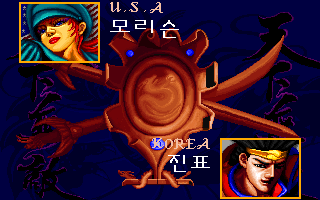
The first few matches have a pleasingly immediate arcade-fighter energy: choose one of eight international combatants, step into a side-view bout, and start figuring out how far you can push jumps, backflips, and leaps over an opponent. The tournament premise gives the roster a clear reason to collide, while the abundance of weapons—swords and flails among them—helps Cheonha Mujeok feel less like a bare-knuckle clone.
Movement is where its personality comes through most clearly. Being able to jump backward, flip, or clear an opponent’s head invites you to think about position instead of simply standing toe-to-toe. That can make a match feel lively when both sides are trying to slip past one another, particularly in local competition where another person can react to your escape attempts.
Still, this is a small, focused fighter rather than a game built to occupy you for weeks. You can face the computer or another person, but the eight-character roster and lack of a story mode mean repetition arrives fast. Give it a chance if the idea of sampling a 1994 Korean DOS fighting game sounds genuinely fun; go in expecting compact bouts and novelty, not a huge ladder of things to uncover.
Graphics
The side-view battle screens keep the action easy to track, especially when a fighter jumps, backflips, or vaults over the other combatant. With characters representing countries including South Korea, North Korea, Norway, and the USA, the roster concept gives each selection a clear place in the lineup.
Story
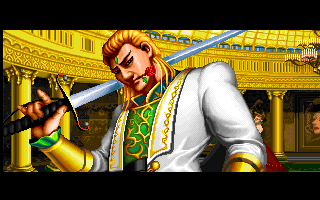
Cheonha Mujeok begins with a surprisingly grand setup. The world’s peoples have formed the Great Nation, a peaceful society without borders, but malicious ambitions return and threaten that achievement. The president’s answer is an elite global police force and a contest to select its first chief.
It is a clean excuse for an international fighting roster, and it gives the championship more weight than a generic “who is strongest” contest. Every competitor is ostensibly chasing a prestigious public role rather than merely entering a tournament for its own sake.
Do not expect that premise to unfold through play. There is no story mode, so the Great Nation and its crisis remain an opening frame around the versus action instead of a narrative you advance. That is a missed opportunity, because the borderless-world premise is more memorable than the game has room to explore.
Overall Experience
Cheonha Mujeok is most enjoyable when you treat it as a concise competitive curiosity. The globe-spanning cast, weapon users, and acrobatic evasive movement give it enough flavor to separate it from a completely anonymous one-on-one fighter.
Its thin structure is hard to ignore, though. Once you have tried the roster against the AI and spent time in head-to-head matches, there is no narrative track to refresh the experience. The payoff comes from the bouts themselves and from seeing how its different fighters handle, not from a long campaign or elaborate progression.
For retro fighting-game fans, that can be enough for an evening of experimentation—preferably with someone on the other controller. Everyone else may find the premise more interesting than the amount of game wrapped around it. Cheonha Mujeok deserves credit for its unusual setting and direct combat focus, but it remains a modest fighter with limited staying power.


Reviews
There are no reviews yet.