 Retro Replay Retro Gaming History, Reviews & Emulation
Retro Replay Review
Gameplay
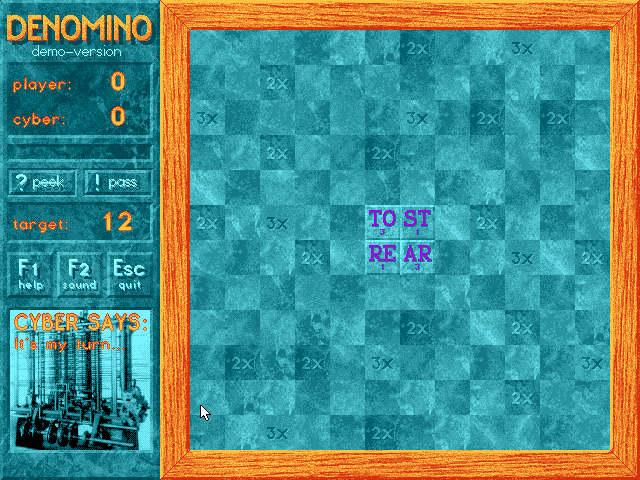
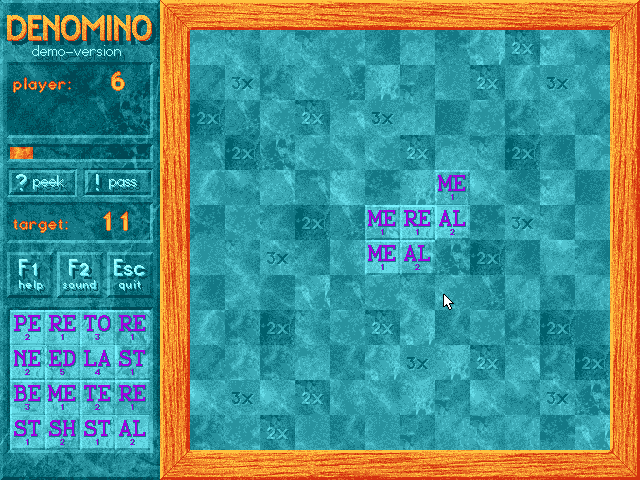
Denomino makes you earn its satisfying moments. You drag a tile onto the board, rotate it vertically with the right mouse button or turn it horizontally with the left, and try to make one or more four-letter words against the letters already in play. That sounds straightforward until the board starts filling up. A legal word is not automatically a good move when a higher-value tile or a bonus square might turn the same corner into a far better scoring opportunity.
The twelve-by-twelve grid gives the game room to develop without making each turn hard to parse. Early on, you can play opportunistically and enjoy spotting simple connections. Later, placement becomes a small planning exercise: preserve useful openings, consider both halves of the domino, and avoid leaving the computer an easy response. The mouse-only controls fit the game well because you spend your attention on the letters and spaces rather than on commands.
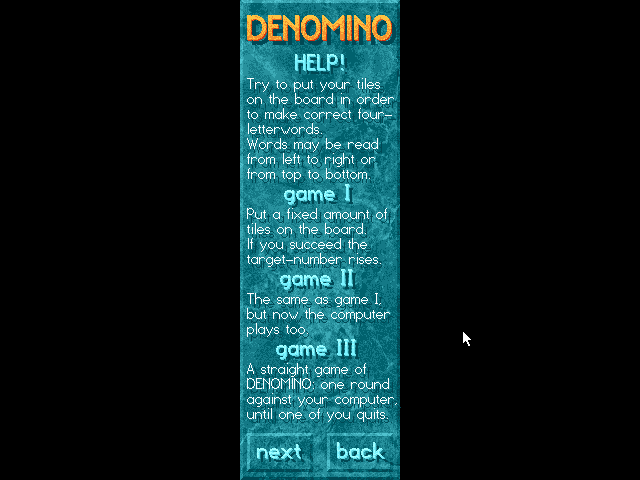
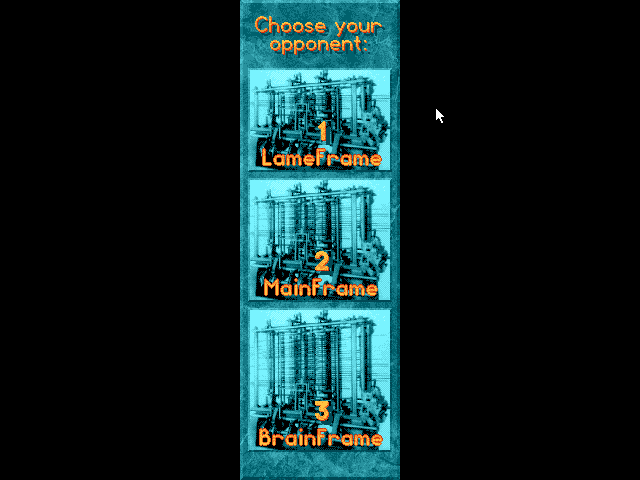
There is a useful range of ways to test yourself. Solo play asks you to place a fixed number of tiles, while the computer games offer both a fixed-tile format and an unlimited version with three intelligence levels. The time limit keeps you from examining every possibility forever, which gives successful placements a welcome snap. If you hit a wall, Peek can suggest a next move, but sacrificing points means it remains a rescue tool rather than an automatic answer. Passing is also there when the board simply refuses to cooperate.
Graphics
Denomino keeps the view focused on its playfield: a twelve-by-twelve board, domino-like letter tiles, and the spaces where words intersect. That clean top-down layout suits a game where you need to judge adjacent letters and tile orientation at a glance.
Story
Denomino does not lean on a character tale or a campaign premise. Its momentum comes from the board itself: the small satisfaction of fitting letters together, then the larger satisfaction of turning that fit into a strong score.
Each match creates its own tiny arc. You begin with open territory and obvious opportunities, then the grid becomes crowded and every placement carries more consequence. A move that looks clever now may make the next turn awkward, while an unremarkable tile can become valuable once a bonus square and the right word line up.
That spare framing works for a word game. You are not here to chase plot beats; you are here to untangle a changing letter puzzle under a clock, perhaps with the computer waiting to punish a careless opening. The high-score tables give those individual rounds a reason to matter after the board is cleared.
Overall Experience
Denomino is a good fit when you want wordplay with more board awareness than a simple anagram game. The domino format gives each tile an awkward, interesting shape in practical terms: you are always weighing two letter pairs, two orientations, and the nearby spaces. When several words come together from one drop, it delivers the exact kind of compact triumph puzzle fans chase.
Its main source of friction is also its point. The timer can turn a promising board into a pressured search, and four-letter-word construction leaves little room for vague guesses. You need to enjoy studying possibilities, accepting that some turns will be passes, and learning when a Peek is worth the lost points. The computer modes are where that discipline becomes most rewarding, especially once you raise its intelligence.
For a shareware-era DOS game, the concept is focused rather than sprawling, and that focus is its strength. Give it a chance if you like scoring games where vocabulary, spatial planning, and a bit of risk management meet on the same grid. It will not win you over through excess; it wins by making a single well-placed tile feel smarter than it first appears.


Reviews
There are no reviews yet.