 Retro Replay Retro Gaming History, Reviews & Emulation
Retro Replay Review
Gameplay
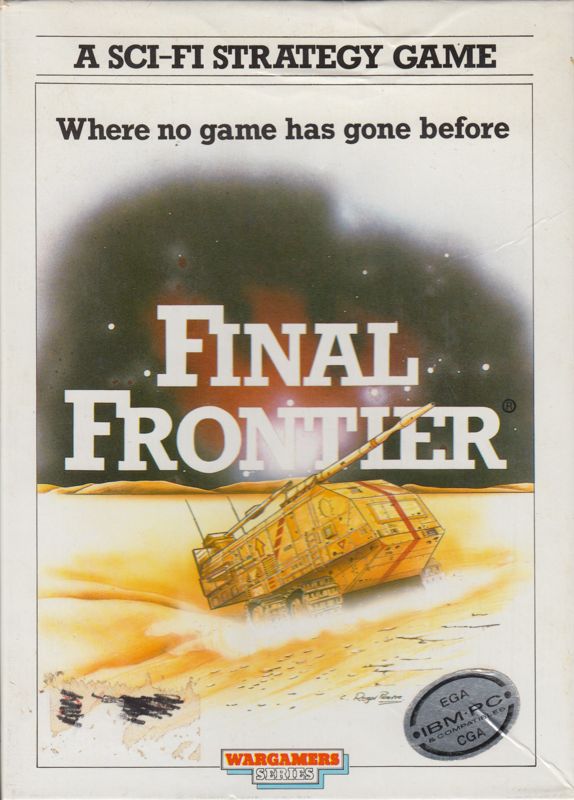
The first hour of Final Frontier is about learning to think like a mobile war factory rather than a commander with an endless barracks. Your robot city moves from zone to zone, while the units it produces gather metal and energy, scout terrain, fight enemy robots, and hunt down the enemy city that blocks your progress. The basic objective is blunt and good: conquer the continent before the planet is written off. What makes it more interesting is the pressure behind every move. Production consumes time and shared resources, and you can only make a limited selection of robot models at once.
The strategic layer starts to click when you realize that the world map is a progression puzzle. Mutant cities in marked zones hold plans for stronger designs, yet you cannot casually pass through a zone ruled by an enemy city; you have to destroy it first. That turns route planning into the heart of the game. A tempting upgrade is not automatically the right next target if a tougher city stands in the way. You need to judge whether your current manufacturing and combat strength can open that route, or whether another conquest will build a safer foundation.
Terrain and weather prevent the robot roster from becoming interchangeable. Hover units cannot cross hills or broken ground, tracked machines cannot cross lava, radiation storms kill robots caught in them, and electromagnetic storms can take out flying models. That is a sharp set of constraints for a game built around mechanized conquest. It means a unit that looks useful on one zone’s ground can become a liability in the next. Frustration will set in if you treat movement as an afterthought, especially when a storm destroys an expensive force, but the restrictions give scouting and composition genuine stakes.
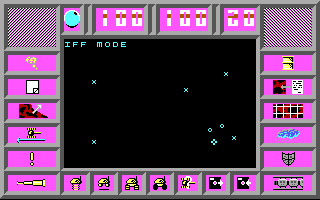
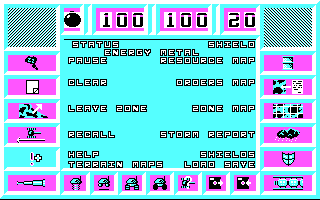
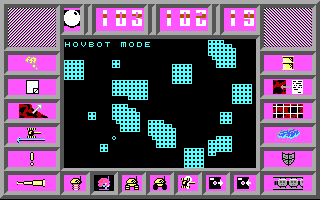
The three-screen structure asks you to stay organized. The Icon screen’s radar can be switched to different information views, the scrolling main map is where you direct action with a cursor, and the production screen is where resources and robot construction are managed. It is not a game that lets you coast on reflexes. You are constantly moving between the immediate problem on the map and the longer-term question of what your city can afford to build. If you enjoy strategy games where logistics, geography, and advancement are tightly connected, that tension is the reason to stick with it.
Graphics
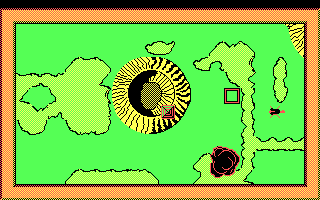
Final Frontier is built around functional strategy views: a scrolling zone map shows your robot city, friendly and enemy robots, terrain, and hazards, while the central radar map gives you an at-a-glance read on the current zone. The production screen shifts to a factory-floor view for robot design and construction, giving the game a distinct operational contrast to the battlefield map.
Story
This is a grim post-apocalyptic setup in which humanity’s ecological collapse leaves androids as the surviving force on Earth. Radiation has replaced solar energy in the planet’s new biosphere, and storms leave behind nuclear material that the machines harvest. It is a suitably strange foundation for a strategy game centered on resource extraction and industrial evolution.
The androids are not merely fighting for territory. They are redesigning robots from recovered debris and evolving toward a dominant form, while a planetary review hangs over the whole conflict. If no clearly supreme android emerges before the next review, Earth will be stripped down and reassigned to a design pool. That deadline gives the conquest objective more personality than a generic map-clearance campaign.
Do not expect the premise to distract from the tactical work. Its real value is how cleanly it explains the systems around you: metal becomes production, radiation becomes energy, better plans become evolution, and rival robot cities become obstacles to survival. The fiction and the strategic loop point in the same direction.
Overall Experience
Final Frontier has the kind of hard-edged strategy structure that rewards patience. Its best moments come from plotting a viable chain of conquests, securing the resources to produce an appropriate force, and finally reaching a mutant city whose plans can change what your factory is capable of. The payoff is not flashy; it is the satisfaction of turning an initially constrained robot city into the dominant machine civilization on the map.
It can also be unforgiving. Limited production, hostile city strength, impassable terrain, and lethal weather all punish a careless advance. A bad route can leave you facing a city beyond your current capabilities, while the wrong robot mix can make the landscape itself feel like an enemy. That harshness is likely to repel anyone who wants a breezy real-time strategy campaign, but it gives every successful decision consequence.
Give Final Frontier a chance if you like older strategy games that make you earn technological progress instead of handing it out. You need to be comfortable studying maps, respecting unit limitations, and accepting that a slower approach may be the smart one. For that audience, its mobile-city concept and route-driven campaign offer a satisfying, demanding take on post-apocalyptic machine warfare.


Reviews
There are no reviews yet.