 Retro Replay Retro Gaming History, Reviews & Emulation

Retro Replay Review
Gameplay
Kid for DOS builds its challenge around a familiar combination: jump between platforms, gather fruit, and avoid enemies and pits. Its more interesting detail is the arrangement of breakable blocks. Hitting them from below can open a different route, making it worth considering where you want to go before clearing everything overhead.
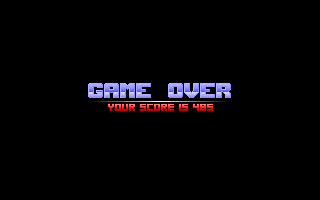
The life system gives those decisions some weight. You begin with three lives, an enemy hit costs one, and losing the last ends the run without a continue. Returning to the place where a life was lost softens individual mistakes, but the limited stock of lives still encourages caution. A safer route may be more valuable than a tempting cluster of fruit.
Scoring provides a reason to revisit the small set of levels. Some exits offer more points, and the high-score table requires a total above 1,000. For an independent perspective on the mechanics, Darren Hewer’s Kid review at DOSGames.com also discusses its familiar jumping and block-breaking, while noting that the hit detection falls short of the precision he expects from Nintendo’s platformers.
Graphics
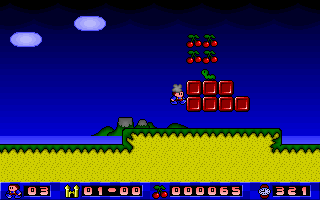
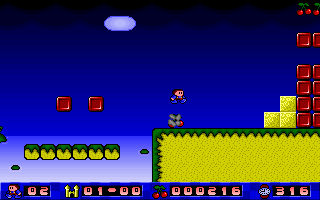
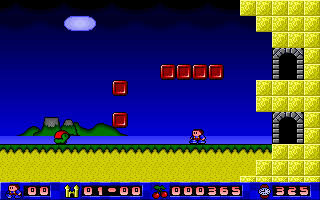
Kid’s strongest visual quality is its use of color. Yellow terrain and red blocks stand out against a deep blue sky, with white clouds and green hills behind the action. Those large areas of contrasting color make the basic structure of a screen easy to pick out.
The hero and enemies are small, leaving plenty of space for the platforms and gaps that determine the route. In the block-breaking scene, fruit hangs above a compact stack of red tiles, turning the next objective into a clear visual invitation. The scenery is sparse, but the screen is not crowded with decorative objects competing for attention.
A narrow status strip sits along the bottom, separating counters from the play area. The result has the charm of a modest DOS arcade game rather than the detail of a lavish production. The bright palette does much of the work; anyone looking for elaborate scenery should keep expectations modest.
Story
The premise is straightforward: guide the character called Kid through the levels and keep him alive. The available setup gives fruit collecting, hazards, and exits center stage, with little need for a larger narrative to explain the next jump.
That simplicity suits a game organized around short attempts and a high-score table. A narrow escape or a route that earns extra points provides the immediate sense of progress. The meaningful choices concern the screen in front of you rather than conversations or a branching plot.
Players exploring other child-hero platformers on DOS can also browse our Commander Keen Combo CD review. It is a separate series with its own setting, but a relevant companion for readers interested in the era’s approach to young protagonists and side-scrolling adventures.
Overall Experience
Kid is most appealing as a small discovery from the DOS platforming library. Its breakable-block routes and score incentives give the simple objective a little texture, while the colorful screens make an inviting first impression. It does not need a complicated premise to establish what the player should be doing.
The limitations are just as clear. A handful of levels gives it a modest scope, and the three-life structure can turn repeated mistakes into repeated restarts. The independent criticism of collision precision is particularly relevant in a game where a single enemy hit costs a life.
Our assessment places Kid at 5.5 out of 10: an interesting curiosity for fans of compact, colorful platform games, with enough route planning to merit a look but limited breadth. Approach it as a small arcade diversion, and its ambitions are easier to appreciate.


Reviews
There are no reviews yet.