 Retro Replay Retro Gaming History, Reviews & Emulation


Retro Replay Review
Gameplay
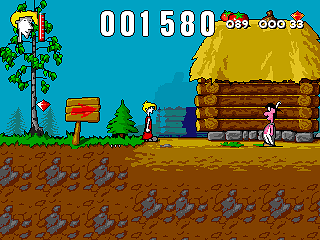
Mr. Tomato gets moving quickly: you are dropped into a side-view comic-book world, asked to find diamonds, and immediately have to account for hostile animals and lethal spikes. The first hour has the focused feel of a classic platform game. You move, explore, throw tomatoes at anything dangerous, and learn that simply reaching the end is not enough. A board only opens up once you have collected 33 diamonds, so poking into its corners is part of the job.
That collectible gate is both the game’s main source of structure and its likely point of friction. If you enjoy combing through a level and making a deliberate sweep before moving on, the diamond target gives the action a useful purpose. If you prefer platformers that let you follow momentum straight to an exit, being held back by a missing gem can become a chore. Mr. Tomato is not shy about making you earn progress.
Combat has more personality than the premise first suggests. Regular tomato throws deal with enemies, while 20 coins buy the tomato rifle. Being able to point that weapon in three directions should make it a meaningful upgrade rather than just a stronger attack, and saving coins for it adds a small decision to the collecting. Five coins also restore energy, creating a sensible push and pull between immediate survival and saving toward the rifle.
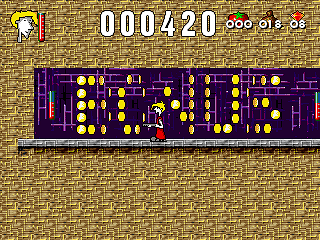
The campaign is arranged as three large stages with five levels apiece, then a fourth stage inside a computer where every enemy returns. That final stretch sounds like a proper test of everything the game has taught you rather than a throwaway ending. Passwords awarded after each level are a major kindness: this is the sort of trap-heavy platforming where you will appreciate being able to resume without replaying huge sections.
Graphics
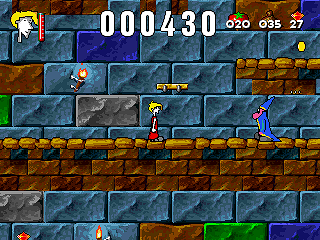
The side-view action leans into the look of a comic book, with a trapped boy, forest animals, spikes, diamonds, coins, and tomato ammunition all forming the on-screen language. Its graphics resemble Bubba ‘N’ Stix, which fits the game’s colorful, cartoonish premise. The later computer-set stage at least gives the journey a change from the forest environments.
Story
The story is deliberately light: a boy is trapped in a comic book and wants out. That is all Mr. Tomato needs to justify its strange mix of woodland enemies, collectible treasure, and vegetable-based weaponry. You are not here for elaborate plot turns; you are here because the world gives the platforming a cheerful, slightly surreal frame.
What works is the directness. Escaping the comic book is an easy goal to hold onto while each board asks for its diamond quota, and the final stage inside a computer adds a distinct destination to the journey. It is a thin story, but it does not get in the way of the action.
The returning-enemy setup in the fourth stage is also a sensible climax for such a simple premise. Rather than pretending the game has a deep narrative arc, it turns the conclusion into a last obstacle course through the cast you have already learned to handle. That suits an old-school platformer better than unnecessary exposition would.
Overall Experience
Mr. Tomato is a modest, old-fashioned platformer whose charm comes from how earnestly it commits to its odd concept. Throwing tomatoes at forest animals is silly in the right way, and the diamond hunt gives its levels more to do than merely shepherd you from left to right. The rifle, energy-restoring coins, and password system add enough texture to keep the basic format from feeling entirely bare.
Its patience test is clear, though. Mandatory diamond totals and deadly traps can turn a missed collectible into an irritating detour, especially for anyone who wants fluid, fast platforming. The game is more likely to reward careful clearing than reckless forward motion. Go in ready to search rather than sprint.
For fans of late-1990s DOS platformers and comic-book cartoon action, Mr. Tomato is worth a look. It does not need a complicated story or a huge mechanical toolbox to make its case; it needs you to enjoy a compact run of levels, deliberate collecting, and the satisfaction of gradually turning tomato ammunition into control over a hostile board. The payoff is a solid little challenge, not a reinvention of the genre.


Reviews
There are no reviews yet.