 Retro Replay Retro Gaming History, Reviews & Emulation

Retro Replay Review
Gameplay
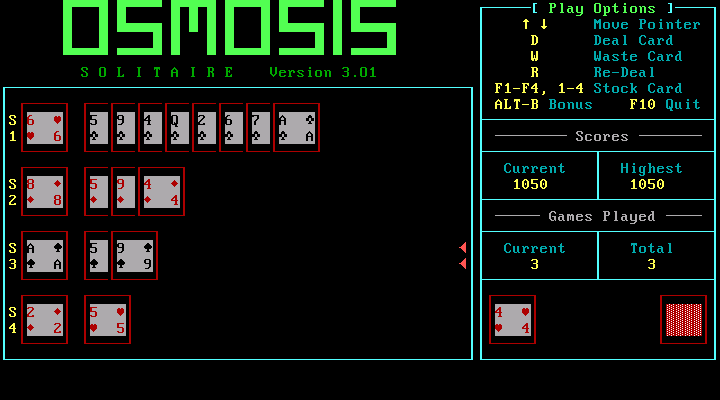
Osmosis Solitaire earns its name because a good move can ripple through the whole deal. You begin with 16 cards arranged in four face-down spare stacks, turn over their top cards, and establish a foundation base beside them. Cards matching that base card’s suit can fill its row in any rank order. The twist arrives with the next three suits: their foundation rows have to mirror the rank order established above them. A card that looks playable now may be far more valuable because it makes a later row possible.
The first hour is likely to be spent unlearning ordinary solitaire instincts. You are not building up or down, and the aim is not to make tidy numerical runs. Instead, you watch the first row become a template, then weigh whether taking a card from the waste or a spare stack helps preserve that template. Once that clicks, the game becomes satisfyingly analytical. Turning over a newly accessible spare card can suddenly reveal exactly the rank and suit you needed.
It can also be merciless. The stock is dealt three cards at a time, so only the top waste card is immediately available, and the redeal comes back in the same order rather than receiving a generous reshuffle. When the waste order and buried spare cards refuse to cooperate, there is no clever rule-bending escape. You can end a dead game manually, which is honest but occasionally deflating. That severity makes a completed four-row foundation feel earned rather than routine.
Scores are tracked through game-specific rules in a local high-score list, with a Grand Masters table for registered users’ results from earlier releases. That suits the game’s replayable, deal-by-deal nature. You are unlikely to master a particular layout through brute force, but you can get better at recognizing which ranks need protecting and when a spare stack is worth opening.
Graphics
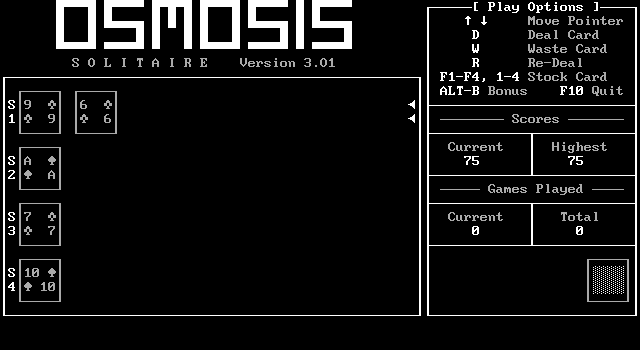
The game is built around a plain card-table view: four vertical spare stacks, a foundation area to their right, and the waste heap. With a fixed screen and a standard deck of cards, the important visual task is following exposed cards and the growing suit rows, and the layout keeps that central puzzle in view.
Story
There is no narrative campaign here, nor does there need to be one. The story of a round is the deal itself: a foundation base sets the terms, hidden spare cards create uncertainty, and each revealed card either opens the puzzle or tightens it.
That makes Osmosis Solitaire feel closer to a compact logic challenge than a leisurely card game. The tension comes from wondering whether the cards you need are still buried in the stock, trapped beneath a spare-stack card, or already made unreachable by the waste order.
If you want character, plot, or a changing setting, this will naturally feel sparse. If you enjoy making your own small drama out of a difficult deal, though, its stripped-down structure has a clear purpose.
Overall Experience
Osmosis Solitaire is a clever variant with a stronger strategic hook than its simple setup suggests. Its central rule—using the first foundation row as a rank-order blueprint for the other suits—creates decisions that remain interesting well after you understand the basics. Every move asks you to think one or two rows ahead.
The downside is that fortune is not subtle. Some deals will end because the required cards remain inaccessible, and the no-reshuffle redeal rule leaves little room for recovery. You need to enjoy patience games where accepting a lost deal is part of the discipline, not an irritation to be designed away.
Give it a chance if regular solitaire feels too automatic and you want a card game with a genuine puzzle spine. It will not suit anyone looking for a relaxed, forgiving time-killer, but for methodical players, its difficult wins and persistent score chase offer a satisfying reason to deal again.


Reviews
There are no reviews yet.