 Retro Replay Retro Gaming History, Reviews & Emulation
Retro Replay Review
Gameplay
Pango starts with a wonderfully direct kind of pressure. You steer a penguin-like hero through an ice-block maze while bees hunt you, and you have only a minute to clear the board. Pushing a block into a bee is immediately satisfying, but it is rarely enough to simply flee and take whatever hit looks available.
The important twist is that some bees are still eggs tucked inside ice blocks. Destroying a bee can cause an egg to hatch, so a careless clear can replace one problem with another. Once that starts to click, you begin treating the maze as a shifting puzzle: remove egg blocks before they become trouble, make room to maneuver, and look for a block push that can solve more than one danger.
You can also shock bees by pushing the walls at the edge of the screen, which gives the cramped board another tactical edge. The three indestructible diamond blocks add a tempting scoring side game. Lining them up earns bonus points, with the middle of the maze paying better than the wall, but chasing that reward when bees are swarming can be exactly the sort of greedy decision that ruins a run.
Its frustration is honest arcade frustration. A bee catching you costs a life, the clock never relaxes, and newly hatched enemies can overturn a plan quickly. If you enjoy short games where improvement comes from reading the board faster and taking smarter risks, that tension is the reason to return.
Graphics
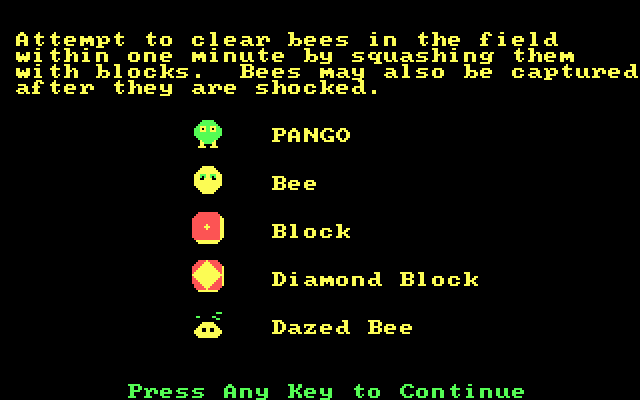
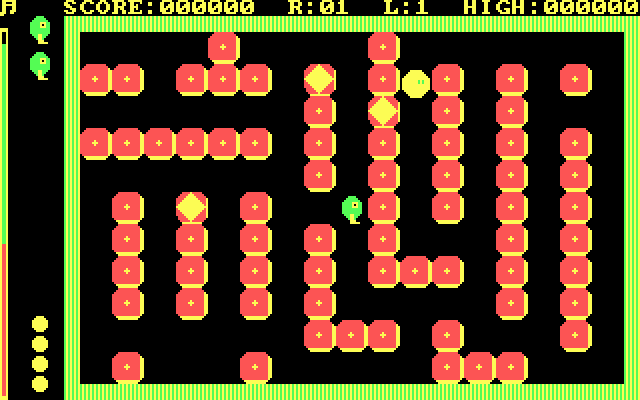
The action is viewed from above, with Pango moving through a compact grid of ice blocks while bees weave through the open lanes. Egg-filled blocks and the three diamond blocks give the maze useful visual landmarks, especially when you are trying to decide what to destroy and what to preserve for points.
Story
Pango is built around an arcade setup rather than a developed narrative: a penguin-like character is trapped in an ice maze with pursuing bees and must clear them before time expires. That is all the game needs to establish the stakes of a round.
The closest thing to a story beat comes from the eggs concealed in the ice. Every time you eliminate a bee and another egg can hatch, the board feels less like a static arena and more like a problem that is fighting back.
There is no need to wait for plot momentum. The tension comes from the changing state of the maze, the countdown, and the small triumph of turning a dangerous crowd into a well-timed block push.
Overall Experience
Pango is a sharp, compact arcade-puzzle game whose strongest moments arrive when you see beyond the nearest bee. The first few attempts teach you the basic danger; later attempts teach you that egg management, wall shocks, and diamond alignment can all compete for your attention at once.
It does not ask for a huge time commitment, but it does ask you to accept its strict one-minute pace. You will get more from it if repeated runs, score improvement, and learning a fixed-screen board under pressure sound appealing rather than repetitive.
For a DOS arcade game, it remains easy to recommend to anyone who likes Pengo-style block puzzles and wants a quick challenge with more tactical depth than its simple setup suggests. The timer and hostile bee spawns can make defeats abrupt, yet the next attempt usually offers a clear lesson: clear that egg earlier, save that lane, or stop chasing diamonds until the swarm is under control.


Reviews
There are no reviews yet.