 Retro Replay Retro Gaming History, Reviews & Emulation
Retro Replay Review
Gameplay
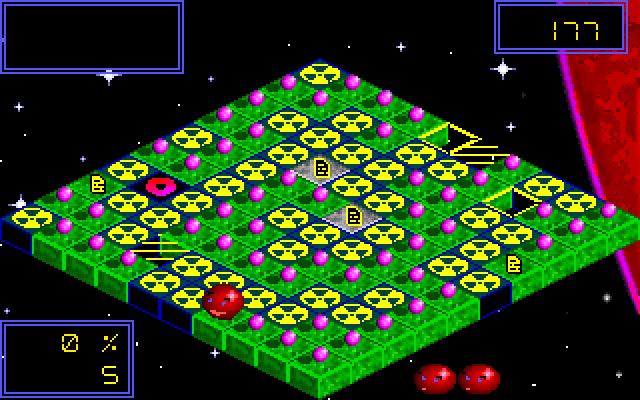
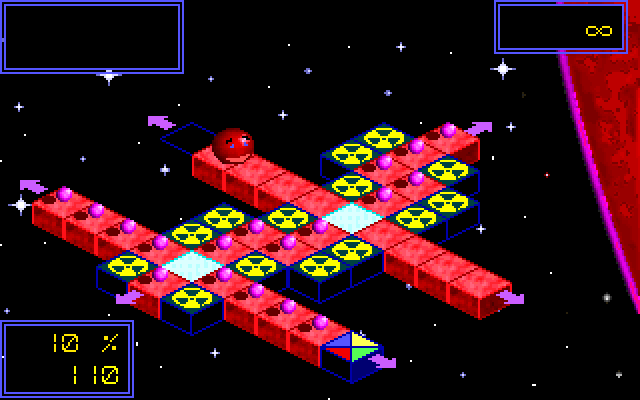
The first few stages of Phobos ’99 pull you in through clarity. You are a robot in a hostile station, fissile material is scattered around the map, and collecting enough of it triggers the destructive end goal. That is an immediately understandable arcade-puzzle loop, but the station is built to make the obvious route unreliable. You are not merely sweeping up collectibles; you are judging how to deal with creature-filled corridors, ice, radioactive traps, bridges, teleports, and moving walkways.
What starts to click is the way these obstacles can turn a small level into a route-planning exercise. A magnetic card that opens bridges is more than a bonus when it changes where you can travel, while ghost hunters and extra lives offer useful breathing room against the station’s hostile population. The game has the right ingredients for that satisfying moment where a layout that first looked messy becomes legible and manageable.
Frustration is likely to arrive with the game’s length and its lack of conventional saving. There are 100 levels, and finishing one earns a level code rather than a saved game. That is better than being sent all the way back, but it still asks you to record and enter codes if you are playing in several sessions. Treat it as a deliberate, stage-by-stage challenge instead of a casual run, and the structure makes more sense.
Phobos ’99 is for you if you like arcade action with puzzle pressure and do not mind being held accountable for errors. The hazards sound varied enough to keep the core collection objective from becoming routine, but the game’s demands are uncompromising. Patience matters as much as quick reactions.
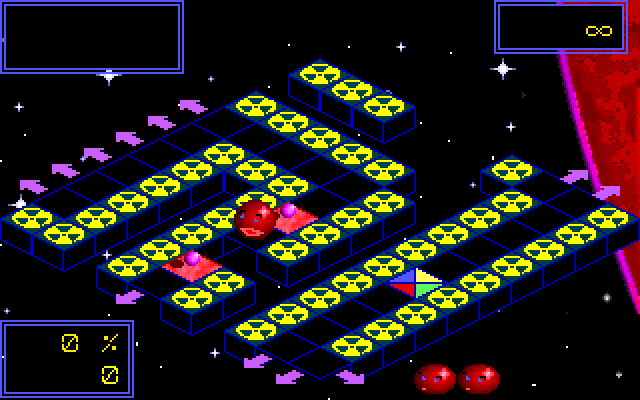
Graphics
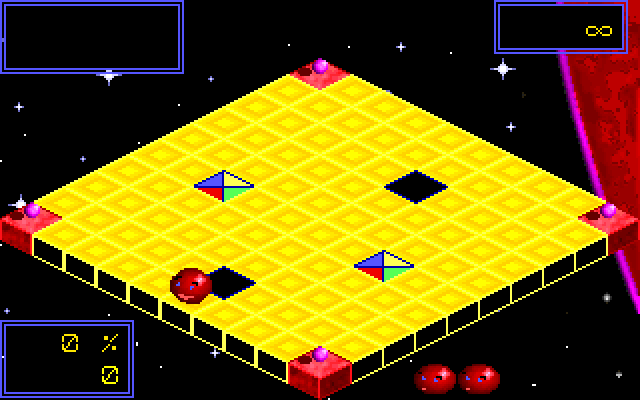
The game uses an isometric view, which suits its maze-like lab-fortress levels and lets you follow the robot’s movement around bridges, walkways, teleports, and hazards. Spiders and ghosts give the enemy roster a suitably odd sci-fi flavor, while the orbital Phobos setting frames the action in a cold industrial maze rather than an open Martian landscape.
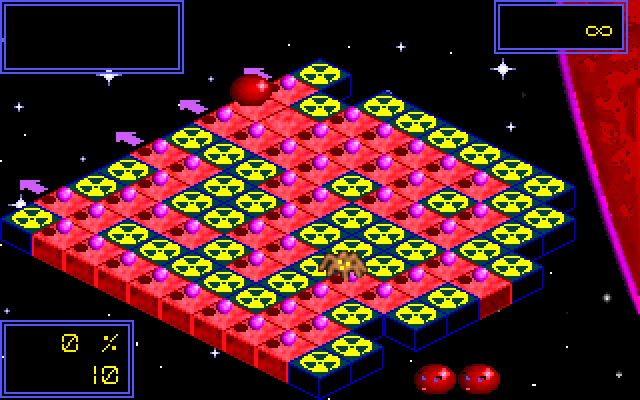
Story
Phobos ’99 keeps its premise focused: an ancient civilization left behind Phobos Lab, the abandoned orbital fortress now threatens Earth, and a new robot is sent in to gather the material needed to destroy it. It is a direct excuse to turn the station into a dangerous puzzle box, and it does not need much more than that.
The 2099 setting gives the mission a little extra character. Phobos is not simply a space base under attack; it is a relic of something long dead, filled with traps and creatures that have outlasted their makers. That combination of abandoned alien technology and practical sabotage work is a stronger backdrop than a generic score chase.
Do not expect the story to carry the game between levels. The narrative stakes stay centered on the mission: collect enough fissile material, reach critical mass, and erase the threat before it reaches Earth. For this kind of arcade-puzzle game, that spare setup is appropriate; the levels are where the drama has to happen.
Overall Experience
Phobos ’99 sounds like a compact DOS game with a surprisingly long runway. Its basic goal is simple enough to grasp immediately, yet the shifting mix of environmental obstacles, enemies, and helpful pickups should keep you thinking beyond the first handful of stages. It has a pleasingly stern “solve the room or suffer the consequences” character.
The level-code system is the dividing line. If you are happy to keep a note of your progress and tackle the game in chunks, 100 levels becomes an inviting supply of bite-sized challenges. If you want frictionless progress or a game that lets you freely resume anywhere, the same design will feel dated fast.
For fans of isometric arcade puzzles, Phobos ’99 is worth a look because it commits to a clear mission and stacks enough complications onto it to demand attention. It may not be forgiving, but its harshness fits an infiltration of an ancient orbital death trap. Go in ready to learn layouts, protect your lives, and write down those codes.

Reviews
There are no reviews yet.