 Retro Replay Retro Gaming History, Reviews & Emulation


Retro Replay Review
Gameplay
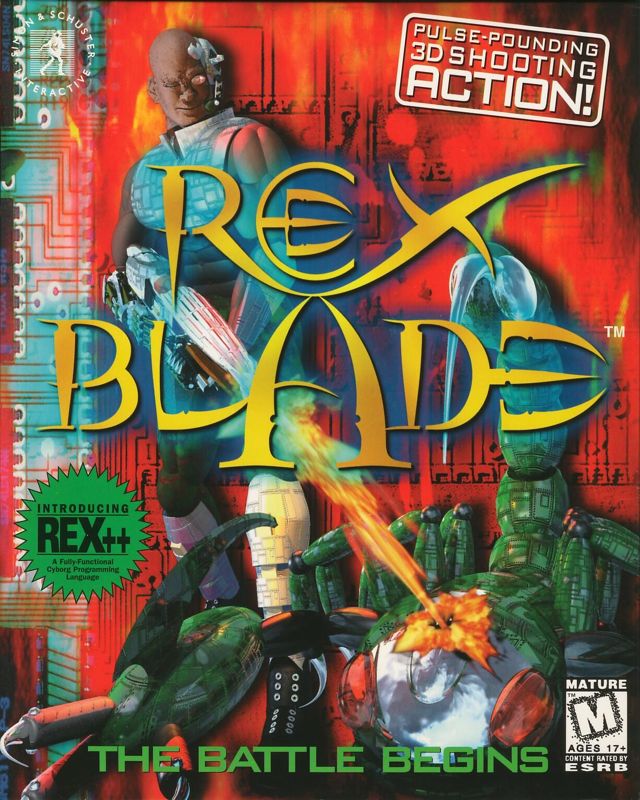
The first few minutes make Rex Blade’s priorities clear: this is a direct first-person shooter built around moving through enclosed levels, firing at hostile cyborgs, and finding a route onward. There is something comfortably immediate about that structure. You are not asked to learn an elaborate combat system before getting started; you enter a level and get to work.
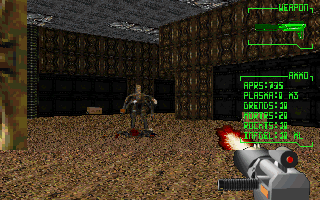
Its problem is the shadow cast by its contemporaries. Rex Blade uses a Wolfenstein 3D-like approach rather than Doom’s more advanced one, so the action has an older, more restrictive feel for a 1996 shooter. If you enjoy early first-person games for their blunt momentum and navigation-focused level crawling, that can still be a draw. If you want the speed and technical punch associated with Doom, the downgrade is hard to ignore.
The terminals are the game’s most distinctive interruption. REXOS lets you enter familiar DOS-style commands such as DIR, HELP, and CLS, and the useful part is being able to read clues about locating an exit. That makes a terminal worth checking when you are stuck rather than just treating it as decoration. The included Starblazer minigame, modeled on Asteroids, is more of a novelty, but it adds personality to an otherwise basic shooting loop.
That personality only carries so far. The core remains a compact, old-fashioned hunt through levels full of sprite-based enemies and objects, and frustration can set in when the exit becomes the main obstacle rather than the fight. Go in ready to poke at terminals and patiently search, not expecting a major evolution of the genre.

Graphics
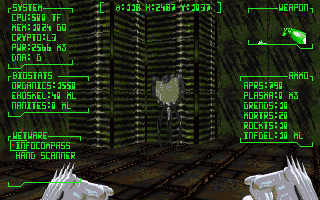
You see first-person 3D corridors populated by flat sprite enemies and objects, much closer to Wolfenstein 3D than Doom. Transparent walls are a genuine visual step up over that older template, adding a little variety to the maze-like spaces, but the underlying look remains plainly early 3D shooter technology.
The REXOS terminals break up the first-person view with a DOS-like text interface. It is a simple sight, yet it fits the game’s cybernetic premise and makes the terminal interactions feel more tangible than a generic clue prompt.
Story
The setup gives Rex Blade a workable bit of sci-fi pulp: humanity built cyborgs as slaves, the cyborgs rebelled, humans won the war, and the defeated machines were forced into another solar system. Now they have reorganized for revenge, while Rex Blade stands apart as a cyborg fighting on humanity’s side.
That last detail is the most interesting part of the premise. Playing a cyborg sent to eliminate other cyborgs gives the mission more texture than a standard human-versus-machine war, even if the game’s stated goal is refreshingly blunt: stop the enemy before it is too late.
Still, this is an opening chapter, and it feels like one. The story mainly supplies a reason to enter the next hostile area and continue the campaign. Anyone looking for a rich science-fiction narrative should temper their interest; the premise is stronger as framing for the shooting than as the main reason to play.
Overall Experience
Rex Blade: The Battle Begins is a curious lower-tier slice of the mid-1990s shooter boom. It does not have the technical edge of Doom, but its no-nonsense shooting and strange REXOS terminals give it a character that is more memorable than its basic engine would suggest.
The payoff depends heavily on your tolerance for older level navigation and limited-era first-person action. You may enjoy it as a short archaeological stop: shoot some cyborgs, get turned around, consult a terminal, and appreciate the moment when a game thought a command prompt and an Asteroids clone belonged in the middle of a sci-fi assault.
For most gamers, it is a curiosity rather than a must-play. For fans who like Wolfenstein-style shooters and want an offbeat DOS-era variation with a few unusual interactive touches, it is worth a look. Its best ideas do not transform the game, but they keep it from being completely anonymous.


Reviews
There are no reviews yet.