 Retro Replay Retro Gaming History, Reviews & Emulation


Retro Replay Review
Gameplay
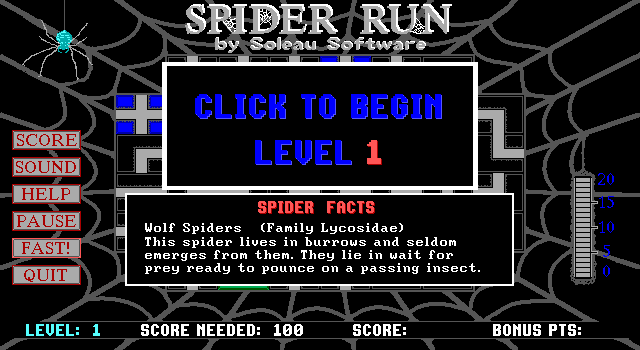
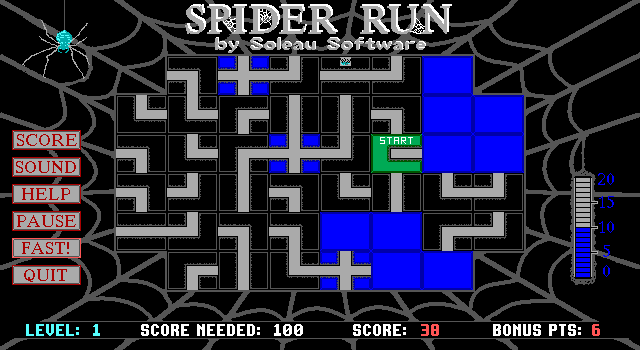
Spider Run begins with the sort of pressure that makes a puzzle game immediately legible. A spider departs from a randomly placed green starting cell, and you rotate the web pieces in its path before it reaches them. One click means one quarter-turn, which sounds gentle until you are staring at a bend that needs two clicks and the spider is already closing in. The first few attempts are likely to end abruptly, but the cause is clear enough that failure feels like a challenge rather than a mystery.
The six-by-eight grid is tiny, with its corner cells removed, so every turn matters. Straight pieces, right-angle bends, and crossroads create just enough route-planning variety to make you consider what the spider will need several cells from now. Since travelled cells turn solid blue and cannot be reused, simply surviving the next turn is not enough. You need to preserve a path that stays viable after the board starts closing behind you.
That is where the edge wraparound rule earns its place. After the spider has covered twenty inches on its current route, taking it off one edge and back onto the other resets most spent blue squares, letting you reuse territory and chase a larger score. It is a satisfying recovery tool, but not a free one: some reset squares become blank, and running into one ends the game. The best games come from balancing immediate rescue clicks with a longer plan for when to wrap and which dangerous gaps to avoid.
Flies and target scores add welcome direction to the survival loop. Reaching the required minimum lets you move onward, with seven levels in the shareware version and thirty in the full game. The mouse-only controls suit the premise perfectly; there is no clutter between you and the next urgent rotation. If you enjoy score attacks where a good run can collapse because of one slow click, Spider Run has a focused, nervy rhythm.
Graphics
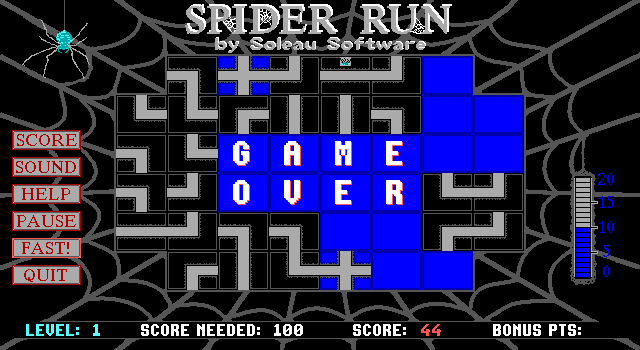
Spider Run is built around a compact top-down grid, with the green start cell and solid blue travelled cells making the board state easy to read at a glance. Web segments, blank squares, and the spider’s route are the important things to track, and the simple board keeps your attention on them.

Story
There is no grand tale pushing you forward here. The entire fiction is a spider making its way across a shifting web, which fits the game’s direct arcade-puzzle structure.
That stripped-down setup works because every run creates its own tiny drama. A safe route turns into a dead end, a wraparound restores hope, and a newly blank square suddenly becomes the one place the spider cannot go. The stakes are mechanical, but they are easy to feel when a strong score is on the line.
The level targets provide the closest thing to progression: meet the score requirement, then move on to the next challenge. Anyone wanting characters or a plotted adventure will find little to hold onto, but the spider-and-web framing is clear and never distracts from the puzzle.
Overall Experience
Spider Run is a compact real-time puzzle game that understands the value of a single strong idea. It takes rotate-the-pieces path building and makes it tense by refusing to wait for you. When your clicks line up and the spider slips across the border just in time to reopen the board, the game delivers the clean satisfaction that score-driven DOS games do so well.
Its biggest strength is also its likely barrier: the board gives you very little room to recover. You must be comfortable losing runs quickly, learning the consequences of spent tiles, and gradually getting faster with the mouse. A player who prefers slow, contemplative route construction may find the constant motion more stressful than clever.
For everyone else, the payoff is real. The limited set of pieces becomes more demanding as you learn to manage space, resets, flies, and score targets at once. Spider Run does not need a sprawling ruleset to stay interesting; it gets mileage from forcing you to make one more correct decision before the path disappears.
Give it a chance if Pipe Dream-style routing sounds more exciting with a timer built into the board itself. It is at its best in short sessions, chasing a better run and realizing that the mistake was not the final bad turn, but the harmless-looking rotation you made several squares earlier.

Reviews
There are no reviews yet.