 Retro Replay Retro Gaming History, Reviews & Emulation


Retro Replay Review
Gameplay
The first few minutes are wonderfully direct: your train is already moving, you steer it around the board, and every successful stretch of survival makes the next turn harder. Like Snake, the central tension comes from managing a body that keeps getting longer. Gorilla Ball Train adds debris dropped in your wake, so you are not merely avoiding where the train is now; you are also closing off the safe space you used a moment ago.
That debris turns ordinary movement into a small routing puzzle. A wide loop can look safe until you realize it has left a barrier exactly where your next turn needs to go. The four bridges are the key twist. Passing under them lets the train cross its own path without triggering a self-collision, giving you a way to untangle a crowded board and making smart bridge use the difference between a run that dies early and one that keeps breathing.
The controls demand attention because the train never stops to let you think. Steering is handled from the numeric keypad, while function keys open help and adjust difficulty. Once the basic movement clicks, the game becomes less about learning rules and more about resisting rushed decisions. Nine difficulty levels leave room to build confidence, and separate top-ten score tables give each setting its own target to chase.
The harsh part is the one-life structure. Touch a wall, your own train outside a bridge, or any dropped debris, and the run is over. That can be frustrating when a long score attempt ends on one poorly judged turn, but it also gives every clean escape some real weight. This is a lean, demanding high-score game rather than a relaxed time-waster.
Graphics
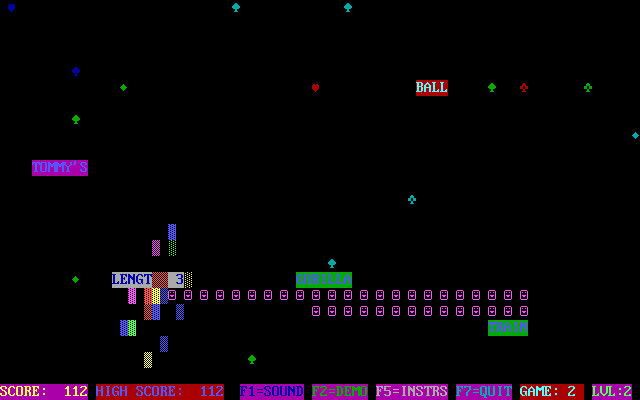
The action is shown from above in a compact game area, where the moving train, its growing trail of debris, the walls, and the four bridges need to be read at a glance. The important visual idea is clear: bridges stand out as the places where crossing your own route is safe, while the rest of the board tightens into a dangerous maze.
Story
There is no campaign to carry you from one scene to the next. The “story” of a session is the one you create through a score run: a small train finds room, fills the board with its own hazards, and eventually runs out of options or nerve.
That stripped-down approach suits the game’s arcade focus. You are not waiting for a new plot beat; you are trying to turn an ugly near-crash into a recoverable route and keep the score climbing.
The high-score tables give that tiny personal drama a useful ending. A failed attempt is not much consolation on its own, but seeing a target score at your chosen difficulty creates a clear reason to start another run.
Overall Experience
Tommy’s Gorilla Ball Train takes the familiar pressure of Snake and gives it a more tactical edge with persistent debris and bridge crossings. Those two ideas work well together: debris makes careless circling impossible, while bridges provide a limited but meaningful way to reclaim space.
Its age shows in its bare-bones, score-first design, and it will not win over anyone who needs variety, a long-term progression path, or forgiving retries. The game asks you to enjoy repetition as practice. Every loss is a quick lesson in where you turned too soon, waited too long, or blocked your own escape.
Give it a chance if you like compact arcade challenges where improvement is measured in cleaner routes and higher numbers. The payoff is modest but genuine: after a few failed runs, you start seeing the board ahead of the train instead of reacting to it, and that is when its simple design becomes satisfying.


Reviews
There are no reviews yet.