 Retro Replay Retro Gaming History, Reviews & Emulation
Retro Replay Review
Gameplay
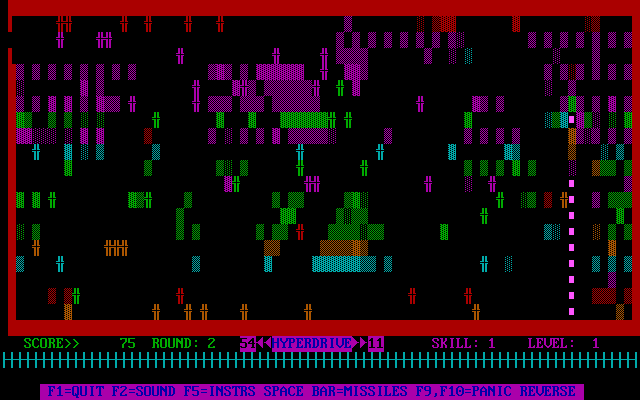
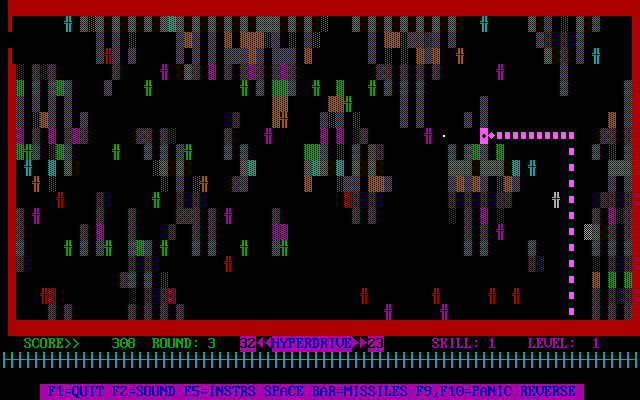
The first few minutes of Tommy’s Hyperdrive are wonderfully direct. Your ship begins trapped in the bottom-right of a packed hyper maze, and the goal is visible in its purest form: get to the opening at the top-left border. Movement is limited to the cardinal directions through the numeric keypad, so there is no learning curve to hide behind. You are immediately reading walls, looking for gaps, and deciding whether a blocked corridor is worth spending a missile on.
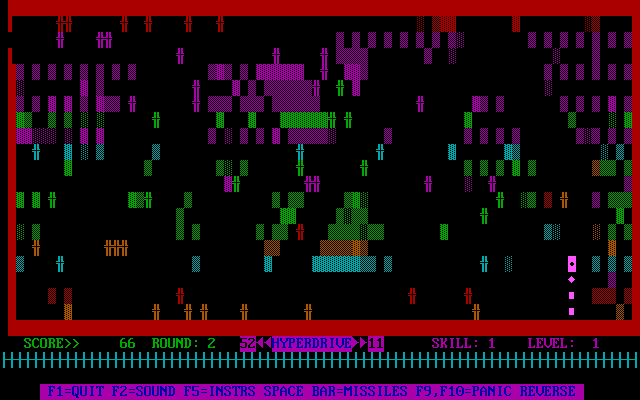
That would be a modest maze game on its own, but missiles turn every route into a risk calculation. Blasting an obstacle can create the opening you need, yet certain barriers reflect the shot back toward your ship and destroy it. Worse, the maze does not politely hold still while you think. Random new obstacles can seal off a path that looked safe a moment ago, forcing you to abandon tidy plans and react to the board in front of you.
The F10 Panic Reverse button is the clever pressure valve. When a returning missile has you lined up, normal movement will not save you; Panic Reverse sends the ship partway back along its current track. If you have recently turned a corner, the missile can fly past instead. That condition matters. You cannot treat F10 as a universal rescue, and learning when your route has left you an escape angle is where the game starts to click.
Frustration arrives when randomness blocks progress or when a shot exposes that you misunderstood an obstacle’s danger. Still, the rules are compact enough that failure encourages another attempt rather than a long recovery. Nine levels keeps the game focused, and it suits anyone who enjoys old-school arcade pressure with a little spatial problem-solving mixed in.
Graphics
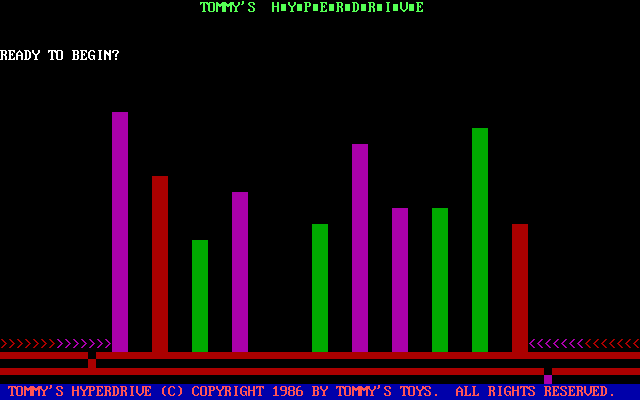
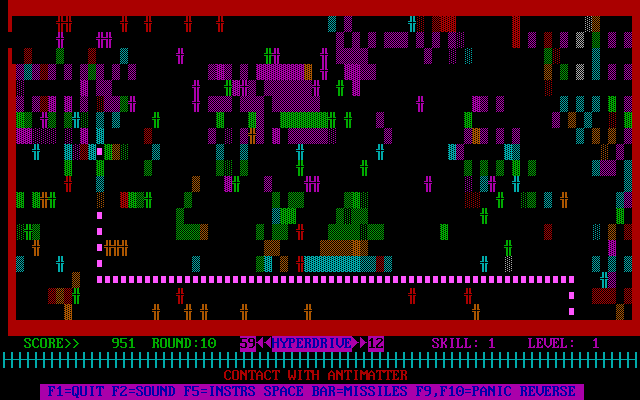
The view is built around the starship and its crowded maze, with the border gap serving as the visible destination on each level. Between stages, the game breaks for an animated hyperdrive acceleration and deceleration sequence, a small reward that gives successful escapes more ceremony than simply dropping you into the next maze.
Story
Tommy’s Hyperdrive uses a thin sci-fi frame: you are piloting a starship through a hyper maze toward an exit. That is enough for the game because the drama comes from navigation, not character or plot.
Each level creates its own miniature escape story. You find a possible route, carve through an obstruction, then watch the maze complicate the situation with a newly appearing barrier or a missile coming back at you. The tension is immediate and mechanical rather than narrative-heavy.
The hyperdrive animation after a completed level gives progress a satisfying sense of travel. It turns the nine mazes into stages of a single flight, even though the real reason to continue is the next difficult board.
Overall Experience
Tommy’s Hyperdrive is at its strongest when it has you one decision away from safety or disaster. The objective is easy to explain, but the interaction between limited missiles, reflective obstacles, changing walls, and the Panic Reverse maneuver gives its small arena a surprisingly active feel.
You should give it a chance if you like compact DOS games that expect quick thinking rather than elaborate setup. The keypad controls and fixed maze structure make it immediately approachable, while the random obstacle appearances stop it from becoming a rote route-memorization exercise.
It is not a relaxed maze crawl. A clear passage can close, and an aggressive shot can become your own death sentence. But that volatility is also the point: Tommy’s Hyperdrive makes a short trip across the screen feel like a scrappy escape, and the nine-level format keeps the challenge from overstaying its welcome.


Reviews
There are no reviews yet.