 Retro Replay Retro Gaming History, Reviews & Emulation

Retro Replay Review
Gameplay
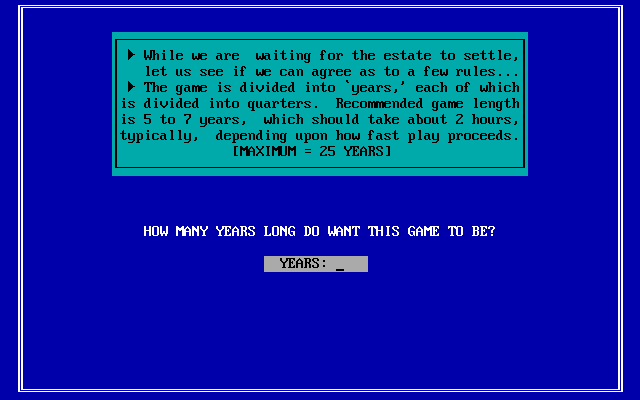
The first hour of Wall $treet Raider is likely to be spent realizing just how far beyond buying low and selling high it wants to go. You begin with a modest inherited fortune, pick the length and difficulty of the game, then work through four trading quarters for every game-year. That structure gives each turn a welcome sense of consequence: a decision is not just a number changing on a ledger, but a move that can shape your position over a long campaign.
What makes it compelling is the range of leverage at your disposal. You can trade shares in any company, arrange loans, research firms, inspect other players’ holdings and net worth, and move into buy-outs, mergers, junk bonds, public offerings, liquidations, and lawsuits. Once you can become a company CEO, the game gets even sharper. Nurturing a business, stripping its assets, or winding it down creates the kind of cold calculation that a lighter trading game never reaches.
The ethical choices are an especially good twist because they give greed a price tag beyond the usual financial risk. Illegal moves can pay handsomely, but getting caught carries major penalties. That makes ruthless play feel like a decision rather than an automatic best strategy, and it gives competitive sessions some enjoyable suspicion.
Its sheer scale can also be exhausting. With 1,590 companies across 70 industries, Wall $treet Raider is built for somebody willing to study a lot of options and live with a match that can run for many game-years. One to five people can play, with the computer able to fill a seat, but the strongest fit is a group that enjoys lengthy, adversarial business games rather than a fast evening of casual speculation.

Graphics
Wall $treet Raider is a business simulation first and foremost, with its attention directed at companies, industries, finances, and the choices attached to them. The later version’s emphasis on being easier to use matters more here than decorative flourish: this is a game you need to navigate while comparing a very large field of possible targets.

Story
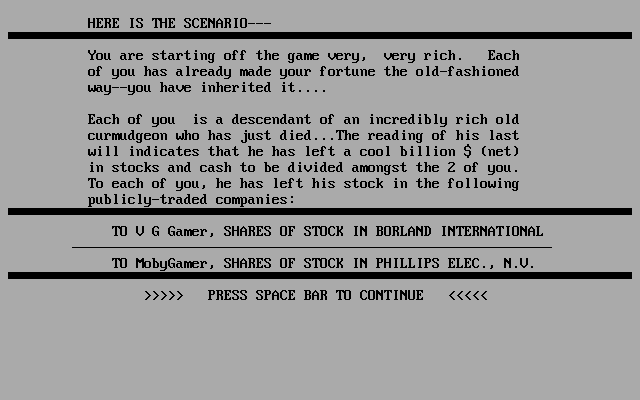
There is no authored tale pushing you from one event to the next. Instead, the story starts with your inherited fortune and develops through the deals you make, the firms you target, and the rivals you choose to pressure.
A takeover can become a personal grudge in a multiplayer game, particularly once everyone is checking one another’s holdings and relative net worth. The ability to sue competitors, arrange mergers, or dismantle a company gives those rivalries more bite than simple score chasing.
The ethical decisions provide the closest thing to a moral arc. You can pursue major gains by breaking the law, but the threat of serious punishment turns that route into a gamble with consequences. Your final fortune is therefore also a record of how carefully—or how recklessly—you built it.
Overall Experience
Wall $treet Raider is admirably unapologetic about its ambitions. It takes the stock-market board-game idea and piles on corporate control, financial maneuvering, player investigation, and long-term planning until you have a sprawling contest of calculation and nerve. The payoff is real if you like games that reward studying a system rather than merely reacting to the last turn.
It will frustrate anyone looking for a clean, breezy introduction to investing. The many available actions and enormous company list demand attention, and the quarterly, multi-year format naturally favors commitment. Treat it like a dense strategy game rather than a stock-market toy, and its complexity becomes the point.
For patient solo strategists and competitive groups, this remains an unusually expansive financial sandbox. The broad currency support also makes its worldwide scope feel considered rather than purely cosmetic. Give it a chance if the thought of winning through research, timing, leverage, and occasionally questionable corporate conduct sounds more exciting than simply watching a portfolio rise.



Reviews
There are no reviews yet.