 Retro Replay Retro Gaming History, Reviews & Emulation


Retro Replay Review
Gameplay
Blue: Will to Power asks you to settle into a classic early-1990s RPG rhythm: travel across a top-down world map, build strength through a simple leveling system, and handle threats in turn-based combat. That foundation is familiar enough that you will know what sort of pace you are getting almost immediately. It is a game for taking your time rather than racing from one dramatic surprise to another.
The conversation system is where the routine gets more interesting. Every NPC can be approached with four different requests: information, joining, negotiation, and battle. That is a much more playful setup than the usual one-note town chatter. You are not merely checking every character for the next clue; you are deciding how to engage with them, and each meeting carries the possibility of a new ally, a useful answer, or trouble.
Recruitment gives those choices real weight because many NPCs can join, allowing the party to become considerably large. If you enjoy assembling a broad roster, this is the feature most likely to pull you through the conventional parts. It also makes a practical case for speaking to everyone instead of treating towns as brief stops between fights. Gamers who want tight, rapid-fire progression may find that deliberate approach a little slow, but curious and methodical play is clearly the better fit.

Graphics
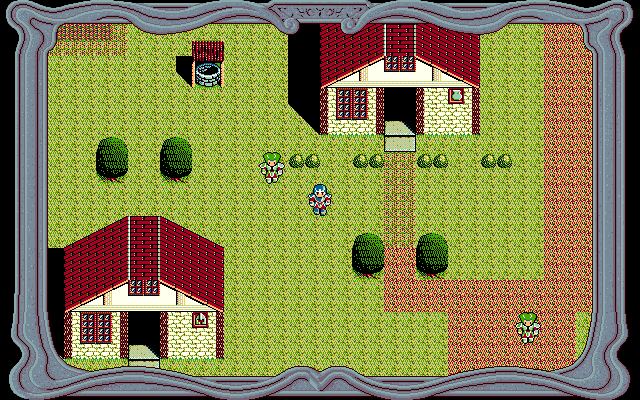
Blue: Will to Power uses the top-down perspective associated with its world-map travel and turn-based RPG structure. The viewpoint suits a game built around moving from place to place and meeting a large number of NPCs, keeping the focus on exploration and party-building rather than cinematic staging.

Story
The story begins with a solid piece of political history. Ishut, once the continent’s dominant protector of peace, is thrown into conflict when Seden attacks. The eventual peace is personal as well as diplomatic: Ishut knight Gene marries Claire, the daughter of Seden’s duke, binding the two sides after a prolonged war.
That peace does not hold. Gene dies during a rebellion in Seden, leaving his son to inherit both a noble lineage and a difficult obligation. The new hero is expected to follow his father’s example and restore peace and glory to his homeland, which gives the adventure a clear sense of duty from the outset.
It is a traditional fantasy setup, but it has more grounding than a simple evil-versus-good quest. The conflict is tied to war, rebellion, marriage, and diplomacy, so the hero’s mission is not only about proving himself in battle. That pairs neatly with a game that lets you negotiate, recruit, and challenge the people you meet.
Overall Experience
Blue: Will to Power earns its interest through an old-school RPG framework with one unusually flexible social system at its center. The world map, leveling, and turn-based battles supply dependable genre structure; the four-way NPC conversations give you a reason to be more engaged with the inhabitants along the road.
Its limitations are also part of the bargain. This is not an RPG built around throwing out the familiar rulebook, and the basic progression sounds intentionally simple. If you need constant mechanical novelty, the traditional structure may start to feel restrictive. But if you like the idea of a fantasy journey where nearly every NPC is someone you can question, recruit, bargain with, or confront, it has a worthwhile hook.
Give it a chance if your favorite older RPG moments involve poking at a town’s entire population and seeing what opens up. The payoff is a party-building adventure whose most distinctive choices happen in conversation, not just in combat. That is enough to make Blue: Will to Power more memorable than its otherwise conventional outline suggests.



Reviews
There are no reviews yet.