 Retro Replay Retro Gaming History, Reviews & Emulation

Retro Replay Review
Gameplay
Hong Kong no Mashu gets moving quickly by making you choose a route: Jigen leads one story, while Goemon leads the other. That split is the game’s best structural decision. Rather than treating the two men as interchangeable Lupin sidekicks, it gives you a reason to return after one path ends and see how the other half of this Hong Kong incident plays out.
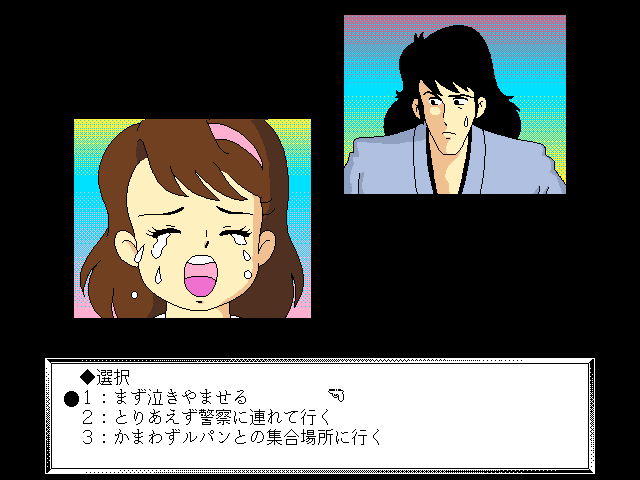
The actual play is firmly visual-novel territory. You read scenes and repeatedly choose from several responses or actions, with a wrong answer sometimes sending you directly to Game Over. That makes every prompt carry more tension than a purely linear licensed story, especially early on, when you are still learning its logic. It also means frustration can set in if you want your choices to express a personality rather than identify the one answer the game has decided is correct.
The item selection at the start of each chapter is the wrinkle that keeps the format from becoming nothing but conversation prompts. You choose three items from a list, then can call on those selections in the relevant scenes later in the chapter. Think before committing: this is the closest the game comes to letting you prepare for trouble, and it makes a replay after failure feel like revision rather than simple repetition.
Patience helps. The pleasure here is not in mastering a deep system; it is in picking through a dangerous episode, taking a wrong turn, and coming back with a better sense of what Jigen or Goemon ought to have brought and said. If frequent Game Overs sound exhausting, the game’s narrow choice structure may wear thin. If you enjoy testing routes in vintage adventure games, the consequences give its brief decisions some bite.
Graphics
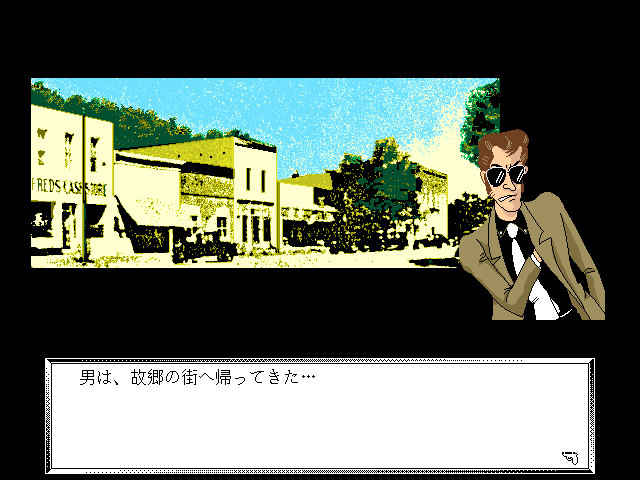
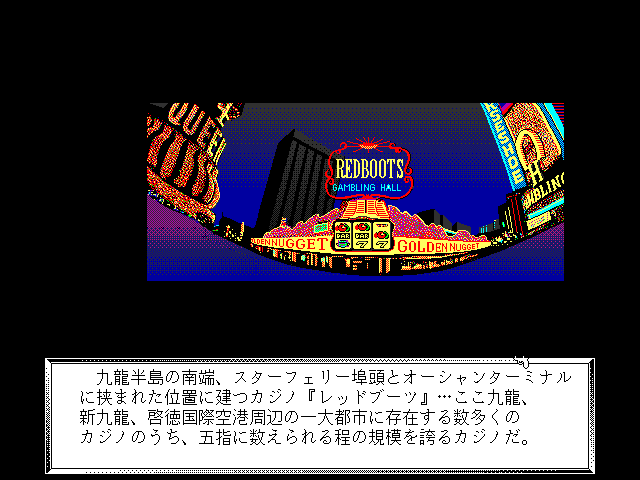
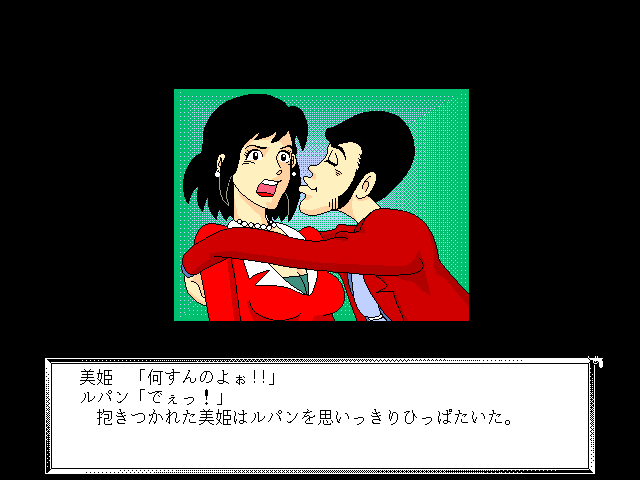
As an anime/manga-licensed Lupin the 3rd game, Hong Kong no Mashu centers its two routes on recognizable series regulars Jigen and Goemon, with Hong Kong as the shared backdrop. The focus stays on following character-led scenes rather than on action-driven spectacle.
Story
This is built like an episode for people who already know the Lupin the 3rd crew. Lupin’s grandson is still the gentleman thief at the center of the wider world, Jigen remains the expert marksman at his side, and Goemon brings his famous swordsman lineage into the mix. The game does not need to spend much energy introducing why these people belong in danger together; it expects you to arrive with that affection intact.
Hong Kong gives both stories a common point of pressure. Jigen and Goemon are there for their own reasons, then an evasive figure with a dark past crosses their paths and pulls them into action. It is a clean serial setup: suspicious stranger, complications, and two capable men who cannot comfortably ignore the mess in front of them.
The divided protagonists are more than a menu novelty. Jigen’s and Goemon’s separate stories make the game feel less like a single fixed chapter and more like two angles on the same kind of Lupin trouble. Fans invested in the ensemble will get more from that arrangement than newcomers, since the game deliberately leans on familiarity with the cast instead of rebuilding their chemistry from scratch.
Overall Experience
Hong Kong no Mashu is a focused piece of early visual-novel adventure design: two character routes, high-stakes choices, and chapter preparation that can decide whether a later scene goes your way. Its pace comes from uncertainty. You are rarely being asked to perform complicated actions, but you are often being asked to commit before you know whether the game will punish the choice.
That makes it an easy recommendation for Lupin devotees who want more time with Jigen and Goemon, particularly if they enjoy the stop-start rhythm of choosing, failing, and retrying. The licensed setting supplies the charm; the item system supplies the practical reason to keep poking at another route after a dead end.
For everyone else, this is a tougher sell. The game lives or dies on your tolerance for frequent decision prompts and occasional instant failure. Still, the two-story setup and the chance to prepare with a limited item selection give it more texture than a passive tie-in. Go in ready to experiment, and its compact episodic mystery can be a satisfying detour.


Reviews
There are no reviews yet.