 Retro Replay Retro Gaming History, Reviews & Emulation



Retro Replay Review
Gameplay
Daisenryaku gets to the point quickly. You are managing a military force in a turn-based contest, producing units and trying to turn their differing attack strengths into territorial advantage. That directness is its strongest quality. A Bradley, an F-15, a MiG-23, and a T-80 are not just names decorating a roster; they invite you to think about what kind of force you are building and where it ought to be used.
The early turns have the familiar strategic itch of deciding whether to invest in infantry, armor, helicopters, or air power before your rival gains room to maneuver. Because units have distinct strengths and weaknesses, blindly buying the biggest-looking hardware is not a plan. You need to consider matchups, and combat depends on the attacking strength of the unit involved. That makes each commitment matter more than it would in a strategy game where every piece is a slight variation on the same soldier.
The square-based “fake hexagon” grid is likely to be the first thing veteran hex-war gamers notice. It does not offer the natural all-direction movement of a true hex map, and that can take adjustment. Still, the grid does not change the essential pleasure of working out a line of advance, protecting vulnerable units, and choosing when an attack is worth the risk.
With six maps and support for either a computer rival or another person, the game has enough structure for repeated tactical experiments. Human matches should be the richer option, since a second person can punish predictable production and overextended attacks far more sharply. Against the console, the core loop remains worthwhile if you enjoy measured, unit-by-unit decision-making rather than quick tactical fireworks.
Graphics
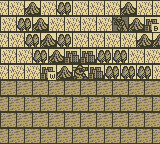
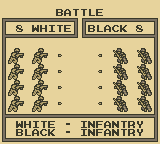
This is a top-down Game Boy strategy game built around military counters and map positions rather than detailed battlefield spectacle. The most distinctive visual quirk is the map geometry: the game calls its spaces hexagons, but they are actually square, so movement and front lines will look more like a square-grid war game.

Story
Daisenryaku treats conflict as a scenario framework, not a dramatic campaign. Each map sets black against white, while the available forces draw on US, USSR, West German, and Japanese military equipment. The focus stays on the war-game question of how those tools perform on the field.
That spare setup suits the game’s practical tone. You are not being asked to follow a cast or wait for plot turns; the tension comes from seeing an opposing force develop and deciding how to answer it. For a strategy fan, a fresh enemy formation can create more suspense than a lengthy briefing.
The trade-off is clear: anyone wanting a narrative reason to care about each battle will find little to hold onto beyond the competition itself. If you can supply your own context for a Cold War-flavored clash of armored units and aircraft, the scenarios have enough military texture to carry them.
Overall Experience
Daisenryaku is a focused portable war game with a solid foundation: asymmetric unit choices, production decisions, and combat built around unit strength. Its strongest moments come when your plan begins to click—when the force you chose starts covering its weaknesses and pressuring the opponent where it hurts.
It also asks for patience. The grid convention may feel awkward, and the game’s deliberately plain scenario-based structure leaves you to find the drama in positioning and attrition. If you need constant surprises or a strong story hook, this is likely to feel dry.
Give it a chance if you like traditional turn-based military strategy and enjoy learning a roster well enough to make informed purchases and attacks. The payoff is not flash; it is the quiet satisfaction of winning because you understood the battlefield and your opponent did not.


Reviews
There are no reviews yet.