 Retro Replay Retro Gaming History, Reviews & Emulation

Retro Replay Review
Gameplay
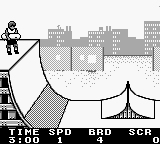
The opening choice between Retro Rocket Ramp and Stale Fish Tour tells you exactly what kind of skateboard game this is: small, direct challenges built around beating a clock. Retro Rocket Ramp is the immediately approachable one. You ride a side-view half-pipe, build momentum from wall to wall, then hit buttons at either lip to throw tricks for points. It has the familiar, satisfying arcade rhythm of taking one more risky attempt because a bigger stunt might turn an ordinary run into a strong score.
That simplicity has teeth. Trick selection changes with both your speed and how long you hold the buttons, so success is not just a matter of mashing at the top of the ramp. You have to judge whether you have enough pace for a more dangerous move, and whether it is worth spending part of the time limit setting up another pass. The mode is closely modeled on the ramp event in Skate or Die 2: The Search for Double Trouble, which makes it a good fit if that focused score-attack format is what you wanted more of.
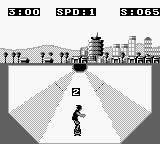
Stale Fish Tour is the more demanding half of the cartridge. The camera moves behind your skater as you race through a long half-pipe, accelerating, braking, steering, jumping, and ducking on the way to the finish. Concrete walls and the edges of the pipe are genuine time thieves, so each course becomes a three-minute exercise in staying composed. An AI skater occasionally adds pressure, and a second human can join in, giving this mode a welcome competitive spark. It can feel harsh when a mistake drains the clock, but the rules are clear enough that you know exactly what to clean up on the next run.
Graphics
The two modes make sensible use of their distinct views. Retro Rocket Ramp keeps the entire half-pipe in side view, making the back-and-forth motion and the moment you reach either wall easy to follow. Stale Fish Tour puts the skater behind the board in the sustained half-pipe, where incoming walls and the course borders become the important things to watch.
Story
Tour de Thrash is framed less as a character-driven skate tale than as a trip through championships around the world. Stale Fish Tour supplies that thread: you are progressing through a sequence of courses with a simple finish-line target rather than merely replaying an isolated race.
That competitive framing works because it gives the racing mode a reason to keep moving forward. The goal is always concrete—reach the end inside three minutes—but the changing obstacle courses make the journey feel more like a tour than a single track challenge.
Retro Rocket Ramp sits alongside that structure as a pure stunt event. It does not need extra drama; the story it tells is the familiar arcade one of turning a limited run into a better score through nerve and timing. For game-specific background, the Skate or Die: Tour de Thrash history is a useful companion.
Overall Experience
This is a decent, modestly enjoyable portable skating game because it understands that short sessions need a clean hook. One mode rewards stunt timing and point greed; the other rewards careful racing and quick reactions. Neither asks you to wrestle with a complicated structure before the fun starts.
Its weaknesses come from that same stripped-down focus. The half-pipe events are narrow by design, and repeated failures in Stale Fish Tour can sting when a brush with a wall costs the time you needed. You need to enjoy score improvement and route cleanup for the game to hold your attention.
At its best, Tour de Thrash is an effective little arcade challenge, especially with another person in the racing mode. It is worth trying if you want a brisk Game Boy skate game with two clearly different disciplines. Just go in ready to replay runs, learn the timing, and accept that the payoff comes from shaving off errors rather than unlocking a broader adventure.


Reviews
There are no reviews yet.