 Retro Replay Retro Gaming History, Reviews & Emulation


Retro Replay Review
Gameplay
R.B.I. Baseball ’93 for Genesis offers a useful spread of ways to approach the diamond. A single game suits a quick matchup, while best-of-seven play and challenges against a division or the entire league give the same sport a longer arc. You can face the computer as the home or visiting side, play against another person, or watch two computer-controlled teams compete.
The most interesting option is Game Breaker. By setting the teams, inning, and score, you can begin with the pressure already on instead of playing through an entire game to reach a decisive situation. Historical division-champion rosters from 1984 onward broaden the possibilities. Home Run Derby and fielding practice provide more focused alternatives when a complete contest is too much of a commitment.
Team editing adds another reason to return: transferring players makes it possible to adjust a roster or assemble an unlikely combination of talent. Passwords support the longer modes, although writing down a code is less convenient than a modern save slot. Readers exploring the Genesis entries can also visit our R.B.I. Baseball 4 review for another game in the series.

Graphics
The batting view uses a bold green field and compact player sprites, with the batter in the foreground and the pitcher farther up the screen. In the Home Run Derby view, boxed side panels show portions of the diamond while statistics sit beside the batter. It is a busy composition, but the separation of the batter and pitcher makes the central confrontation easy to identify.
Giving all 28 teams individual ballparks modeled after their real counterparts is a welcome part of this edition’s identity. Stadium variety matters in a baseball game, where so much time revolves around familiar views of the same field. The small Genesis image leaves limited room for fine detail, so the appeal is the overall ballpark setting rather than close-up realism.
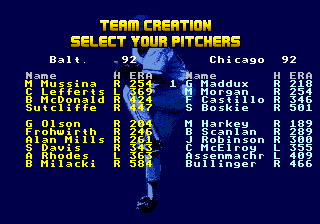
The team-creation screen takes a different approach: yellow headings, columns of player names and numbers, and a dark blue background put the roster information first. That dense arrangement is practical for comparing players, though it also makes the age of the interface apparent. Bright color choices give the menus character without disguising how much reading roster management involves.
Story
There is no conventional story campaign here. The setting is baseball in 1993, with Colorado and Florida joining the lineup of 28 teams. For someone interested in that period, the player lists and club selection are the game’s historical hook.
Game Breaker supplies situations rather than scripted scenes. Choosing an inning and score lets you frame your own comeback attempt or protect a narrow lead. The drama comes from the match conditions you create, not from dialogue, cutscenes, or a predetermined hero.
The older division-champion rosters offer another way to give a matchup context. Combining historical teams with editable lineups turns the game into a collection of baseball what-ifs. That freedom is more relevant to its appeal than trying to judge it by the narrative expectations of an adventure or role-playing game.
Overall Experience
R.B.I. Baseball ’93 makes its strongest case through variety. Full contests, multi-game challenges, practice, Home Run Derby, and configurable situations offer several reasons to revisit the same sport. The roster tools are especially useful for players who enjoy setting up a matchup as much as seeing its result.
Its presentation is clearly of its era. Small sprites and information-heavy menus ask the player to meet an early-1990s sports game on its own terms, and password-based progress adds a little friction to longer sessions. Anyone expecting the presentation and convenience of a contemporary baseball simulation should account for those limits.
For Genesis collectors and baseball fans curious about the 1993 season, this is a worthwhile entry to investigate. The expanded team selection, individual stadiums, and flexible Game Breaker mode give it more substance than a roster list alone suggests. Its best audience is the player who appreciates a broad set of baseball options within a compact 16-bit package.



Reviews
There are no reviews yet.