 Retro Replay Retro Gaming History, Reviews & Emulation

Retro Replay Review
Gameplay
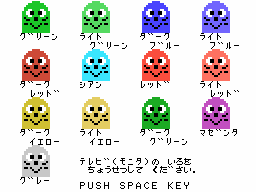
Mole starts by daring you to do the obvious thing: hit whatever rises from a hole. Then the mallet color changes and that instinct becomes a liability. A matching-colored hit reduces the score bar, so every appearance asks for a split-second check before you commit. It is a simple twist, but it gives the game more bite than a straightforward reaction test.
The pressure comes from two directions. You need to build the score before the timer bar runs out, yet you also need to avoid the particular mole color that will punish you at that moment. When the rhythm clicks, you stop treating the board as a blur and begin making rapid little judgments. That is the satisfying part of Mole: it rewards attention without abandoning the immediate, physical feel of an arcade challenge.
The nine difficulty levels matter because the later settings bring up moles matching the mallet more often. That turns the game from brisk target-hitting into a test of restraint, and frustration can arrive fast if your hands keep answering before your eyes do. There is little room to coast, but that is also why retrying is tempting. Give it a chance if you want a compact score-chasing game that asks you to stay alert rather than merely react quickly.
Graphics
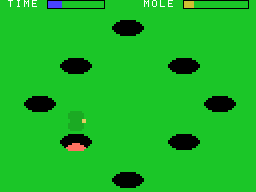
The action is centered on eight holes arranged around the field, with colored moles emerging as targets and the mallet color acting as the crucial cue. That clear layout suits the game well: you can scan the full set of possible positions while keeping one eye on the color that can cost you points.
Story
Mole does not build its challenge around a story. There are no narrative detours between attempts; the point is to get you back into the field and see whether you can fill the score bar before time expires.
That stripped-down approach fits an arcade game whose tension comes from immediate decisions. The changing mallet color supplies all the context you need: some targets are valuable, one kind of mistake hurts, and the clock is not waiting.
If you need characters or a larger goal to stay engaged, Mole will feel bare. If a game can earn your attention through a clean rule and a steadily harsher test of execution, its lack of narrative is unlikely to bother you.
Overall Experience
Mole is a concise arcade distraction with one genuinely effective idea at its center. The color-matching penalty prevents the action from becoming mindless button work, while the timer makes every hesitation expensive. It is easy to understand and harder to play cleanly once the difficulty rises.
Its limits are equally clear. Everything rests on the same loop of spotting, deciding, and striking, so the game lives or dies on how much you enjoy refining that skill. There is no broader adventure around the challenge, and the repeated setup will not convert anyone who needs constant new objectives.
Still, the design has enough sting to justify a few more attempts after a bad run. Mole is worth your time if you enjoy old-school arcade games that turn a familiar premise into a focused test of discipline. It is modest, demanding, and more mentally prickly than its whack-a-mole foundation first suggests.


Reviews
There are no reviews yet.