 Retro Replay Retro Gaming History, Reviews & Emulation
Retro Replay Review
Gameplay
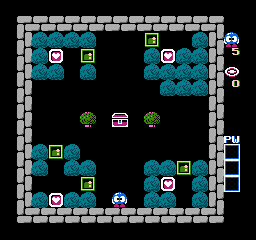
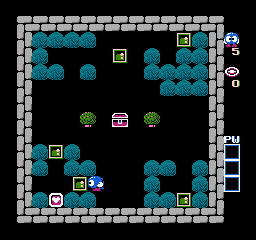
Eggerland: Sōzō e no Tabidachi is at its best when a room looks simple for ten seconds, then quietly exposes the bad decision you made two moves ago. You control Lolo through compact, screen-by-screen puzzles, collecting every heart to reveal a chest and taking its key to finish the stage. That goal is instantly understandable, but the route to it rarely stays straightforward.
Blocks and enemies turn each room into a small planning exercise. You need to decide what to move, what to leave alone, and how to make space without cutting off the route you will need later. The strongest puzzles make you feel clever for spotting a solution rather than merely lucky for stumbling into one.
A particularly sharp wrinkle is that many enemies wait until you collect the final heart before becoming active. That splits a room into two distinct problems: first you arrange the board and clear the hearts, then you have to survive the consequences long enough to reach the newly available key. It is a great bit of puzzle pressure, though it can be aggravating when you realize the setup you made before that last heart has doomed the finish.
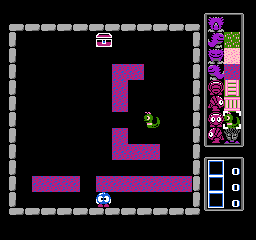
There are 50 stages here, although many are carried over from earlier Eggerland games. That makes this less essential as a wholly fresh campaign for a veteran who has already worked through those puzzles, but the underlying design remains satisfying. The map creation mode is the reason this entry has its own personality: you can use the same obstacles and enemies to make puzzles of your own and save them to disk. For anyone who has ever finished a Lolo room and immediately wondered how they would make it nastier, that is a meaningful reward.
Graphics
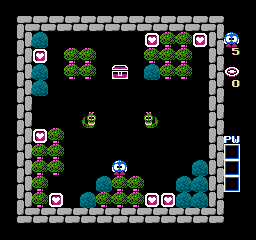
The game keeps each puzzle on a fixed single screen, with Lolo’s small ball-like form, the hearts, blocks, chest, key, and enemies all arranged as clear pieces of the problem. That compact view fits the game well: you can study the entire room before committing to a move.
Story
Lolo’s immediate purpose is plain and functional: collect the hearts, open the chest, and take the key. That simple framing puts all the focus on the next room rather than asking you to carry a complicated premise between stages.
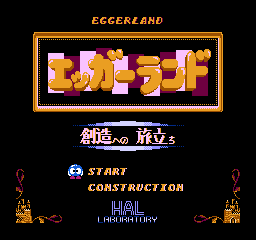
The Japanese subtitle, “Departure to Creation,” points toward the game’s most distinctive idea. Completing puzzles is only one half of the experience; the other is stepping into the creation mode and arranging the same toolkit yourself.
That gives the game a satisfying little arc for puzzle-minded players. You begin by learning the logic behind somebody else’s rooms, then get the chance to test whether you can create a challenge with equally careful traps and solutions.
Overall Experience
This is a focused, old-school puzzle game that trusts you to slow down and think. Its rooms are compact, its rules are direct, and its best moments come from seeing how a block move or an enemy’s delayed activation changes the whole board. If you enjoy deliberate trial, observation, and eventual breakthroughs, Lolo’s format still has real bite.
The reused stages make the 50-room campaign a less exciting proposition if you know prior Eggerland games inside out. For everyone else, they remain a solid collection of tightly contained brainteasers, and the ability to create and save original maps adds welcome longevity beyond the built-in set.
Give Eggerland: Sōzō e no Tabidachi a chance if you want puzzles that are easy to read but not always easy to solve. It can punish careless planning, especially around that final heart, yet the payoff is exactly what this series does well: a stubborn little room finally clicks, and you see the route that was there all along.



Reviews
There are no reviews yet.