 Retro Replay Retro Gaming History, Reviews & Emulation

Retro Replay Review
Gameplay
The first few minutes make Mario’s Time Machine seem like a clever educational detour. Mario clears enemies from a single-screen arcade challenge, grabs the artifact they leave behind, and steps into the Timulator for a trip through history. It is an easy structure to understand, and bouncing between a quick action test and a historical location gives the game more movement than a straight quiz would have.
Unfortunately, the punishment for being wrong is out of proportion to the task. Put an item down in the wrong place or visit the wrong time period, and the artifact is taken away. You then have to earn it again before taking another shot. That does not encourage curiosity about the facts. It makes you anxious about experimenting, and it can turn a simple mistake into a tedious replay of the least interesting part of the loop.
The side-scrolling historical areas at least give you a reason to poke around. Message blocks contain facts about each era and location, so progress is tied to paying attention rather than blindly wandering. Still, the game asks you to retain enough information to return fourteen artifacts and later pass a history exam. If you are here for a breezy Mario platformer, the stop-start rhythm and repeat penalties will wear thin fast. If you are patient and willing to treat it as a history lesson first, its structure makes more sense.

Graphics
The NES artwork is clean but sparse. Inside Bowser’s museum, Mario walks past pale stone statues, tall columns, and a framed Bowser portrait against a plain gray backdrop. It looks orderly and recognizable, though the room has little detail beyond its props.
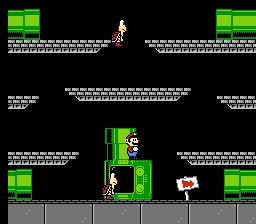
The arcade screens are much harsher to look at: black backgrounds, chunky gray platforms, bright green pipes, and tiny enemy sprites create a stripped-down early-arcade look. Mario remains easy to spot, but these stages feel more functional than lively.
Story
Bowser’s museum theft gives the game a simple, kid-friendly reason to visit different periods of history. Yoshi’s capture supplies the personal stake, while the stolen artifacts make Mario’s trips feel like repairs rather than random sightseeing.
The story is mostly a frame for the educational material, and that is fine. What matters is that each artifact belongs somewhere specific, making the facts in the message blocks relevant to your immediate goal. You are not just reading trivia for its own sake, at least in principle.
The trouble is that the game turns this premise into a final exam after all fourteen returns. That is a bold commitment to its educational purpose, but it also makes the ending feel gated behind recall rather than a satisfying Mario-style climax. The Bowser confrontation and Yoshi rescue are a decent reward, though the journey there has more homework energy than adventure.
Overall Experience
Mario’s Time Machine is more memorable as an odd attempt to teach history through a famous mascot than as a consistently fun NES game. Its strongest idea is the connection between an artifact, its era, and the information needed to restore it. When you make that connection on your own, the game briefly feels like it has earned its lesson.
Its weakest idea is making failure erase your progress on an artifact. That one choice drains the fun from exploration and puts too much weight on every guess. The arcade stages are not rich enough to stay enjoyable when you must repeat them, so the game can feel like it is making you redo chores for a chance to learn the answer it wants.
Give it a chance if you are curious about unusual educational games, have nostalgia for Mario’s stranger 1990s outings, or want to share basic history facts with a patient kid. Everyone else is likely to find the good intentions buried beneath a frustrating retry loop. It is interesting, occasionally charming, and far more educational than entertaining.


Reviews
There are no reviews yet.