 Retro Replay Retro Gaming History, Reviews & Emulation

Game Overview
Gameplay
The first pull of Marusa no Onna is how stubbornly it commits to its job. Ryōko Itakura is not chasing a killer or swinging a weapon. She is a tax auditor working through suspected evasion and fraud, so the investigation has a grounded, procedural flavor that separates it from most crime adventures of its era.
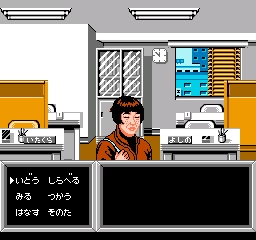
Most of your time is spent selecting actions from menus as the game delivers its investigation in a visual-novel-like format. That makes the pace methodical. If you enjoy stopping to consider the next line of inquiry and working through conversations rather than reacting quickly, the format can become pleasantly focused. If you need constant movement or open-ended experimentation, the menu structure can start to feel restrictive.
There is at least a change of pace in the overhead exploration sections, where you walk city streets and enter buildings. These stretches make travel feel like part of the work instead of a purely abstract jump between scenes. Progress can be saved with a password received from the home office, a very period-appropriate system that is functional but demands a little patience when you return to the case.
Graphics
Investigation scenes use close pixel portraits against sparse interiors. One ordinary room pairs white walls, ceiling strip lights, gray glass doors, blue lockers, a wall clock, and brown fixtures, while a brown-haired man in orange-brown clothing stands out with bold, dark facial features. The people have more character than the blocky furniture around them, and the blue and brown accents keep the room from becoming a wash of gray.
Story
Following the 1987 film A Taxing Woman, the game puts Ryōko at the center of a fraud investigation. Tax evasion is an unconventional foundation for a licensed adventure, and that is exactly why the premise has some bite. The stakes come from what people may be hiding and how hard it is to get at the truth, not from a conventional action-mystery setup.
That focus gives the story a more adult, workaday tension. You are not asked to save the world. You are doing a difficult public job in a city where dishonesty can hide behind ordinary doors and conversations. For a player interested in crime stories that leave behind murder clichés, Ryōko’s assignment is a refreshing change.
The film connection also means this is best suited to gamers willing to meet it on its own cultural and historical terms. It is not a broad, action-heavy licensed game. It is a compact investigative adaptation whose central subject, following money and exposing fraud, remains distinctive.
Overall Experience
Marusa no Onna is an easy game to admire more than to universally recommend. Its menu-driven structure and password saving are unmistakably old-school, and the subject matter will not overcome that friction for everyone. Still, there is real charm in a Famicom adventure willing to make a tax auditor its lead and treat paperwork-adjacent detective work as drama.
Give it a chance if you like deliberate Japanese adventure games, especially ones that prioritize questioning and investigation over action. The payoff is not adrenaline. It is the satisfaction of inhabiting a specialized kind of investigator rarely given the spotlight in games.
For a useful point of comparison, Portopia Renzoku Satsujin Jiken is another classic Japanese investigative adventure, though its murder mystery is a very different proposition from Ryōko’s pursuit of financial wrongdoing. Marusa no Onna is the stranger, narrower pick, but that narrowness is also its reason to exist.



Reviews
There are no reviews yet.