 Retro Replay Retro Gaming History, Reviews & Emulation
Retro Replay Review
Gameplay
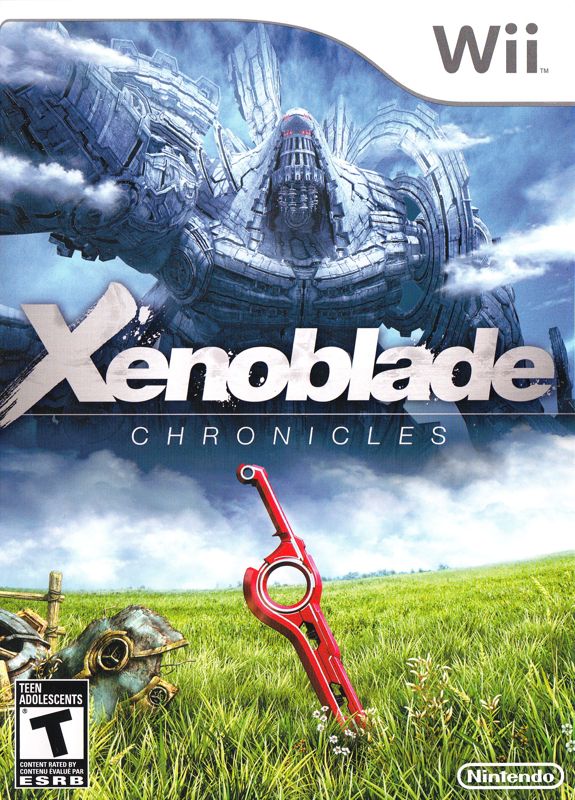
The first hour gives you a strong reason to push onward: Shulk’s Monado can show him fragments of what is coming, and the conflict between Bionis’s people and Mechonis’s machines immediately gives that power some weight. Then the world opens up and Xenoblade Chronicles becomes a game about following your curiosity as much as chasing the main goal. You can take objectives in different orders, pick up side quests, and spend a great deal of time simply moving through the enormous landscape.
That freedom has teeth. Enemies far beyond your current ability can be wandering the same areas you are exploring, so you need to pay attention rather than assume every fight is meant for you right now. It is a welcome kind of danger in an open RPG: retreat is often the sensible call, and a later return can feel like a genuine measure of how much stronger your group has become. The lack of a death penalty beyond returning to the last save point also makes those risky detours much easier to enjoy.
Combat plays out directly in the field, without a separate battle screen. Your character attacks at regular intervals on their own while you choose actions from menus, which can initially feel more hands-off than a traditional turn-based RPG. Stick with it. The interesting decisions come from choosing abilities at the right time, building a group with varied strengths, and saving team attacks for extra damage. You control one character at a time, though, and cannot swap once a battle has started; the rest of the party runs on AI. That limitation will frustrate you if you demand command over every move, but it also keeps fights moving instead of turning each encounter into menu management.
Graphics
The sights have a built-in sense of scale: you explore a world spread over the bodies of two motionless giant gods, Bionis and Mechonis. Shulk and his allies travel through those spaces in a third-person view, while the machine enemies provide a clear visual contrast to the people living on Bionis.
Story
Xenoblade Chronicles starts from a genuinely memorable fantasy premise rather than a generic quest for a magic weapon. Shulk is a young man of mysterious origin who finds the Monado, and its ability to reveal glimpses of the future gives the journey a persistent question: what can he change, and what can he not? That is an excellent hook because it makes forward momentum feel personal instead of merely geographical.
The larger conflict is equally easy to latch onto. Humans on Bionis are locked in a struggle with the machines of Mechonis, and Shulk’s path is not just about defeating those machines; he is also helping Bionis’s inhabitants rebuild their world. It gives the adventure a useful human center amid its enormous setting.
Its story works best if you enjoy a long JRPG journey where the world itself matters as much as the hero’s immediate problem. The giant world-gods are more than backdrop: they frame the entire conflict and make each stretch of exploration feel connected to a larger struggle.
Overall Experience
Xenoblade Chronicles earns its reputation through the combination of a bold setting, a huge world that rewards detours, and combat that grows more satisfying once you stop expecting it to behave like a conventional turn-based system. Weather and the day/night cycle affect which quests and characters are available, so the world encourages revisits rather than a straight rush from marker to marker.
There are real points of friction. Automatic attacks and AI-controlled allies can make the opening battles feel like you are watching part of the action rather than directing it, while the inability to switch characters mid-fight can sting when a situation goes wrong. Yet the game gives you room to learn because failure is forgiving, objectives are flexible, and dangerous encounters can simply be left for later.
If you want an RPG that packs every hour with tightly directed battles, this may test your patience. If you like getting lost in a broad fantasy world, accepting a few perilous wrong turns, and letting a deeper combat rhythm reveal itself over time, Xenoblade Chronicles is absolutely worth your time. It is a big, confident adventure whose strongest moments come from the feeling that there is always another path, quest, or impossible-looking enemy waiting just beyond where you meant to go.

Reviews
There are no reviews yet.