 Retro Replay Retro Gaming History, Reviews & Emulation
Retro Replay Review
Gameplay
The first few minutes feel instantly familiar if you have ever played Tetris: pieces drop from above, you slide and rotate them, completed lines vanish, and the board gradually asks more of you. It is a simple loop, but Tetris 64 understands why it lasts. You begin by chasing clean placements and points; before long, you are staring at an awkward cavity near the bottom of the well and trying to rescue a run that was under control thirty seconds ago.
Standard play is the dependable centerpiece. Difficulty rises over time, so the game naturally shifts from measured stacking to quick decisions under pressure. The loss condition is brutal in the proper Tetris way: once the pile reaches the point where a new piece cannot be placed, that run is over. If you enjoy the clean, repeatable challenge of improving your own play, this remains compulsive.
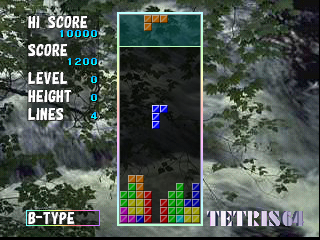
B-Type changes the opening rhythm by filling the bottom of the screen with random block formations. Instead of building an ideal stack from an empty field, you are immediately solving somebody else’s mess. That makes it a good choice when you want a more directed clean-up puzzle, though the random clutter can also make early mistakes feel harder to recover from.
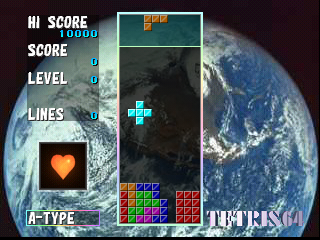
Giga Tetris is the strongest variation because its huge blocks force you to rethink the familiar board. Since they break apart when they touch the ground, they create sudden structural problems and opportunities instead of merely acting as oversized obstacles. Bio Tetris is stranger: clip the included sensor to your ear and rising heart rate can be set to slow the game down or speed it up. It is an ingenious party trick, but the ordinary modes have the more reliable long-term pull.
Graphics
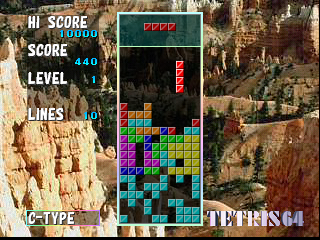
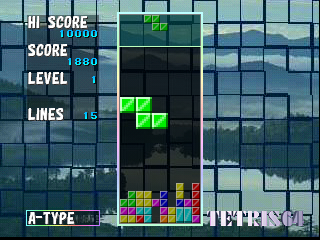
The action stays on a fixed, side-view playfield where the important thing is easy to see: falling blocks above, your growing stack below, and the lines you need to clear. Giga Tetris earns a bit of visual drama from the sheer size of its blocks and the moment they break apart on the ground, while the rest is appropriately focused on keeping the board legible during faster play.
Story
There is no narrative detour here, and that is the right call. Tetris 64 tells its story through the shape of a single attempt: a blank or cluttered board, a few smart repairs, mounting speed, then either a satisfying clear or an untidy collapse.
B-Type gives that arc a different opening. You start with trouble already on the floor, so each cleared line feels like visible progress rather than just score accumulation. It is a small change, but it makes a short session feel like you have solved a compact problem.
Giga Tetris and Bio Tetris add their own little anecdotes. One run may be remembered for a huge piece shattering into a suddenly dangerous stack; another may turn into a contest with your own rising pulse. These are not story modes, but they give the familiar rules a few unusual situations to talk about afterward.
Overall Experience
Tetris 64 is a solid version of an immortal idea, with enough unusual modes to avoid feeling like a bare conversion. The core game remains the reason to play, and it is still capable of swallowing an evening one increasingly tense run at a time.
The catch is that the extras are uneven in their staying power. B-Type is a welcome alternate start and Giga Tetris meaningfully changes how you read the board, while Bio Tetris is more of a curious experiment built around its heart-rate accessory. If you want the purest possible Tetris package, the sensor mode will not be the deciding factor.
Give it a chance if you enjoy score-chasing puzzle games and like seeing a familiar formula pushed in a few eccentric directions. The payoff is not a reinvention; it is the comfort of classic falling-block play sharpened by rising difficulty, plus a pair of variants that can still catch an experienced player off guard. Giga Tetris alone makes this more than a routine round of line clearing.



Reviews
There are no reviews yet.