 Retro Replay Retro Gaming History, Reviews & Emulation


Retro Replay Review
Gameplay
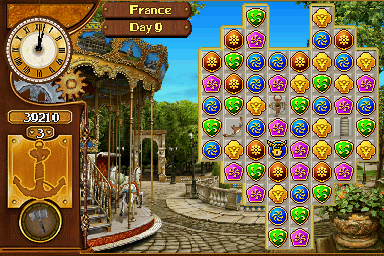
The hook in Around the World in 80 Days is simple enough to grasp almost immediately: artifact pieces sit above a field of tiles, and you clear the tiles beneath them until the pieces can fall away. That small wrinkle gives each board a useful sense of priority. Instead of treating every available match as equally valuable, you are naturally drawn toward the spaces supporting the objects you need to remove.
Most of the 81 stages follow that artifact-collection pattern, with bonus points and extra time also waiting to be dropped from the board. It is an easy loop to settle into, especially if you enjoy working through a long sequence of compact puzzle challenges. The bonus time matters because it keeps the pace from becoming completely sleepy; when a board resists, you feel the pressure to stop making casual clears and focus on the tiles that open a path downward.
At the end of each country, the goal changes to clearing every tile from a stamp. These boards are a welcome reset, asking for a full cleanup rather than a narrow route to a few falling objects. The structure is not especially daring, and repetition can set in over such a long itinerary, but the changing objectives do enough to keep the campaign from feeling like one identical board repeated 81 times. If you want a relaxed tile matcher with clear goals rather than a deep puzzle system, it has a dependable rhythm.
Graphics
The game is built around side-view puzzle boards where artifact pieces, bonuses, and stamp tiles are the important things to watch. That direct layout suits the falling-object objective well: you can quickly see what needs support removed beneath it and where the next useful clear might be.
Story
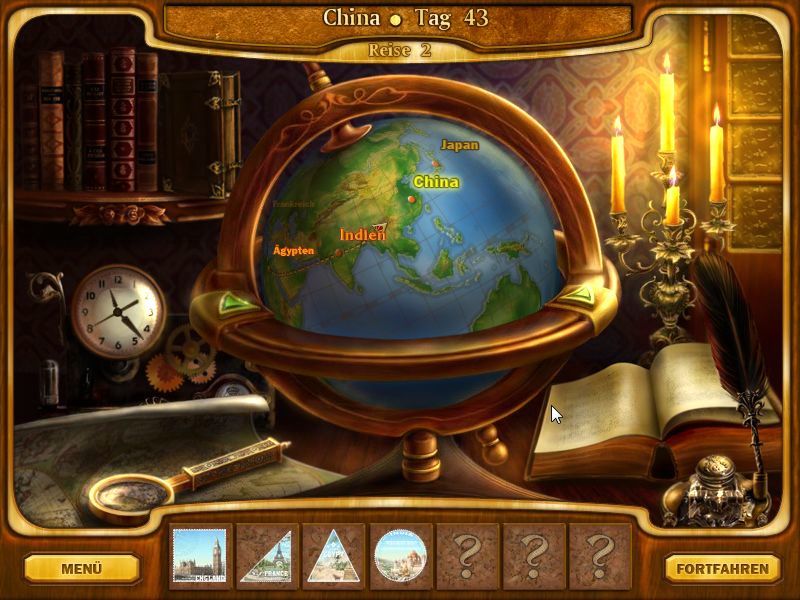
This is a light Jules Verne-inspired travel frame, told through dialogue between stages rather than a story that drives the puzzles moment to moment. The trip around the world gives the long campaign a bit of momentum; you are moving through countries, not simply ticking off a list of anonymous boards.
Do not come in expecting the novel’s adventure to be deeply recreated through play. The actual work remains tile clearing, artifact recovery, and stamp completion. Still, the dialogue breaks are useful palate cleansers after several boards, and the country-by-country structure gives the progression a more deliberate shape than a bare score chase.
The strongest part of the story is its modesty. It does not interrupt the puzzle flow for long, and it provides just enough context to make the 81 stages feel connected. Gamers who want narrative weight will find it thin, but anyone happy with a themed excuse to continue onward should find it pleasant.
Overall Experience
Around the World in 80 Days earns its time by giving a familiar tile-matching foundation a concrete objective: clear underneath the things you want to collect. That is not a revolution, but it is a smart adjustment. It makes boards feel less like random cleanup and more like small routing problems, particularly once time becomes a concern.
The trade-off is that the game leans heavily on that one idea. Over a campaign this long, the routine can become predictable, and the travel theme does not change the core interaction. You should give it a chance if you enjoy steady, low-friction puzzle progression and prefer clear, immediate goals over elaborate systems.
At 6.9, it lands as a competent and agreeable genre entry rather than an essential one. The payoff is a lengthy, gently varied tile-clearing journey that stays understandable and focused. It is worth the trip for fans of the format, especially if the prospect of chasing falling artifact pieces and clearing country stamps sounds more inviting than another pure high-score board.


Reviews
There are no reviews yet.