 Retro Replay Retro Gaming History, Reviews & Emulation

Retro Replay Review
Gameplay
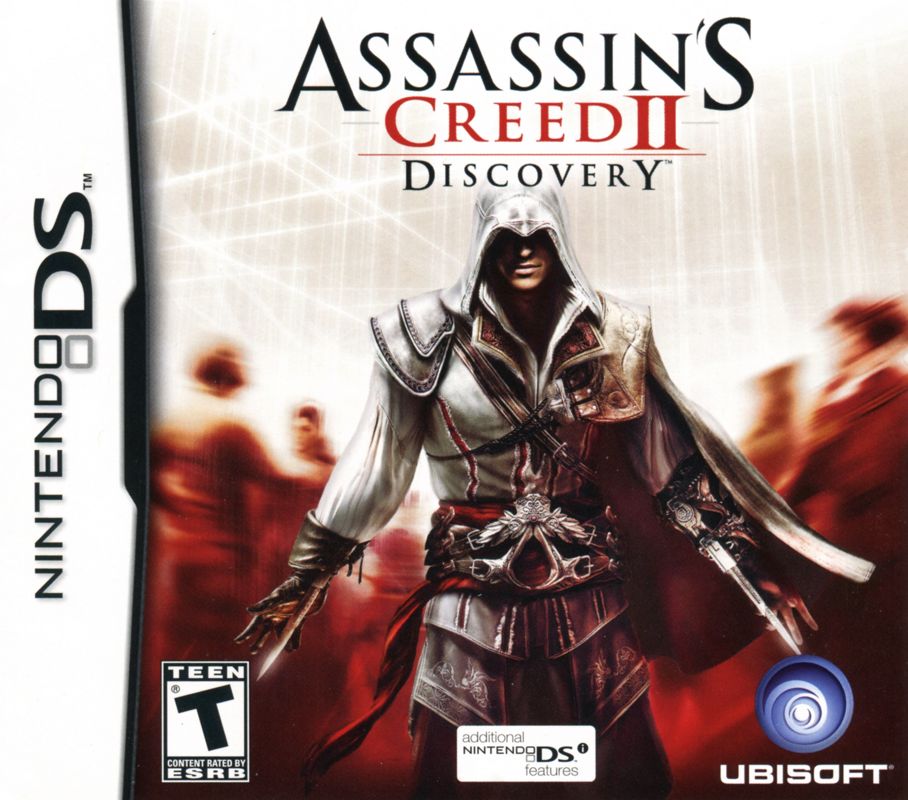
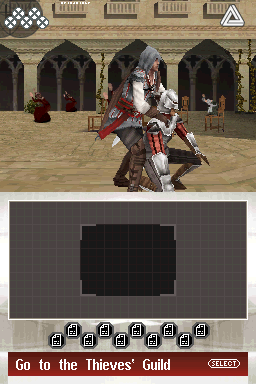
The smart thing Discovery does is stop trying to imitate its console sibling head-on. You still guide Ezio through climbs, escapes, assassinations, and fights, but the fixed camera turns everything into a side-scrolling platform challenge. That can feel restrictive at first if you come directly from Assassin’s Creed II, where a city is something you roam. Here, each route is a constructed obstacle course, and it starts to click once you treat positioning and timing as the point rather than looking for open-ended freedom.
Stealth has real teeth because many missions impose a specific mode. In Stealth mode, getting noticed too often sends you back to a checkpoint, so shadows, hay carts, bushes, and empty barrels become essential stops instead of optional scenery. A clean approach behind an enemy earns a one-hit stealth kill, and that makes patient movement genuinely rewarding. Normal missions loosen the leash and let you decide whether to sneak or fight, which is where the game feels most comfortably flexible.
Chase missions bring a different kind of pressure: reach a target, escape, or make it to a location before time expires. They suit the direct, linear layout, though players who dislike timed runs may find them stressful rather than exciting. Combat is simple but not mindless. Ezio has only his blade and throwing knives, while tougher enemies can block attacks and force you to break their defense or wait for a counterattack. Moves opening gradually gives the campaign a sense of progression, even if the limited toolkit never matches the range of the larger games.

Graphics
Discovery uses full 3D characters and environments viewed through a fixed side-on camera. That viewpoint makes the platform routes, enemies, and hiding spots easy to judge, while keeping the action closer to a 2D scrolling game than the roaming city view associated with Ezio’s console adventures.

Story
This is a bridge chapter set after Assassin’s Creed II and before Brotherhood, following Ezio into Spain as he battles the Inquisition, frees fellow Assassins, and interferes with Templar schemes. It has a clear job in the wider saga: move Ezio through another dangerous chapter without asking the handheld game to carry the entire burden of his story.
The Spanish setting gives the missions a focused conflict. Rather than wandering away from the central struggle, Ezio is consistently pointed toward rescuing allies and frustrating his enemies. That directness works well with a mission-based portable game, where you are more likely to play in short bursts and want the next objective to arrive with purpose.
Come to it as a companion piece, not a replacement for the fuller Ezio games. If you want background on the game itself, its game history and release information is useful, but the narrative hook in play is straightforward: Ezio remains caught between endangered allies and the Templars pursuing their plans.
Overall Experience
Discovery is most enjoyable when you meet it on its own terms. It is not trying to give you a huge free-roaming Assassin’s Creed on DS; it is giving you a compact stealth-platformer with Ezio at the center. Once that expectation settles, the rhythm of scouting a path, slipping into cover, landing an ambush, and making a quick escape has a satisfying snap.
The main frustration is that mission restrictions can turn a small mistake into a restart. Stealth-mode detection limits and chase-mode timers make failure immediate, and the fixed camera leaves less room to improvise than in the console games. Yet those constraints also create its strongest moments, especially when you thread through cover and finish a mission without turning it into a brawl.
Give it a chance if you enjoy deliberate side-scrolling action and can tolerate a more tightly controlled version of Ezio. Skip it if your favorite part of Assassin’s Creed is freely exploring a city with a broad set of tools. For everyone in between, it is a decent handheld detour: narrower, tougher, and less lavish than its inspiration, but often more engaging than its limited premise suggests.

Reviews
There are no reviews yet.