 Retro Replay Retro Replay gaming reviews, news, emulation, geek stuff and more!
Retro Replay Review
Gameplay
The first hour has a clear, accessible hook: you watch a routine, commit it to memory, and mimic it against opposing cheer squads. There is little mystery about what the game wants from you, which is a strength. You can get into the action quickly, and each successful response feels like a small contribution to rescuing the school’s atmosphere.
Difficulty comes from increasingly complex routines and the need for sharper reactions. That escalation is where the game either clicks or starts to wear thin. If you enjoy the pressure of accurately recalling a sequence after seeing it once, the rival encounters give you a satisfying reason to improve. If memorizing and repeating cheer patterns sounds more like homework than play, the central loop will not suddenly become more exciting later.
Progress has a practical reward beyond simply clearing the next match. As your squad gains fame, it can grow in membership and take on the more involved maneuvers needed for stronger opponents. Currency earned after matches also feeds into customization unlocks, so there is a steady sense that you are building something rather than just replaying isolated rhythm tests.
The option to challenge other squads for practice is especially useful in a game built around reaction time and recall. It gives you a place to work on the core skill before the next major game. That said, this is still a focused mini-game structure: its longevity depends on whether you want to chase better execution and keep advancing the squad.
Graphics
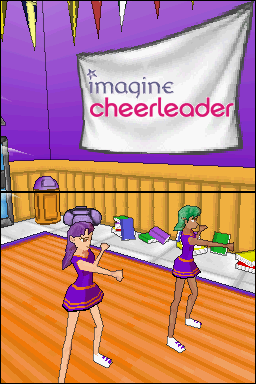
The Nintendo DS game centers its visuals on the cheer squad and its customizable pieces. Outfits, hairstyles, characters, and cheer styles are the tangible visual rewards of progress, giving your growing team a more personal look as you unlock options.
Story
The story is small-scale but easy to root for. The school’s teams keep losing, the crowd has stopped showing up, and you and your best friend Sam answer the problem by forming a squad. It is a familiar school-spirit setup, yet it gives every routine a straightforward purpose: bring some energy back to the games.
Sam’s presence keeps the premise from feeling entirely solitary. You are not presented as a lone superstar parachuting in to fix everything; the squad begins as a shared attempt to help. That is enough context for a game whose real focus is performance and progression.
Do not expect a complicated drama around the cheerleading world. The narrative mainly links matches, rising fame, new members, and bigger challenges. It works as a light frame for the climb, though anyone looking for a richly developed school story will find the emphasis firmly on the routines.
Overall Experience
Imagine: Cheerleader knows its lane. It turns cheerleading into a memory-and-reaction contest, then sweetens the repetition with squad growth, rival challenges, and a respectable pile of cosmetic unlocks. The strongest part is the connection between doing well in routines and seeing your team become larger and more customized.
Frustration can set in when the routines become demanding, particularly if quick recall is not your strength. There is no broad sports-management layer here to carry you through a weak match; you need to enjoy practicing and reproducing patterns. For the right player, that directness is a benefit rather than a limitation.
Give it a chance if you want a kid-friendly DS rhythm game with a school-cheer theme and you like earning new ways to dress up and develop a team. Skip it if you want a detailed simulation of cheerleading or a story-heavy sports game. Its payoff is modest, but for someone invested in mastering routines and watching a homemade squad gain momentum, it can be genuinely encouraging.


Reviews
There are no reviews yet.