 Retro Replay Retro Gaming History, Reviews & Emulation
Retro Replay Review
Gameplay
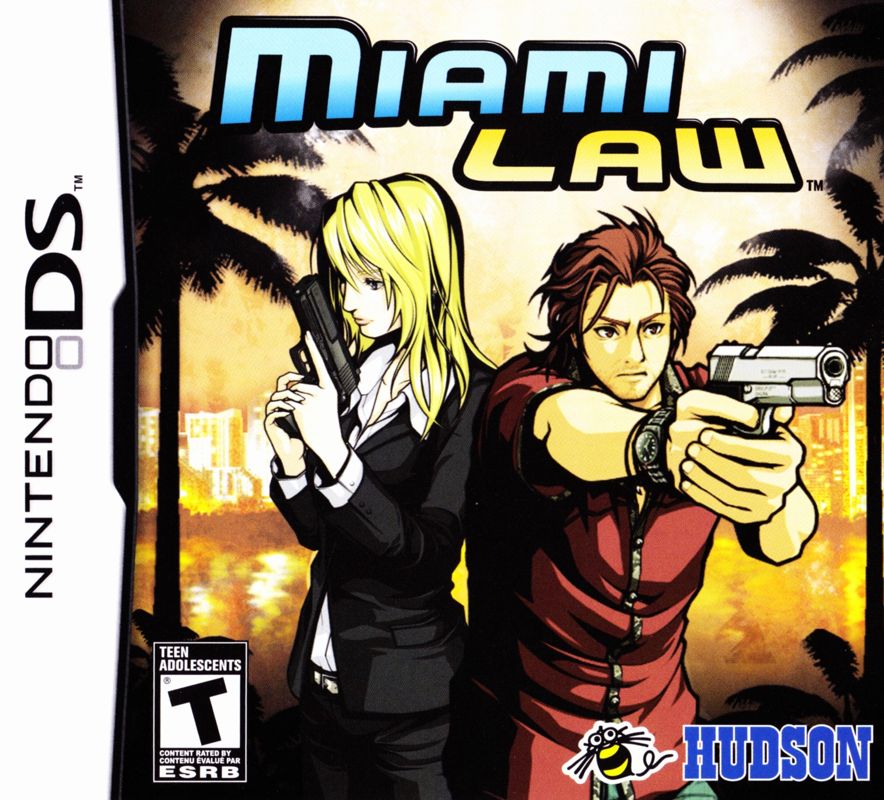
The first hour of Miami Law has an easy hook. You are not stuck with a single detective voice: Martin Law is the impulsive Miami PD officer driven by his partner’s death, while FBI agent Sara Sterling brings a more measured, forensic angle. Their contrast keeps the dialogue and investigations from feeling completely one-note, and the game is at its most engaging when you are weighing a conversational response or following a case through its textual clues.
It also makes a sensible call by handling investigation through text selections instead of making you poke every corner of the DS screen for a hidden hotspot. That removes the most tedious kind of adventure-game busywork. You spend your attention on choosing leads and responses rather than searching for pixels, which is a good fit for a detective story built around dialogue.
The major problem is that its choices are not really choices in the satisfying sense. There is one right answer, while every other answer ends the run with a game over. That turns experimentation into repetition and can make a perfectly reasonable line of questioning feel like a trap. If you enjoy learning a game’s preferred solution through trial and error, you may tolerate it; if you want decisions to create different paths, this is a frustratingly narrow experience.
The character split helps break up the format. Martin’s portions lean toward shootouts and car chases, while Sara gets puzzle-solving tasks, so neither investigation style has to carry the entire game. The mini-games add pace, though their real value is simply giving the story’s many dialogue scenes a change of rhythm rather than deepening the detective work.
Graphics
This is a graphical text adventure on DS, with the focus firmly on reading scenes, making selections, and moving through cases rather than on lavish imagery. The game’s two leads and crime-case setup give the screens a clear police-procedural frame, but the writing and choice prompts do most of the heavy lifting.
Story
The central pairing is the reason to care. Martin is a loose cannon pursuing vengeance for his dead partner; Sara is a by-the-book FBI agent with forensic skill. It is familiar detective-fiction material, but it is a functional setup because their methods naturally create different kinds of scenes and activities.
The cases ask the pair to hunt criminals and reduce Miami’s crime, with dialogue and investigation carrying most of the storytelling. Don’t come in expecting your decisions to reshape that crime story in meaningful ways. The rigid right-or-wrong structure makes the plot feel authored at you rather than jointly shaped with you.
Still, the game knows what kind of pulpy procedural it wants to be. Martin supplies the brawling, chase-oriented side of the partnership, and Sara handles the more methodical puzzle side. That division gives each protagonist a recognizable lane, even if the larger mystery is constrained by the fail-state-heavy decision design.
Overall Experience
Miami Law is easier to enjoy as a guided detective serial than as a branching visual novel. When you accept that it wants the correct answer rather than your answer, the mix of case dialogue, textual investigation, puzzles, shootouts, and chases has a decent portable rhythm.
Its harsh game overs are the sticking point. A mystery game should make you feel clever for noticing the right detail; here, being wrong can too often feel like stepping on an invisible mark. That undercuts the fantasy of playing either a hard-charging cop or a careful federal investigator.
At 6.1, it lands as a modest recommendation for patient fans of DS-era detective adventures who can forgive rigid answers in exchange for a dual-protagonist crime story. Everyone else will likely find the premise more appealing than the punishment attached to its choices. For release background, the Miami Law history and release information is a useful companion.


Reviews
There are no reviews yet.