 Retro Replay Retro Gaming History, Reviews & Emulation

Retro Replay Review
Gameplay
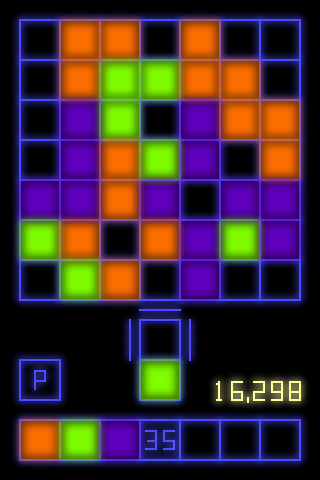
The first few turns of Primrose feel almost too simple. Put down one tile, place its partner somewhere along that row or column, and start boxing in tiles of one colour with another. Then you notice that the board is only 49 spaces, each pair commits you to an axis, and a harmless placement can close off the exact route needed for your next enclosure. That small-board pressure is where the game gets its hooks into you.
Its clearing rule is stronger than ordinary matching because it asks you to think in borders rather than piles. A group disappears only when it is completely surrounded horizontally and vertically by a different colour; the outer edge of the grid can complete that boundary. When you pull it off, the cleared tiles become black spaces that can be used again, while their surrounding tiles change to the cleared colour. That conversion means a good clear is not merely cleanup. It rearranges the logic of the next several moves, sometimes creating a much bigger opportunity and sometimes forcing you to repair a new problem.
Score chasing gives that puzzle loop real teeth. Large groups are worth more, so there is always a temptation to delay an easy clear and build something ambitious. Often that is exactly how a run dies. Additional colours unlock as your score rises, up to four beyond the initial three, making later boards more crowded with conflicting possibilities. The escalation is elegant, but it can be frustrating if you prefer puzzles that let you fully plan several moves ahead; the incoming tile pairs demand adaptation.
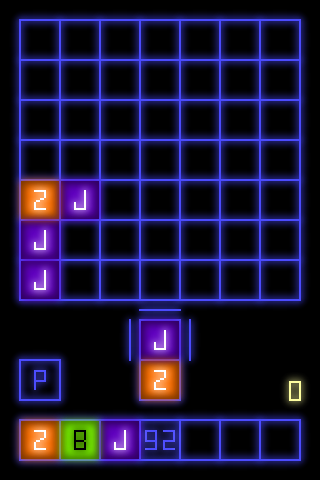
The best advice is to treat black spaces as future building material, not empty relief. Leave yourself lines that can accept the second tile of a pair, and be wary of converting your useful surrounding colour into something less flexible. Primrose rewards patient board reading more than fast clicking, and its online leaderboard makes the desire to squeeze out one better score easy to understand. The colourblind mode is also a welcome practical inclusion for a game built so completely around colour relationships.
Graphics
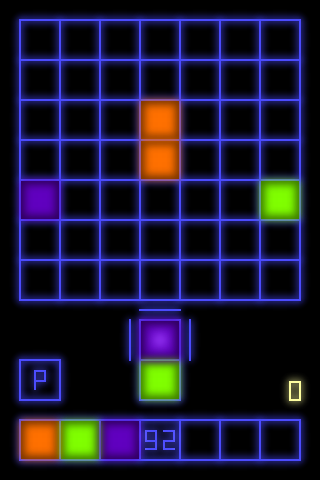
Primrose is seen from a clean top-down view of a square seven-by-seven grid. Coloured tiles, black cleared spaces, and the board edges carry nearly all the visual information, which suits a puzzle where you need to judge rows, columns, and enclosed groups at a glance.
Story
There is no narrative campaign pulling you from puzzle to puzzle. Primrose is interested in the story a board tells through its changing colours: a neat enclosure forming, a huge group hanging in danger, or a previously tidy plan becoming tangled after a conversion.
That lack of story is not a weakness for this format. The stakes come from your score and from the mounting difficulty of preserving useful shapes as more colours join the pool. Each run creates its own brief arc from confident opening to increasingly delicate survival.
If you need characters, a setting, or a final narrative payoff, this will feel spare. If you enjoy abstract games where the consequence of a move becomes clear a few turns later, the board supplies enough drama on its own.
Overall Experience
Primrose is a smart, concentrated puzzle game that earns its difficulty from a few rules interacting in clever ways. The row-or-column restriction on each tile pair prevents mindless placement, and the surround-and-convert clears make every success change the board instead of simply reducing it. It is easy to start, but not especially forgiving once you begin aiming for serious scores.
The payoff is the moment you stop seeing individual tiles and begin seeing boundaries, reusable black spaces, and colours that can be converted to rescue a damaged layout. That shift takes a little time, and early failed runs can feel abrupt, but it is also the point where Primrose becomes compelling rather than merely clever.
Give it a chance if you want a score-driven abstract puzzle with enough depth to punish casual habits and reward careful recovery. Its 7.6 score feels right: this is not trying to overwhelm you with variety, but its central idea is sturdy, demanding, and satisfying enough to keep calling you back for another attempt.



Reviews
There are no reviews yet.