 Retro Replay Retro Gaming History, Reviews & Emulation
Game Overview
Gameplay
The first board asks almost nothing of you beyond the basic word-search instinct: scan the listed terms, sweep across the letters, and lock onto the satisfying straight-line match. That simplicity is its strength. You can start a puzzle immediately, make progress in a few minutes, and stop without feeling as if you have abandoned a larger commitment.
What keeps the format from becoming completely disposable is the recorded completion time. Once you know a puzzle’s subject and have trained your eyes to catch likely letter combinations, replaying becomes a modest speed-running exercise. The words are scrambled into new positions on repeat attempts, so you cannot simply memorize a route through the grid. You still have to do the searching.
There are 100 themed puzzles, with categories including palindromes, pirates, and painting. That range adds a little flavor to a fundamentally consistent task, but do not expect the topics to transform how you play. If word searches usually put you to sleep, this sequel will not convert you. If you enjoy shaving seconds off a familiar kind of puzzle, its clean focus can be surprisingly sticky. For a related handheld word game built around making words rather than locating them, WordJong takes a notably different route.
Graphics
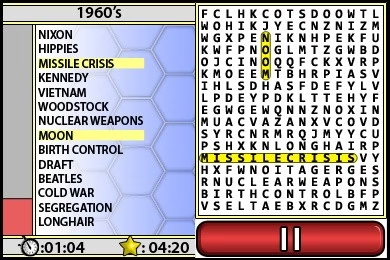
Active puzzles are stark and practical: black capital letters sit in a white grid, while yellow bars mark words you have found. A pale periwinkle-blue hexagonal texture frames the topic list. The bold letters are easy to distinguish, which matters far more than decoration here, but board after board looks much the same. It is functional DSiWare design, not something you will linger over.
Story
There is no authored adventure pulling you from puzzle to puzzle. Word Searcher 2 is built around themed word lists and your own improvement, so the closest thing to a forward drive is deciding whether your latest finish time is good enough.
The themes give individual boards a light mental hook. A pirates puzzle or a painting puzzle can put a loose subject in your head as you hunt, while palindromes invite you to pay a little more attention to the words themselves. That is atmosphere in miniature, not storytelling.
For this kind of game, the lack of narrative is sensible. You are here for a low-pressure word hunt that can become competitive only with yourself. Anyone needing characters, surprises, or a final story payoff should look elsewhere.
Overall Experience
Word Searcher 2 succeeds by staying in its lane. It takes a classic paper puzzle, makes the words clear enough to scan on a handheld screen, and adds just enough timing structure to make repeat runs meaningful. The payoff is modest but real: a quicker clear, a newly noticed diagonal, and the pleasant click of a completed list.
Its limitations are equally plain. Every puzzle returns to the same core routine, and the utilitarian boards do little to freshen the experience across a large collection. The timer may also create pressure where you wanted a calmer pastime, though you can treat it as a personal record rather than a demand.
Give it a chance if you genuinely like word searches and want a portable stack of them with a reason to replay. Skip it if you need varied puzzle rules or a richer sense of progression. For the right mood, it is a tidy little time-killer that turns a familiar pastime into a quiet race against your previous self.
Reviews
There are no reviews yet.