 Retro Replay Retro Gaming History, Reviews & Emulation



Retro Replay Review
Gameplay
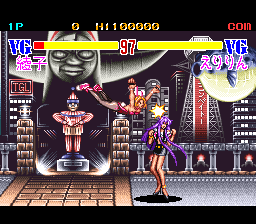
Your first few fights in Advanced V.G. are easy to read: this is a traditional side-view fighter where punches and kicks establish the basics, while special attacks ask you to learn button combinations. That directness is welcome. You can pick a heroine, get into a match quickly, and start figuring out what feels comfortable without wading through a pile of systems.
The roster of nine heroines gives the game its immediate replay value. Normal mode is useful for trying them against the AI, while Vs. mode is the obvious place to test your preferences against another person. It also includes computer-versus-computer matches and lets you choose stages, a small but welcome option if you simply want to watch the cast trade blows.
Story mode is where the game finds its clearest hook, even if it narrows your choices. You play only as Yuka Takeuchi, the young martial artist arriving from secluded forest training, as cutscenes carry her from match to match. That restriction may frustrate anyone hoping for a separate campaign for every fighter, but it gives the game a protagonist and a reason to push forward beyond another string of exhibition battles.
Graphics
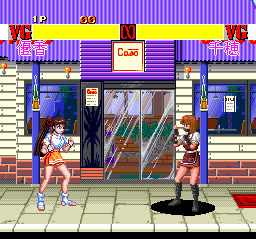
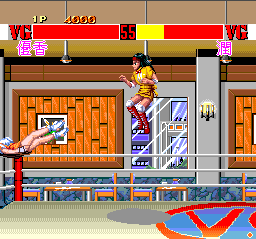
The game uses side-view fighting screens and an anime-styled cast of young women, with the restaurant-and-tournament premise giving the character selection a distinctly niche flavor. The focus is squarely on the fighters facing off rather than on elaborate visual detours.
Story
This is not a fighting game trying to hide a grand epic behind its bouts. Its premise is knowingly peculiar: the country’s strongest young women enter a tournament backed by restaurant chains, then pose as waitresses for promotional purposes. That combination is either the exact kind of eccentric anime-game energy you enjoy or a hurdle you will never quite get past.
Yuka is a sensible focal point because she enters the competition as a new main character rather than simply inheriting the spotlight from the returning Jahana group. Her forest-training background is broad martial-arts shorthand, but it gives Story mode a clean arrival point: you are following someone stepping into an established competition and meeting its familiar faces.
The returning cast matters more if you already know the earlier Variable Geo games. Newcomers can still follow the central setup, but the story’s strongest draw is its cast continuity and the excuse it creates for the match-to-match cutscenes, not a complicated plot full of surprises.
Overall Experience
Advanced V.G. is a decent mid-tier fighter whose personality does more work than its basic fighting framework. The controls and modes give you the expected ways to practice, play competitively, or follow a campaign; Yuka’s Story mode is the feature that keeps the game from feeling like a purely functional versus package.
Frustration is most likely to set in if you want a campaign that lets every heroine take center stage, or if a simple punch-kick-special-move foundation feels too familiar. The game does not need to win you over with complexity. It needs its cast, tournament structure, and unusual restaurant sponsorship framing to land with you.
Give it a chance if you have a soft spot for 1990s anime fighters and want a compact game with a defined protagonist-led mode alongside standard one-on-one play. For everyone else, it is an agreeable curiosity rather than an essential stop: enjoyable in short sessions, more memorable for its offbeat setup than for reinventing the genre.


Reviews
There are no reviews yet.