 Retro Replay Retro Gaming History, Reviews & Emulation
Retro Replay Review
Gameplay
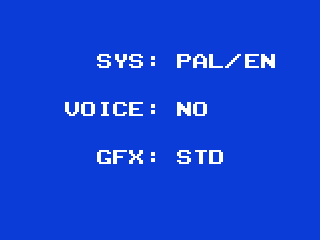
The first few rallies are exactly what you want from Pong: immediate, tense, and just awkward enough to make a clean return satisfying. You choose a numbered variation, move a paddle, and try not to let the ball get past. There is no learning curve to climb, which makes it easy to bring in another person and start competing almost immediately.
The main six modes are where this cartridge feels more expansive than a simple novelty. Squash supports solo practice as well as two-player turn-taking, while Tennis gives two people a more direct contest. Paddles can move in all eight directions here, and the action button accelerates movement. That extra freedom gives you more room to chase a bad angle, though it also means a rushed correction can put your paddle out of position. You can switch ball speed during play with 1 and 2, a useful option when a slow game stops feeling demanding or fast play becomes a blur.
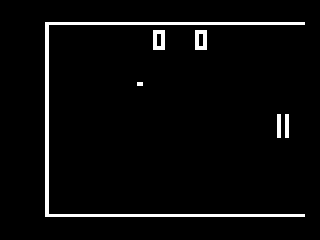
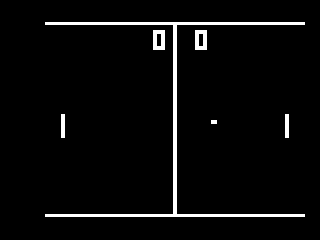
Classic Pong pares the format back to the AY-3-8500-style rules: vertical paddle movement, accelerated motion with the action button, and matches ending at 15 rather than 40. These are the most immediately familiar variations, and they have a clean competitive rhythm. Squash requires players to alternate hits, so it asks for cooperation and timing instead of pure head-to-head pressure. Tennis is the better pick if you simply want to beat the person beside you.
The Pong-Analog modes are less conventional. With six ball speeds and no score or time limit, they play more like a free-form rally exercise than a proper match. You adjust speed with 1 and 2, then use the action button to serve again whenever the ball leaves the playfield. That can be pleasantly meditative, but it lacks the built-in stakes that make the scored modes so replayable.
Graphics
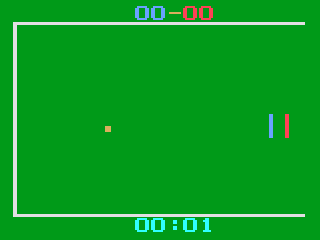
On-screen, this is the stripped-back paddle-and-ball game you expect. The playfield keeps the focus on following the ball and judging your paddle position, and the different modes alter rules rather than dressing the court in elaborate scenery.

Story
There is no story pulling you from match to match. This is a cartridge about the exchange itself: return the ball, force an error, and see whether you can stay composed as the pace rises.
That absence suits the format. A round can be a quick warm-up, a long race to 40 in the enhanced variations, or a shorter Classic match to 15, with no narrative detour between attempts.
The closest thing to progression is personal improvement. You start by simply keeping the ball alive, then begin aiming returns and changing speed when the current rhythm no longer challenges you.
Overall Experience
Pong for Videopac and Odyssey²! succeeds because it does not treat Pong as a museum piece. Its core remains wonderfully plain, but eleven variations give you several ways to tune the same durable idea for practice, a casual duel, or a stricter retro contest.
The split between enhanced, Classic, and analog rules is the cartridge’s strongest decision. Enhanced modes offer more freedom and voice-enhanced sound; Classic modes deliver the constrained old-console feel; analog modes let you fiddle with pace outside the pressure of a score. Not every variation will become a regular favorite, but they are meaningfully different rather than redundant menu entries.
Frustration arrives when the ball speed is raised before your hands are ready, especially with the longer 40-point games. Still, that is productive frustration: slow the ball down, learn the angles, then turn the pressure back up. If you enjoy early arcade rules, own an Odyssey² or Videopac-compatible setup, and have someone nearby for competitive rounds, this is an easy recommendation. Solo players will get the most from the practice and analog modes, though the real payoff is the familiar moment when one more rally turns into ten more matches.


Reviews
There are no reviews yet.