 Retro Replay Retro Gaming History, Reviews & Emulation
Retro Replay Review
Gameplay
The first hour’s pull comes from uncertainty. Kaname receives a message apparently written by Chika Yazawa, his childhood friend, despite her death two years earlier after she could not receive the heart transplant she needed. The letter’s instruction—go back to where she fell with Momoka—gives the investigation a personal weight before you have any answers. You are not solving a detached case; you are walking into a wound shared by Kaname and Chika’s sister.
Fragments Blue is fundamentally a visual novel, so most of your time is spent reading voiced scenes, watching the group compare what they know, and choosing Kaname’s responses. The choices matter because they direct the story toward different paths and endings. That structure gives conversations some welcome tension: a response is not only about the immediate mood, but about where you may be steering the mystery.
The light investigation layer is where the format starts to click. Information accumulates in an in-game log, and you can revisit it instead of relying entirely on your memory of an earlier scene. When the story asks you to select one or two pieces of evidence, it asks for more than passive attention. You need to connect the details you have collected and commit to a conclusion, knowing that conclusion can alter the route.
Do not come in expecting a dense detective simulation. The clue work is occasional and story-led rather than an all-encompassing system. But for a mystery visual novel, that restraint can be a strength: the evidence selections punctuate the reading with moments where you have to stop, think, and decide what the characters should believe.
Graphics
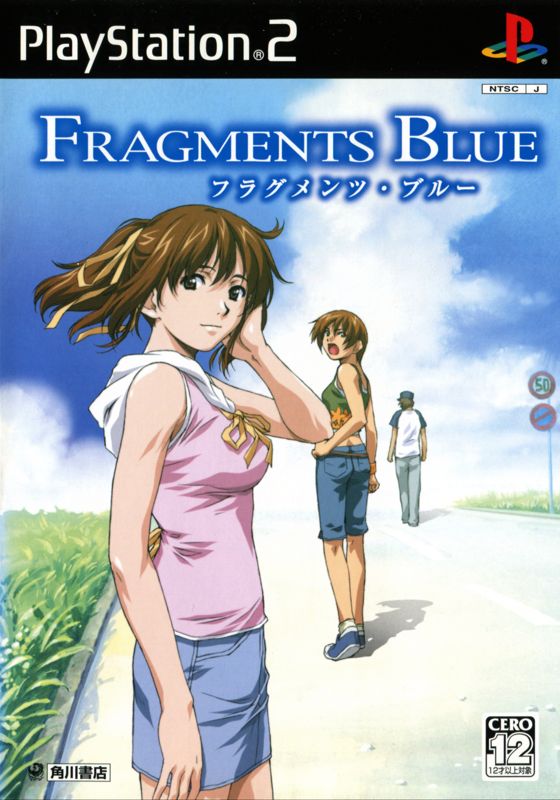
Lightly animated illustrations carry the major scenes, with Kaname, Momoka, and Natsune at the center of a distinctly anime-styled cast. The voiced dialogue and character art suit a story built on close relationships and uneasy recollection, letting a conversation hold attention even when the mystery has not yet produced a fresh lead.
Story
The premise does a lot of heavy lifting, and it earns that responsibility. A dead friend’s letter is an inherently dramatic starting point, but Fragments Blue gives it useful emotional context through Chika’s failed heart transplant and Momoka’s connection to her. Kaname, Momoka, and Natsune begin without an explanation, which puts you in the right position: curious, suspicious, and aware that every answer may hurt someone.
What makes the setup promising is that the mystery is rooted in memory as much as fact. The instruction refers to where Chika fell, while the letter itself challenges the group’s understanding of what happened and who could have sent it. That is a strong engine for a visual novel, where careful wording and the gradual accumulation of information can matter as much as a dramatic reveal.
The branching endings give the story replay value, but they also make your choices feel consequential within a narrative that already hinges on interpretation. If you like mysteries that invite you to revisit scenes and wonder whether a different answer or piece of evidence would lead somewhere else, Fragments Blue has the right kind of structure. It is especially easy to recommend to anyone who enjoys a supernatural-tinged question without needing the game to abandon its intimate character focus.
Overall Experience
Fragments Blue is a good fit when you want a compact-feeling mystery to settle into, not an action-heavy adventure to master. Its strongest asset is the personal nature of its question: Kaname is not chasing an anonymous culprit, but trying to understand a message from someone he lost, beside the sister left behind. That gives even its straightforward investigative moments an emotional charge.
The payoff depends on your willingness to read attentively. You will spend far more time with dialogue and decisions than with active problem-solving, and the investigation elements work as accents rather than the whole meal. Yet the log and evidence choices keep you engaged enough that the branching structure does not feel like empty route selection.
Give it a chance if you want a voiced anime mystery where clues, relationships, and alternate conclusions share the spotlight. Skip it only if you need constant mechanical challenge. For everyone else, the anonymous letter and tiny key are a sturdy invitation to follow Kaname into a mystery that knows grief is often the hardest clue to interpret.
Reviews
There are no reviews yet.