 Retro Replay Retro Replay gaming reviews, news, emulation, geek stuff and more!
Retro Replay Review
Gameplay
The early pull comes from how quickly Pink Pong gets you into a rally. You move only left and right with the stick, while the face buttons handle different kinds of returns. That stripped-down setup is inviting: instead of learning a dense simulation, you are immediately trying to time shots, cover the table, and keep pressure on the opponent. It is table tennis reduced to a direct arcade-like rhythm.
Shoulder-button special moves add a useful wrinkle, though their recharge requirement keeps them from becoming a panic-button solution. You have to decide whether a charged move is worth spending now or saving for a more important moment. That small resource-management layer gives matches more texture than the basic controls initially suggest, especially once you stop treating every rally as a race to hit the ball back.
Dramatic mode is where the game has the strongest reason to keep you playing solo. Pick a character and work through a story against a sequence of opponents, with additional characters, costumes, and items opening up along the way. The reward loop is concrete and sensible: winning matches expands the toy box. Free mode is there for a quick computer match, Practice offers room to get comfortable with the options, and two-player Versus is likely the cleanest test of whether the fundamentals hold your interest without unlocks dangling in front of you.
Still, this is not a game for anyone demanding a serious sporting challenge first and foremost. Its controls sound accessible rather than richly nuanced, and much of the long-term hook rests on progressing through Dramatic mode and collecting extras. Go in wanting a breezy, oddball table tennis game with some tactical seasoning from specials, not a full-scale simulation.
Graphics
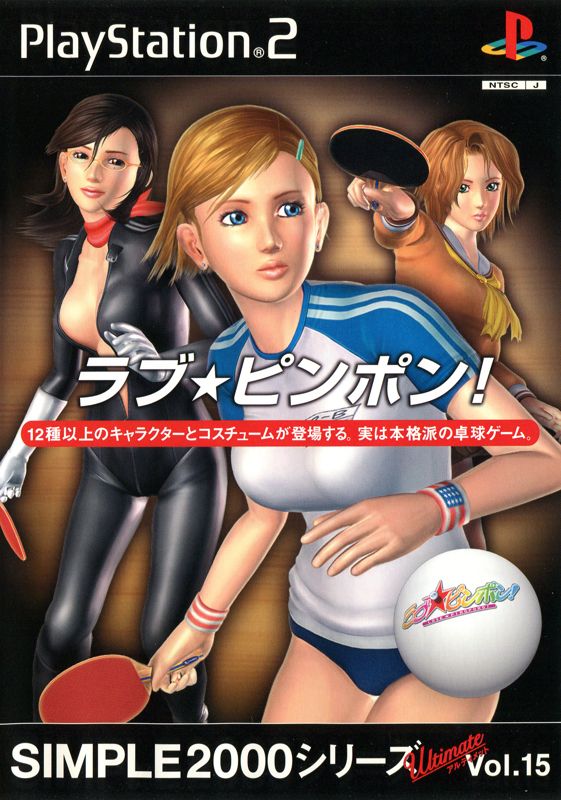
This is a 3D PlayStation 2 game built around an all-female cast, with character costumes and items taking center stage. View mode lets you put any available outfit on a character, watch animations, hear voice clips, and browse bios, making the models and wardrobe a major part of what you are collecting rather than a minor unlock-screen bonus.
Story
Dramatic mode gives each selected character a single-player route through a run of opponents. That is a modest story framework, but it does more than simply place a tournament bracket in front of you: it makes character choice part of the progression and turns each cleared match into another step toward unlocking more of the roster and wardrobe.
Do not expect the narrative side to carry the game on its own. The stated structure is a character-led series of matches, and the real motivation is the combination of seeing a route through and earning its rewards. For this kind of game, that may be enough; the story is a reason to continue playing, not the reason you will remember it.
The cast is sizable for such a focused sports title, reaching 13 characters once unlockables are included. Their bios and voice clips give you a little extra material to browse in View mode, but the stronger draw is choosing a favorite and taking them through Dramatic mode rather than treating the cast as a deeply developed ensemble.
Overall Experience
Pink Pong is a niche game that knows exactly where it wants your attention: quick table tennis, character progression, costumes, and a knowingly sexualized all-female cast. That mix will be immediately off-putting for some gamers, and it is fair to say the game lives or dies on whether you can enjoy that framing. The sports portion has a clear, approachable control scheme, but it is not separated from the fan-service-heavy package around it.
There is more substance here than the title’s reputation might imply. Four modes cover solo progression, quick computer matches, practice, and local competition, while unlockable characters, items, and dozens of costumes give Dramatic mode a tangible payoff. The inclusion of Practice is especially welcome in a game where learning shot choices and knowing when to spend a rechargeable special could make the difference between merely batting the ball around and actually engaging with its systems.
Give it a chance if you have affection for unusual PS2-era Japanese games and want an uncomplicated competitive sports game wrapped in a collectible character package. Skip it if your priority is realistic table tennis, a story with real dramatic weight, or a sports game whose tone stays focused on the competition. For the right audience, it is a curious little time capsule with a more structured loop than its provocative premise suggests.

Reviews
There are no reviews yet.