 Retro Replay Retro Gaming History, Reviews & Emulation



Retro Replay Review
Gameplay
The first hour has an immediate, slightly mischievous pull. Workers are steadily carrying materials around the tower, and you are not building defenses or commanding an army—you are choosing the right moment to ruin their progress with divine force. That directness makes Babel Rising 3D easy to understand: spot the laborers, spend power, stop construction.
The useful wrinkle is the mission-by-mission loadout. You bring two of the four elements—earth, fire, water, and wind—and select three powers for each: a local power, a trail power, and an ultimate. This means you cannot simply lean on every answer at once. A loadout choice matters more once resistance appears, and it gives repeat attempts a little room for thought rather than turning every stage into the same bout of indiscriminate smiting.
Mana management is where the game starts to click. Local and trail powers draw from mana that refills over time, and each power has three levels. Firing off lower-level attacks can keep the pressure on, but waiting for full mana unlocks the strongest version and invites a more patient rhythm. Meanwhile, striking workers with those basic powers builds fury for ultimates. You are constantly weighing immediate control against a larger payoff.
That rhythm can also be the source of frustration. More powerful moves cost more mana and naturally arrive less often, so bad timing can leave you watching workers continue their climb while your best answer recharges. Priests sharpen that problem: each is immune to an element and can protect nearby workers from that same element. When they show up, blindly repeating a favorite power stops working. You need to pay attention to the element you brought and redirect your attacks accordingly.
It is not a deep strategy epic, but it understands the value of short-term decisions. The enjoyable part is not merely killing workers; it is getting a clean chain of basic attacks, building fury, and choosing when to cash in a large effect. If you want tower defense structure without the usual construction phase, this is a decent, brisk alternative. If you need elaborate long-term planning, the limited elemental toolkit may wear thin.
Graphics
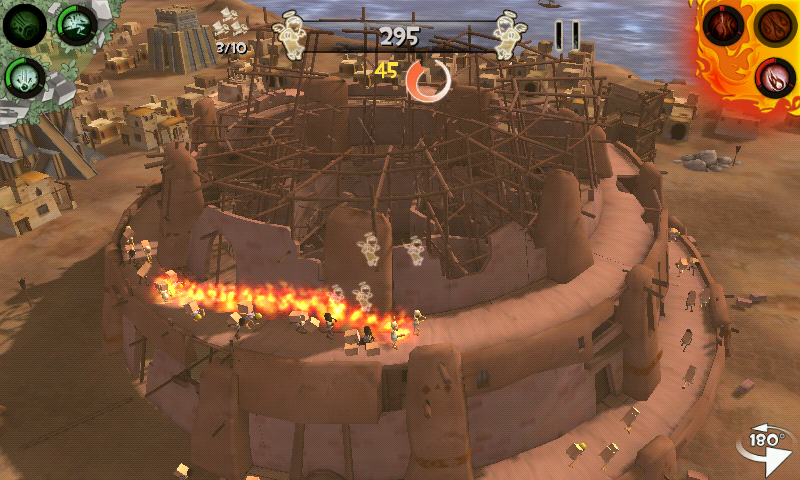
The action centers on a spiralling Tower of Babel packed with workers hauling building material upward. That clear setup gives you a practical view of the problem: the laborers have a route and a destination, so it is easy to understand what your attacks are trying to interrupt.
Priests stand apart from ordinary workers through their tactical role, since their elemental immunity and protection aura make them threats you must account for rather than just more bodies on the tower.
Story
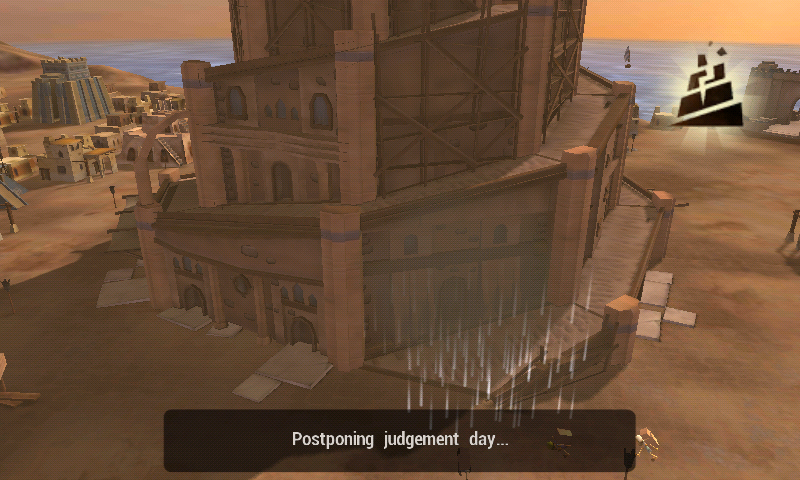
Babel Rising 3D uses the Tower of Babel as a clean excuse for divine sabotage. The Babylonians want to finish a structure that reaches heaven; you take the role of God and stop them before they can do it. It is a premise built for conflict, and the game sensibly gets to the point.
Do not come in expecting a story-heavy sequel. The narrative exists to frame each mission’s destruction, not to compete with the action for attention. In practice, the tower’s ascent is the story you are tracking: workers make progress, and you try to erase it.
That simplicity works because the theme matches the play. Calling down earth, fire, water, or wind on a construction project feels appropriately mythic, while the priests provide a natural religious counterweight to your power. The fiction is thin, but it is coherent and never distracts from the central game of preventing the tower from being completed.
Overall Experience
Babel Rising 3D is a modest but clever reversal of tower defense. Instead of preparing a maze and watching it work, you are the active hazard, spending resources and reacting to a stream of construction workers. That switch is enough to make the game memorable when its mana-and-fury loop is humming.
Its strongest design choice is making power feel conditional. Choosing only two elements keeps missions from becoming a full arsenal fantasy, mana limits prevent constant use of your biggest attacks, and priests punish one-note elemental play. The result asks for more awareness than its straightforward objective initially suggests.
The downside is that the same constraints can make its action feel narrow over time. Much of the tension comes from waiting for mana, building fury, and finding the right elemental response, so your enjoyment depends on whether that compact loop stays satisfying for you. There is no grand strategic layer implied by the premise; the focus stays on moment-to-moment intervention.
Still, there is real fun in being the obstacle rather than the architect. Give it a chance if you want a contained action-strategy game with a playful biblical setup and like making quick resource calls under pressure. It earns its payoff in those moments when a carefully timed set of powers halts a climbing workforce just before the tower advances.


Reviews
There are no reviews yet.