 Retro Replay Retro Gaming History, Reviews & Emulation
Retro Replay Review
Gameplay
Child of Light begins like a gentle 2D fantasy adventure, with Aurora running, jumping, and eventually flying through Lemuria, but it has more tactical bite than that first impression suggests. The four major areas invite detours rather than forcing a straight line, and returning to earlier locations for missed items gives the world a welcome sense of openness. Environmental puzzles are usually about getting past hazards or clearing an obstruction, which keeps exploration moving without turning every room into a long brain teaser.
Igniculus is the small idea that makes the whole structure click. You can control the firefly yourself or hand that role to a second player, and his ability to light dark spaces, activate light-sensitive switches, collect unreachable objects, and help Aurora slip past staggered enemies gives exploration a cooperative rhythm. He is useful rather than ornamental, so even solo play asks you to think about positioning both characters.
The turn-based combat is where Child of Light becomes genuinely engaging. Portraits advance along a timeline, and selecting an action as a character reaches the casting portion means committing to an attack, spell, defense, or item while remaining vulnerable to interruption. Landing an interrupt before an enemy finishes a dangerous move feels great, while having your own carefully chosen action stopped can be a sharp lesson in paying attention. Two active party members may sound limiting, but free swapping keeps the wider cast relevant.
Later fights add enough buffs, debuffs, counters, weaknesses, and Oculi customization to keep the battle system from flattening out. Characters level up through skill trees, and collecting wishes restores resources between encounters, so there is a pleasing loop between wandering and preparing for the next fight. If you want a brisker challenge, increasing battle speed is a welcome option, and New Game Plus gives the adventure some replay value once the credits roll.
Graphics
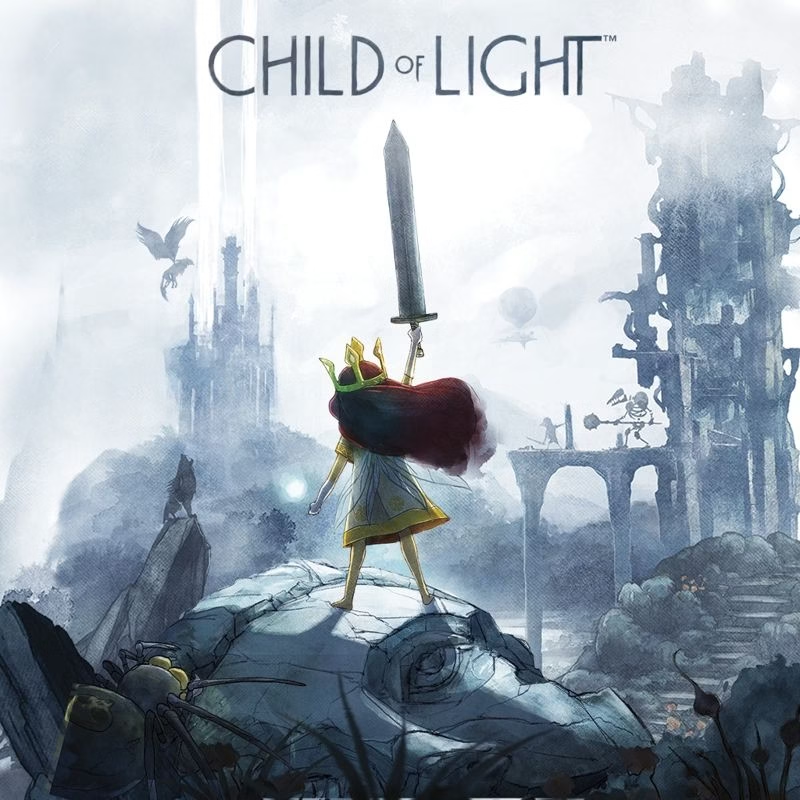
Lemuria is painted in soft watercolors, giving its side-view landscapes a delicate, storybook look. The hand-painted scenery is the game’s clearest visual strength: it makes Aurora’s journey feel airy and dreamlike instead of like a standard grim fantasy quest.
Story
Aurora’s premise is immediately melancholy. She is the daughter of an Austrian duke who dies on the night of his remarriage, wakes in the fantasy kingdom of Lemuria, and learns that the Queen of the Night has kept her there. Her route home requires recovering the stolen sun, moon, and stars, a suitably grand goal for a girl thrown into an unfamiliar world.
The story works best as a fable about a young heroine finding her footing. Aurora is not traveling alone for long, since Igniculus becomes her constant companion and other characters can join the party through quests and decisions. That expanding group gives the journey a sense of company without losing Aurora as its center.
Every character speaks in verse, which is a bold choice and one you will either find charming or a little precious. It fits the fairy-tale framing and gives conversations a distinct cadence, though it can make even simple exchanges feel more formal than they need to be. If you enjoy lyrical fantasy, it is a major part of the charm rather than a hurdle.
Overall Experience
Child of Light succeeds because its prettiness is backed by a combat system that asks you to stay alert. The exploration is approachable, the puzzles break up the travel nicely, and the timeline battles make ordinary encounters more involved than they first appear. It is a game that feels inviting without being mindless.
Frustration can set in when the later systems begin piling up, particularly if you prefer RPGs with fewer moving parts. Yet the extra mechanics have a purpose: they make party selection, Oculi assignments, and action timing matter as enemies become more demanding. The game does not need overwhelming scale when its core decisions are this satisfying.
Give Child of Light a chance if you want an RPG that balances a tender fairy-tale journey with deliberate, interruption-focused combat. The watercolor world and rhyming dialogue will carry a lot of the initial attraction, but the payoff is learning how much control you have over a battle once you understand its timing. It is an especially easy recommendation for a pair of friends who want to share the adventure through Aurora and Igniculus.


Reviews
There are no reviews yet.