 Retro Replay Retro Gaming History, Reviews & Emulation


Retro Replay Review
Gameplay
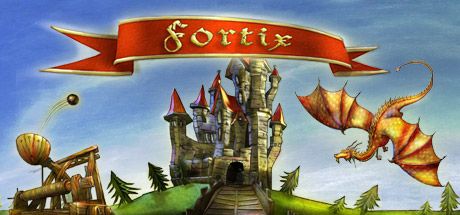
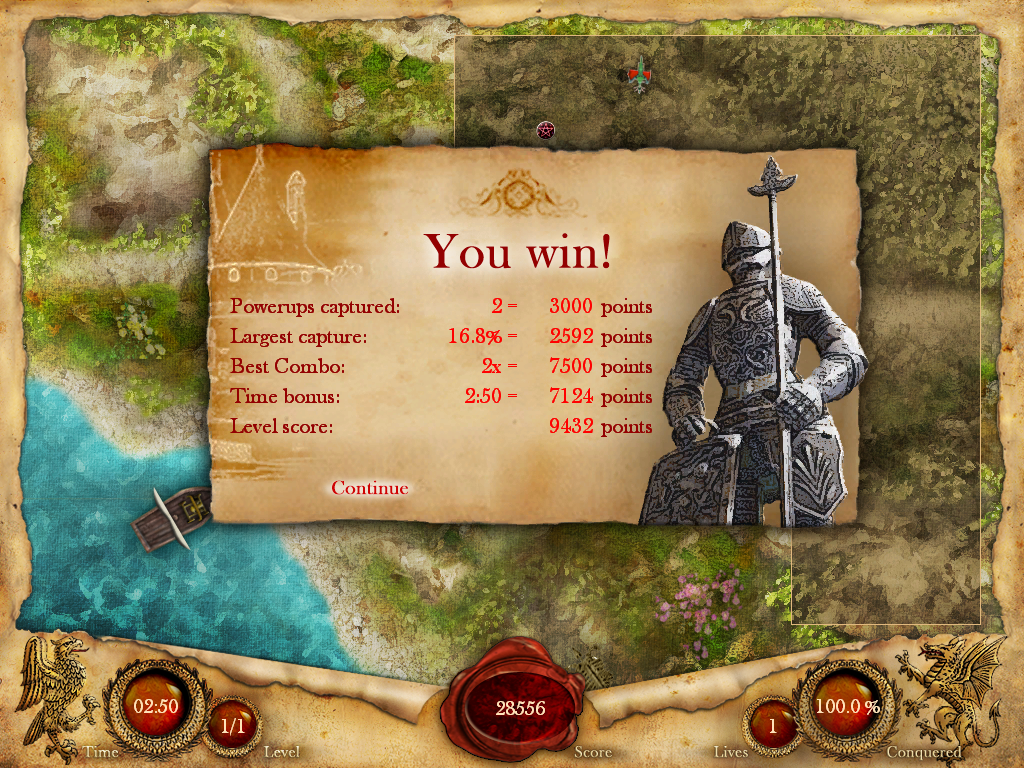
The first few minutes of Fortix are wonderfully direct. You move Knight Fortix around a level’s outer boundary in safety, then deliberately leave that line to claim a chunk of land. Until you reconnect with the base line, you are exposed, and that simple risk makes every route feel like a small gamble. Cut off a dragon or an enemy building inside your newly claimed territory and it is removed, delivering the satisfying snap of a clean board-control win.
It is a strong use of the old Qix template because the game gives your route planning a few more concerns than raw land-grabbing. Dragons come with different capabilities, towers fire pellets when you leave the safe boundary, and walls force you to find a viable path instead of drawing the most obvious line. Catapults are particularly useful problem-solvers: encircle a halberd icon to activate one, then use it to destroy its matching tower. You can also remove towers by claiming the ground beneath them, so there is usually a choice between a careful setup and a bolder territorial cut.
Terrain is where the pressure can turn into frustration. Grass lets you move quickly, while water and swamps slow you down, which matters enormously when danger is bearing down on an unfinished line. Power-ups can improve your speed or freeze monsters briefly, and they are worth pursuing when they sit in a practical spot. Still, the basics never stop being the whole game: judge distance, choose a route, and do not overextend. If you enjoy repeatedly refining that decision under pressure, the twelve shires have a steady arcade pull. If you need a constantly expanding set of ideas, the formula may feel thin before the kingdom is reclaimed.
Graphics
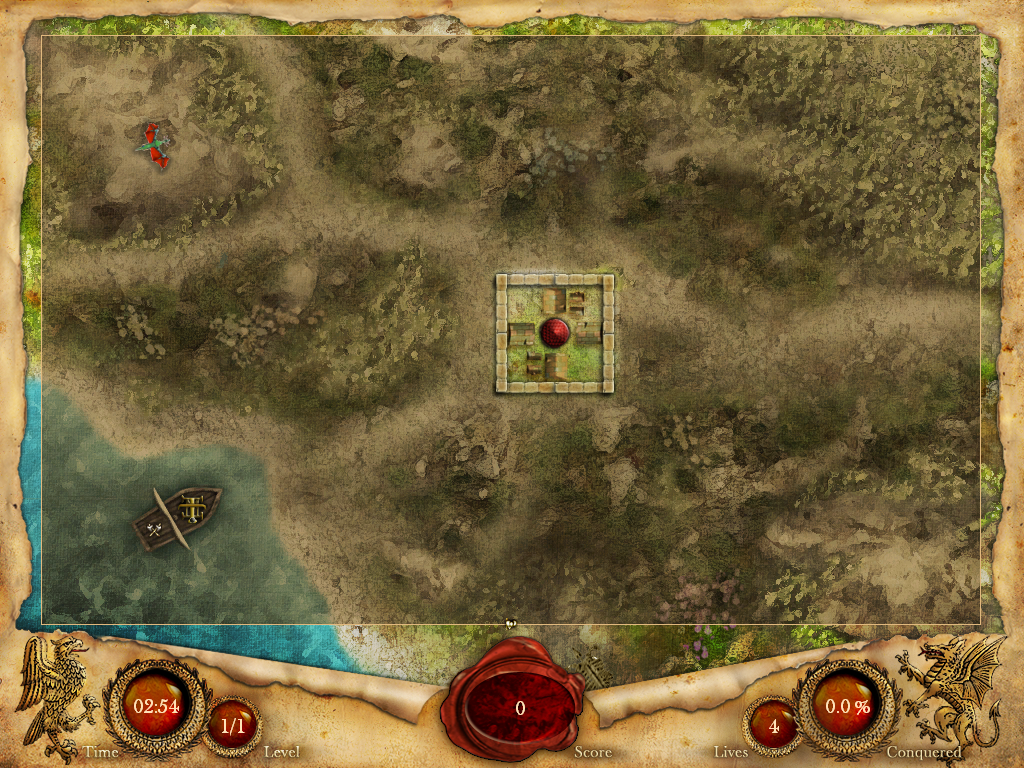
The top-down playfields keep the action clear: Knight Fortix traces his boundary across grass, water, swamps, and impassable walls while dragons, towers, enemy buildings, halberd icons, and catapults mark the threats and opportunities. The medieval-fantasy framing fits the land-reclaiming premise, and the fixed battle screens make it easy to see the territory you have secured and the dangerous open ground still ahead.
Story
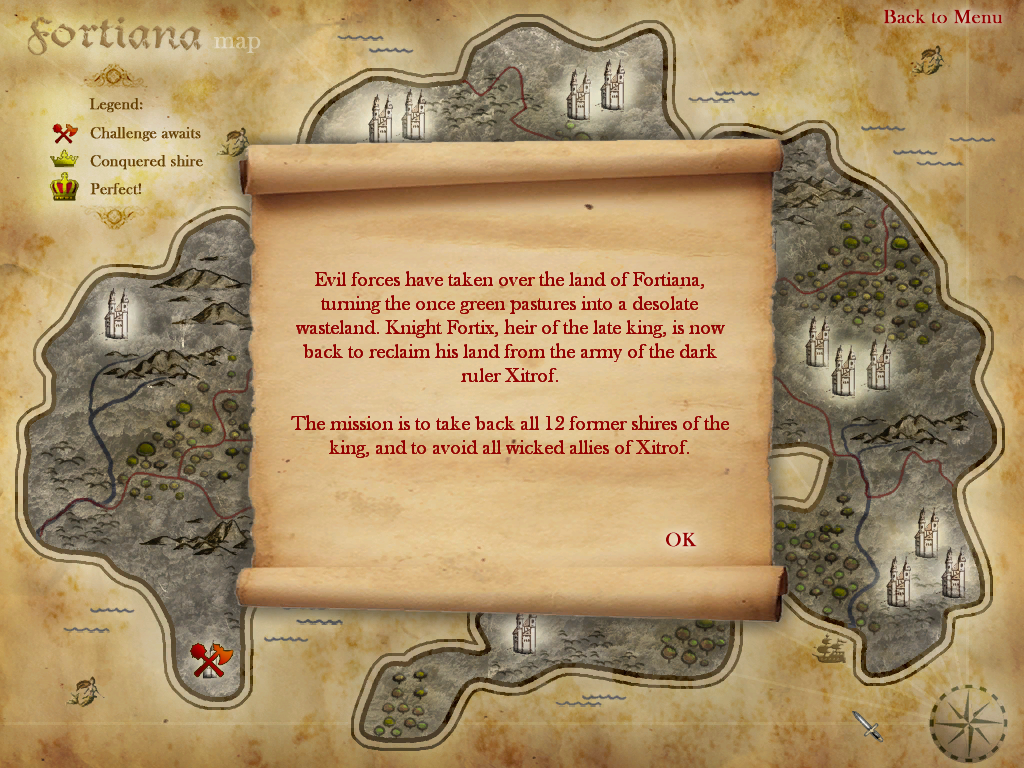
The story is a straightforward excuse to conquer map after map. Evil forces have reduced Fortiana to a wasteland, and you take the role of Knight Fortix, heir to the late king, fighting to reclaim the land from its dark ruler. It is broad fantasy rather than a character-driven adventure, but it gives the territory-capture loop a more purposeful frame than abstract shapes on a blank field.
Each of the twelve shires functions as another piece of that recovery effort. Enemy buildings make the objective concrete: you are not merely filling space for a percentage, but cutting hostile strongholds off from the remaining board. That is enough context to make a well-planned encirclement feel like a victory, even if the narrative is not where the game earns its keep.
Do not come in expecting a deep tale of Fortiana or a detailed portrait of its hero. The story stays in the background and lets the action carry the momentum. For this sort of compact arcade-puzzle game, that restraint is reasonable; the important drama happens when your line is one short stretch away from safety.
Overall Experience
Fortix is a decent, focused Qix-style game with a fantasy coat that actually affects how you play. Towers, catapults, varied terrain, walls, dragons, and power-ups create enough situational wrinkles that you cannot solve every shire with the same reckless perimeter dive. Its best moments are tense and clean: you spot a route around a wall, take a risky cut through slow terrain, and close the loop with an enemy building trapped inside.
The limitation is equally clear. Most of the enjoyment rests on your appetite for this one kind of tension, and the harsher terrain can make the game feel stubborn when movement speed works against a route you thought was safe. There is little room to hide if the core act of drawing vulnerable lines does not grab you.
Give it a chance if you like old-school arcade puzzle games that reward nerve and spatial planning more than elaborate systems. At a 6.7 level, it is easy to recommend with a qualifier: Fortix is not a reinvention, but it is a solid medieval-flavored take on a durable idea, and the payoff is there whenever a risky claim clears a troublesome part of the board.



Reviews
There are no reviews yet.