 Retro Replay Retro Gaming History, Reviews & Emulation



Retro Replay Review
Gameplay
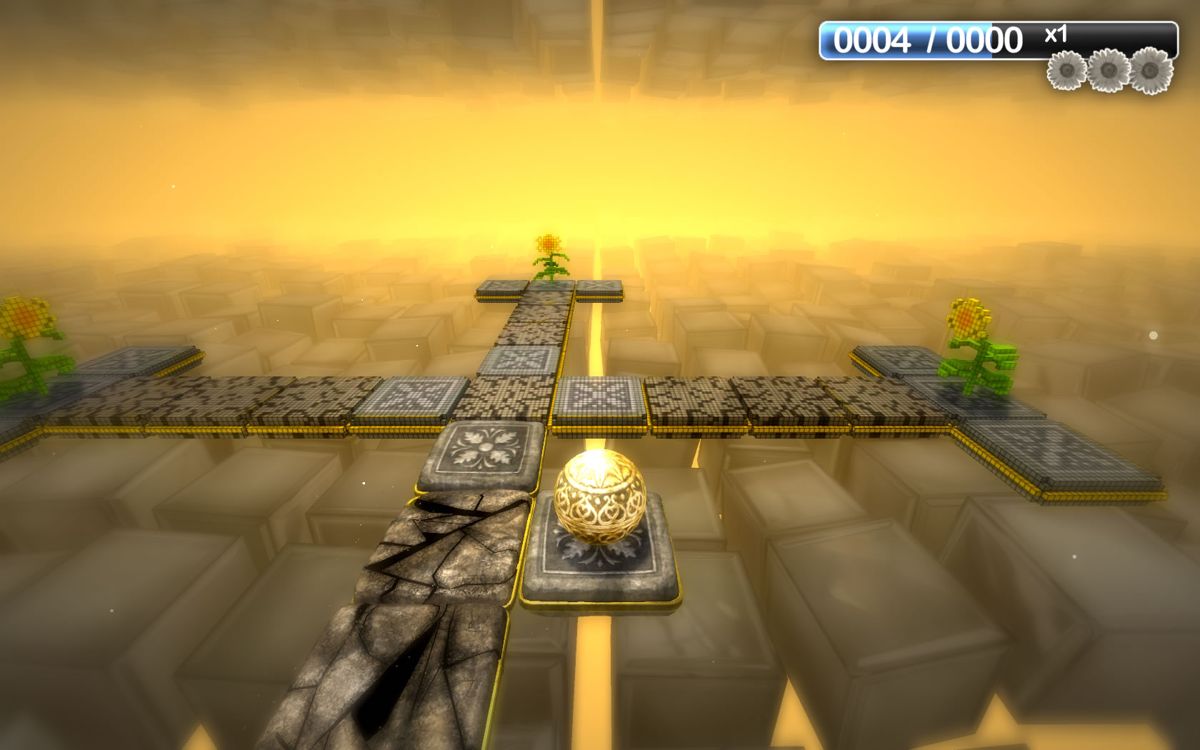
Puzzle Dimension feels inviting for about five minutes, then reveals that it has been quietly teaching you to think in three dimensions. You roll a ball around floating structures, collect every flower, and activate the exit portal. Early courses are simple enough to establish the rhythm, but the twist arrives when rolling up a slope rotates the whole puzzle with the ball. What looked like a wall becomes a floor, and the route you had dismissed suddenly matters.
That gravity trick is more than a novelty. It makes each puzzle feel like a small object you are learning to turn over in your head. Rotating the camera and using the mode that lets you inspect the entire structure are essential rather than optional niceties; use them before committing to a risky route. The game rewards the moment you pause, trace a path through several orientations, and realize that the solution was never on the surface you started on.
Tile hazards keep that thought process tense. Crumbling blocks, tiles that ignite, and frictionless surfaces can make a retreat impossible, so collecting a nearby flower is not always the obvious correct move. The ball can jump over a tile, which gives you a useful escape valve without turning every route into a shortcut. Frustration can set in when a promising attempt dies because you failed to account for how a tile behaves after the structure rotates, but that is also where the puzzles gain their bite.
The 100 puzzles are split into ten clusters, and new block types continue to change the questions the game asks. You do not need to finish every puzzle to open another cluster, provided you have collected enough flowers, which is a smart concession in a game this demanding. It lets you leave one brain-bender behind for a while instead of turning a single stubborn level into a hard stop.

Graphics
The courses begin in chunky pixel-block form and become more detailed as you advance through a puzzle. That shift gives successful progress a pleasing sense of momentum, while the four unlockable themes let you replay any level with a different graphical look. The camera tools are especially welcome because these floating structures can become genuinely tangled later on.

Story
Puzzle Dimension does not lean on a character-driven tale to push you forward. Its sense of progression comes from clearing clusters, gathering flowers, and opening the next set of spatial problems. That is the right call: the real drama is the instant a rotating structure reveals a route you had not seen.
Each level supplies its own tiny arc. You begin with an apparently manageable shape, discover that its surfaces change meaning as gravity shifts, and either find a clean route to the portal or restart with a better plan. It is spare, but it gives every solved board a satisfying beginning, complication, and payoff.
If you want dialogue, lore, or big narrative turns, this will not be the reason to play. Come for the quieter kind of story a puzzle game can tell: your growing ability to look at the same object from a new angle and finally understand it.
Overall Experience
Puzzle Dimension is a strong puzzle game because its central idea keeps producing new consequences. Rotating gravity could have been a single clever gimmick, but the changing tiles, jump, and increasingly involved structures turn it into a language you gradually learn to speak. The first hour hooks you with accessible shapes; the later clusters ask for real spatial discipline.
The audiovisual progression is a nice match for that climb. As blocks move from pixelated forms toward more detailed ones, the music blends 8-bit sounds with fuller tunes. It is a small but fitting reward for pushing deeper into a level, and it helps the game retain personality across a large puzzle count.
Give it a chance if you enjoy games that reward observation over reflexes and do not mind sitting with a problem until the geometry clicks. The flexible unlock structure softens the rougher edges, while the best solutions deliver exactly the satisfying snap you want from this kind of 3D brainteaser. It is demanding without being needlessly punishing, and its 100 puzzles give the central gravity idea plenty of room to prove itself.


Reviews
There are no reviews yet.