 Retro Replay Retro Gaming History, Reviews & Emulation

Retro Replay Review
Gameplay
The first hour understands exactly why eating furniture, yard clutter, and other bits of a world is fun. You begin as a tiny blob that can only absorb small objects, and every increase in size immediately changes what looks like a route forward. That constant recalculation gives the platforming a playful rhythm. A blocked path is rarely just a wall. It is usually a hint that you need to find something edible, carry the right object, or make better use of what is already in your belly.
Jumping, absorbing, and spitting objects are simple inputs, but the game gets more interesting when it asks you to pull swallowed items back toward the blob. That turns collected junk into puzzle tools rather than disposable fuel. Magnetic and electric powers add another worthwhile layer, letting you work with metal objects and machines instead of merely growing past every problem. The best moments come when size, object placement, and a power interact in a single obstacle, because you feel like you are improvising with a very weird cartoon monster.
These are designed levels, not a free-roaming world, and that is both the strength and the limit. You move from one crafted puzzle-platforming situation to the next, with speed and collection targets providing reasons to revisit stages. If you want a huge adventure or an endless physics sandbox, the structure may feel too tidy. If you enjoy games that introduce a toy, twist it a few times, and move on before it gets stale, this is a satisfying length.
Local co-op is more than an extra body on screen. Two blobs can pass objects between one another, which creates opportunities for cooperative solutions that fit the game’s central ideas. It is a good choice for a couch session with someone willing to communicate and occasionally laugh at a piece of junk bouncing into the wrong place. Solo play remains the cleaner recommendation if you want to work through the puzzles at your own pace.
Graphics
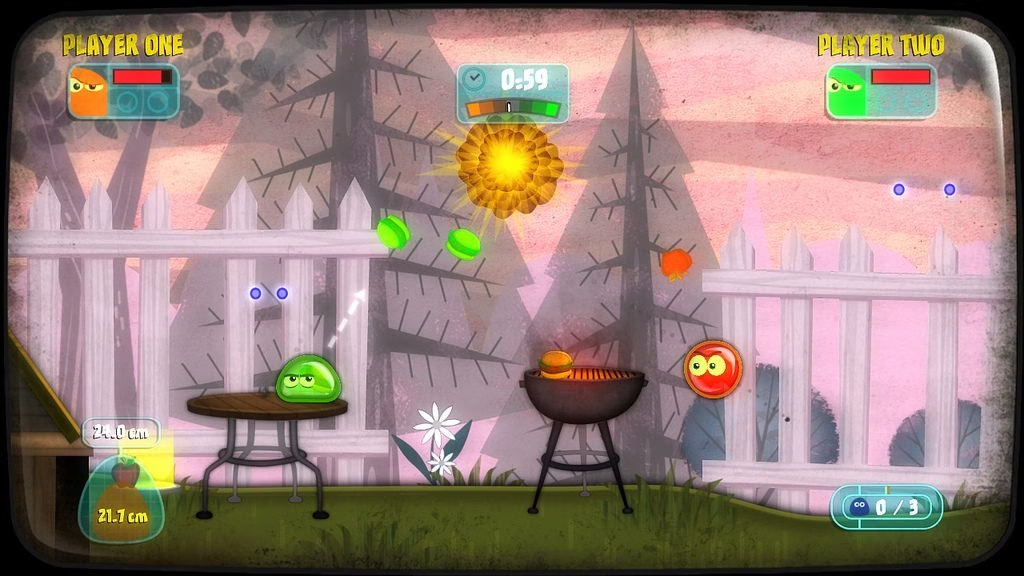
The game uses a deliberately flat, stylized look framed inside a rounded old television screen. In its suburban stages, muted grass, white picket fences, angular gray trees, and pink skies sit behind brightly shaded blobs that are easy to spot at a glance. A green blob’s sleepy eyes give it more personality than its simple shape should manage, while an orange partner pops clearly against the scenery.
The scenery has less depth than the blobs and objects flying around them, which can make the world feel more like a playful diorama than a richly detailed place. That suits the light monster-movie tone, even if it will not win over anyone who wants lavish environments.
Story
This is a monster movie setup, not a character drama. Alien blobs land on an Earth-like planet and start eating objects smaller than themselves, which is all the excuse the game needs to turn growth into the joke and the objective. The premise is silly in the right way: you are not asked to agonize over why a blob is swallowing the neighborhood when doing so is plainly the point.
Humor frames the action without hijacking it. The game keeps its attention on the next obstacle, the next larger mouthful, and the next contraption that needs manipulating. That pacing is a relief if you have little patience for platformers that stop constantly to explain themselves.
Do not come in hoping for a long narrative payoff. The real throughline is the evolving puzzle language, with the monster-movie wrapper giving the levels a consistent, amusing context. It is enough personality to make the action feel memorable, but the story stays intentionally lightweight.
Overall Experience
Tales from Space: About a Blob succeeds because it finds several useful variations on one absurd idea instead of trying to make that idea carry everything by itself. Growing matters, but so does what you swallowed, where you spit it, and how later powers change your options. The result is a brisk puzzle-platformer that feels more thoughtfully built than its goofy title suggests.
It has a distant cousin in Gish, another unusual blob-led physics platformer, but DrinkBox’s game is more focused on authored growth puzzles and object manipulation. You can see the original pitch for its growth, powers, and cooperative play in DrinkBox’s original game announcement. That focus makes it easy to recommend to anyone who enjoys puzzle-platformers with a clear mechanical hook.
Frustration is most likely to set in if you want freedom rather than direction, or if repeatable challenge targets feel like chores rather than invitations. Otherwise, the payoff is worth it. The game does not stretch its premise into a sprawling quest. It gives you a compact run of increasingly clever problems, lets you become a bigger nuisance with each solution, and gets out before the joke wears thin.


Reviews
There are no reviews yet.