 Retro Replay Retro Gaming History, Reviews & Emulation
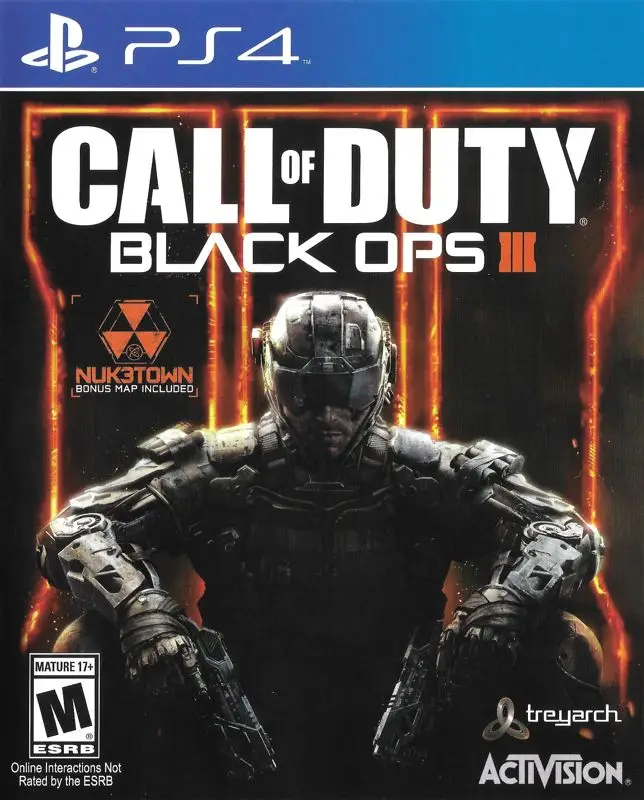
Game Overview
Gameplay
Black Ops III immediately asks you to move differently. Wallruns, boosted jumps, and powerslides make firefights feel less like a cautious march down a shooting gallery and more like a scramble to claim better angles before the other side does. At first, you may spend more time colliding with geometry than looking cool, especially if you come from older Call of Duty games. Stick with it. Once movement becomes instinct, crossing a lane, escaping pressure, or arriving above an enemy position has a satisfying speed that conventional boots-on-the-ground shooting cannot match.
The campaign has more room to breathe than many Call of Duty campaigns, and its co-op support makes that length easier to enjoy with friends. Cyber Cores add a meaningful layer to familiar gunplay, whether you are sending out decoys, disrupting robots, using swarms to occupy enemies, or leaning into boosts to strength and speed. Cyber Rigs further shape how agile you feel. Only equipping one Core per loadout keeps those choices from becoming an everything-at-once power fantasy, although the pileup of futuristic abilities can make individual encounters feel busy.
Multiplayer is where the movement system gets its sharpest test. Specialists give each match recognizable personalities and distinct tactical spikes, while the returning Pick Ten approach and Gunsmith customization leave room to tune a loadout around your habits. The tradeoff is that fast traversal, killstreaks, unique Specialist weapons, and abilities create a steeper learning curve than a simpler shooter. If you enjoy learning routes and punishing predictable movement, that complexity is the point. If you want restrained, old-school Call of Duty pacing, this can feel like a noisy escalation.
Zombies is the other major reason to spend time here. Morg City, its four new characters, creature-form altars, and unlockable shortcuts give the mode a more elaborate structure than simply holding out against waves. The loadout-based abilities and power-ups add another progression layer, which can be rewarding but also pushes the mode further from its stripped-down survival roots. Freerun courses are a smart low-pressure place to practice the movement, and the unlocked Nightmare campaign offers a remixed run with zombies, random weapons, and power-ups for anyone who wants the campaign rules turned inside out.
Graphics
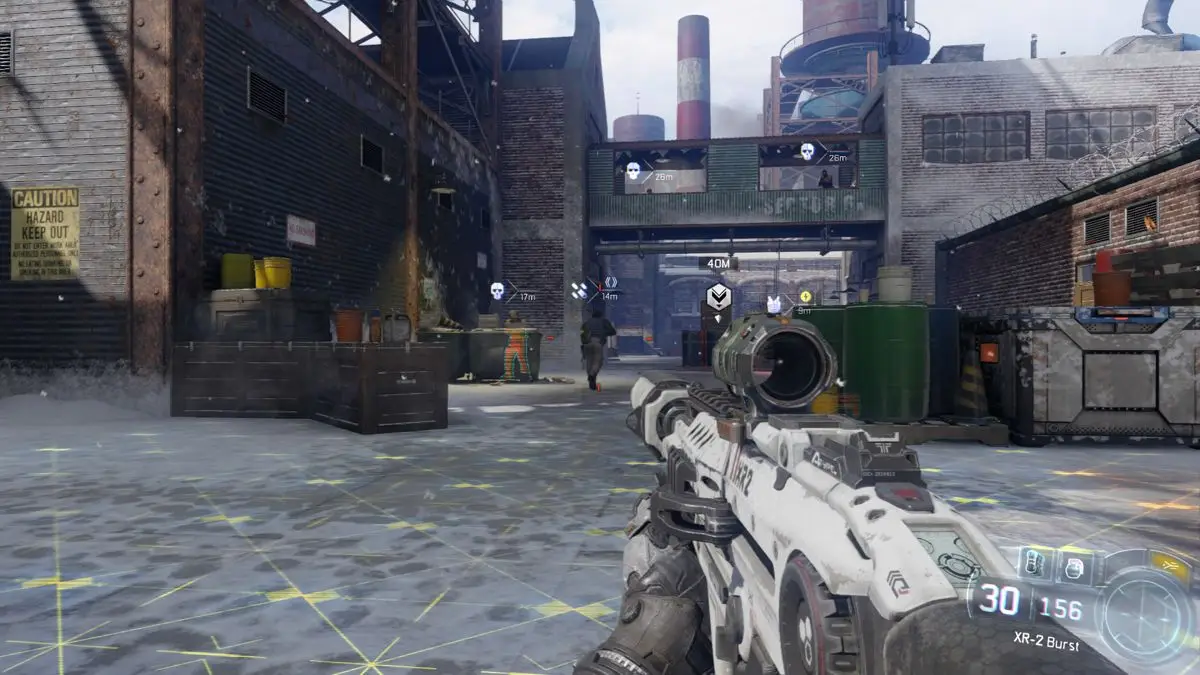
The PlayStation 4 game has a convincingly grimy near-future look in play. An industrial multiplayer yard mixes wet concrete, corrugated metal, pipes, stacked crates, and pale factory light, giving the high-tech weapons a suitably hard-edged backdrop. The first-person weapons are chunky and detailed, especially the white rifle with its large scope and mechanical panels.
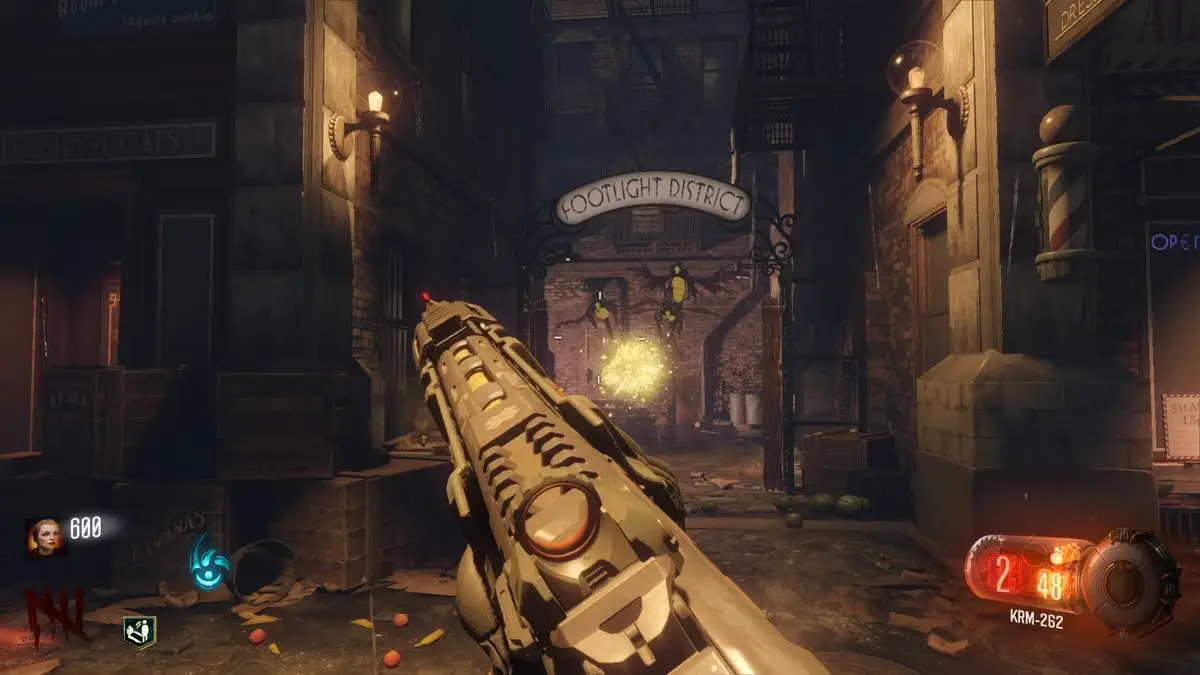
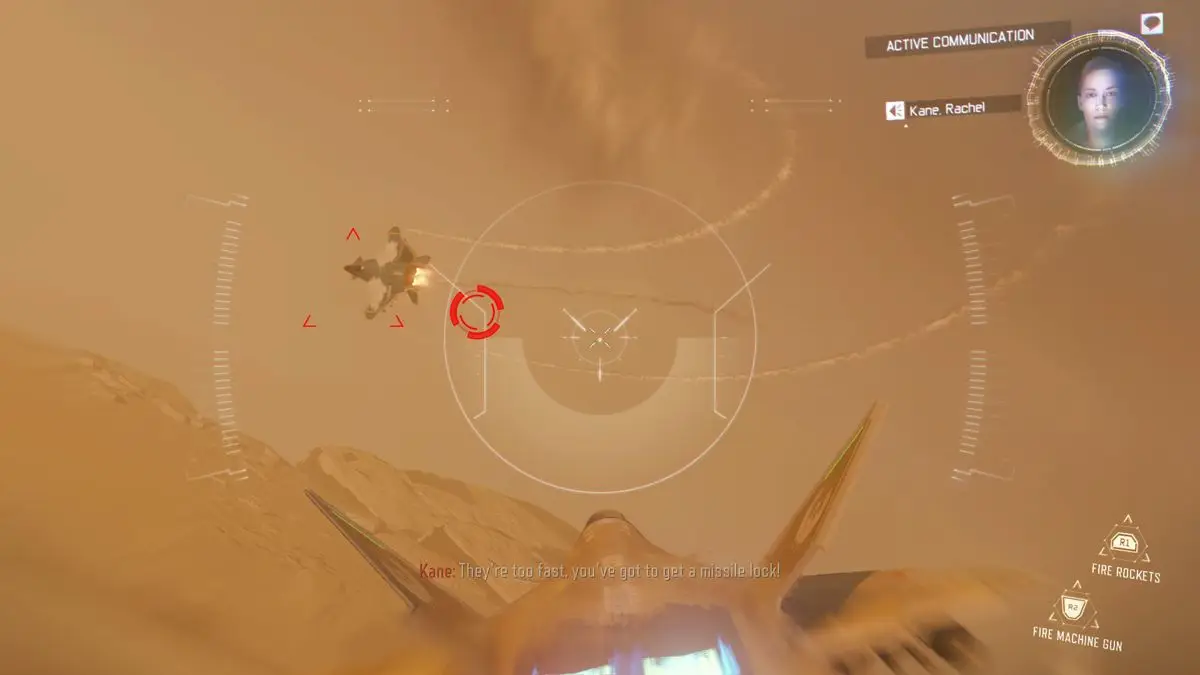
Zombies looks stronger when it leans into atmosphere: a nighttime alley is framed by warm wall lamps, dark brick facades, scattered debris, and a bright, eerie glow around an approaching enemy. The desert aerial sequence trades that density for a sand-choked orange sky, where aircraft silhouettes and missile trails cut through the haze. It is a good range of locations, though the dusty air and dense industrial scenery can sometimes make distant targets blend into the background.
Story
The story moves the Black Ops timeline into 2065 and uses the DNI, an interface that connects soldiers directly to machines and memories, to explore surveillance, cybernetic augmentation, and artificial intelligence. You and Jacob Hendricks begin after a disastrous Egypt mission, then work with CIA agent Rachel Kane through an investigation involving Corvus, Commander John Taylor, Dr. Yousef Salim, and secret experiments. It has real thematic ambition, but the indirect ties to Black Ops II and the density of its ideas can make it harder to follow than the direct momentum of the shooting. Come for a darker sci-fi campaign that wants to be strange, not for the cleanest military-thriller plot in the series.
Overall Experience
Black Ops III is an ambitious Call of Duty built around momentum. Its best moments come when the shooting, vertical movement, and future-tech powers line up and you feel like you are actively outmaneuvering an opponent rather than merely aiming faster. The campaign, competitive multiplayer, Zombies, Freerun, and Nightmare remix make it unusually packed, and they give you several routes into the game depending on what kind of night you want.
That abundance also makes the game less immediately elegant. The campaign’s big ideas can get tangled, multiplayer can be harsh before you learn how much movement matters, and Zombies asks you to absorb its own set of systems. There is a lot to process. Still, none of that feels like empty padding because the modes build on the same satisfying foundation of quick shooting and acrobatic positioning.
Give it a chance if you like Call of Duty at its most futuristic and kinetic, particularly if you have friends for campaign co-op or Zombies. The payoff is a shooter with more variety and mobility than the series usually allows itself. It is not the cleanest Black Ops package, but it is one of the more energetic and generous ones.

Reviews
There are no reviews yet.