 Retro Replay Retro Gaming History, Reviews & Emulation

Retro Replay Review
Gameplay
The first few minutes are pleasantly direct. Each Barbababy runs a separate activity tied to a favorite subject, so you can move from collecting apples with Barbazoo to assembling a picture puzzle for Barbalib without making a child wrestle with a complicated ruleset. The standard controller uses only square, triangle, X, and circle, which makes this unusually easy for small hands to understand.
The strongest activities are the ones that let you try things rather than merely react. Barbalala’s music game maps up to three chosen instruments to three buttons, with vocals on a fourth, turning the controller into a tiny live-performance toy. Barbabeau’s art activity has you choose Barbapapa or Barbamama, select a shape and a background, then watch the selected picture get painted. Neither asks for mastery, and that is exactly the point: a child can make a choice and immediately see or hear the result.
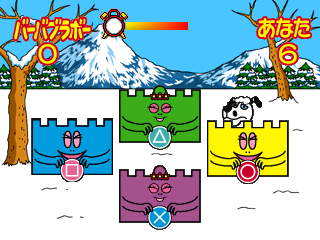
Elsewhere, Barbapapa shifts toward basic recognition and timing. Barbalib’s four-piece puzzles use the character’s transformed shape as a clue, while Barbabelle asks you to match an item with the correct word from three options. Barbabravo’s snowball fight is a clean button-recognition test: hit the displayed button when he appears, but leave the family dog alone. These are small lessons wrapped in simple games, and they work best when an adult is nearby to turn a wrong answer into a conversation rather than a setback.
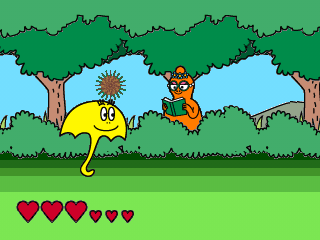
The action-oriented games add variety, though their limited goals may wear thin sooner. Barbazoo collects apples while dodging hazards in a side-scrolling stage, and Barbabright’s airplane sequence asks you to gather balloons while steering clear of vultures. They give the collection a little movement and tension, but repetition arrives quickly. You are not buying Barbapapa for escalating challenge; you are buying a friendly set of bite-size activities that a preschooler can revisit independently.

Graphics
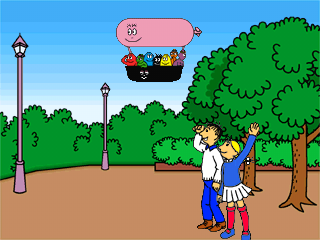
The game puts the Barbapapa family front and center, using the characters’ familiar color coding to separate the activities: yellow Barbazoo, green Barbalala, orange Barbalib, black furry Barbabeau, purple Barbabelle, blue Barbabright, and red Barbabravo. The puzzle, painting, and word activities are built around clear objects and simple choices, which fits their young audience.
The two action games change the viewpoint enough to avoid looking identical. Barbazoo’s apple hunt uses a side view, while Barbabright’s flight game looks forward over the airplane as it travels through a ravine. That contrast helps children immediately understand that they have moved on to a different kind of task.
Story
There is no large adventure pulling these games together. Instead, the family itself is the organizing idea: each Barbababy hosts an activity shaped around a personal interest such as animals, music, books, art, beauty, science, or bravery.
That light framing is enough for the target audience. A child does not need to follow a plot or remember prior events before trying something new; picking a favorite character is effectively the invitation to play.
For fans of Barbapapa, that familiar family focus is likely the main draw. Everyone else will find a very thin narrative wrapper, but it is an appropriate one for a collection designed around short educational sessions rather than storytelling.
Overall Experience
Barbapapa is a modest but sensible preschool game. It understands that young children benefit from quick feedback, few buttons, and activities that end before frustration has time to build. The spread between music-making, picture construction, word matching, and simple action also makes it more useful than a single-subject educational title.
Its weakness is equally clear: none of the seven games has much room to grow once the basic idea clicks. Older children will likely exhaust the challenges fast, and even the youngest players may settle on one or two favorites instead of returning to every mode.
If you are choosing for a young Barbapapa enthusiast or want an approachable first PlayStation game with gentle learning goals, this is an easy recommendation. Go in expecting a toy box, not a deep game, and its short, varied activities make much more sense.

Reviews
There are no reviews yet.