 Retro Replay Retro Gaming History, Reviews & Emulation

Retro Replay Review
Gameplay
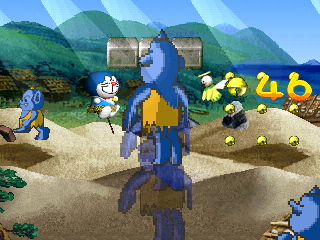
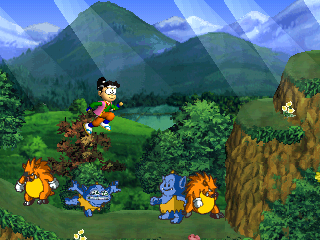
The first hour has a simple, cheerful pull: pick a fairy tale, take control of the Doraemon character assigned to it, and head into a side-scrolling rescue mission. Nobita gets to fill Momotaro’s shoes, while Shizuka takes on Little Red Riding Hood, and that changing cast gives each stage a little more personality than a straight run through six anonymous levels would have managed.
The strongest structural decision is letting you play the first five stages in any order. If one tale or character sounds more fun, you can start there instead of being forced through a prescribed sequence. For a game aimed at Doraemon fans and younger platform-game players, that freedom is welcoming: you can treat the campaign like a shelf of storybooks and pull down the one you want.
Each stage is divided into several sections and ends with at least one boss battle, so there is a proper sense of progress rather than a series of tiny themed cameos. The trade-off is that the game is plainly concise. Five selectable stages and one unlockable final stage make for a focused afternoon-sized adventure, and anyone wanting a long, demanding platformer will likely reach the end before it has time to grow much bigger.
Still, the sixth stage gives clearing every initial route a worthwhile finish line. Doraemon 2 works best when you meet it at its own scale: a light, orderly platform game where the pleasure comes from seeing the cast travel through fairy-tale scenarios, not from mastering an enormous gauntlet.
Graphics
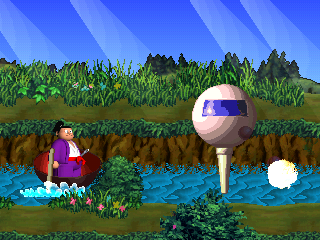
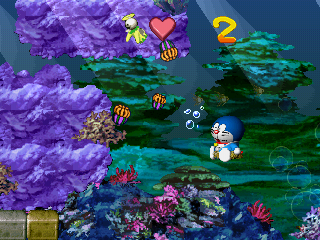
The game uses a side-view, side-scrolling format and draws on Doraemon’s anime and manga roots. Its fairy-tale-based stages give the journey a natural storybook variety, while the rotating playable cast keeps the familiar characters in view rather than leaving the action centered on only one hero.
Story
This is one of those licensed-game premises that immediately fits its source. Doraemon brings a giant television from the future so Nobita and friends can watch famous fairy tales, only for them to discover that the tales’ heroes have been captured by an evil demon. It is a clean excuse to turn the cast loose across storybook worlds without losing the playful, child-friendly Doraemon tone.
Doraemon’s device transforms the friends into the appropriate fairy-tale heroes, and that is more than a throwaway setup. It gives each stage its own role-playing flavor: Nobita as Momotaro and Shizuka as Little Red Riding Hood are specific, easy-to-grasp pairings that make the changing playable characters feel tied to the premise.
The rescue objective stays straightforward throughout, which suits a platform action game. Don’t come expecting a complicated reworking of classic tales; the point is the crossover charm of watching Doraemon’s group step into them. For fans, that is likely enough to carry the short campaign from one stage to the next.
Overall Experience
Doraemon 2: SOS! Otogi no Kuni is a pleasant fit for someone who wants a compact PlayStation platformer with a strong cartoon license behind it. The pick-any-order opening set is genuinely useful, the fairy-tale framing gives each route a reason to exist, and the final unlockable stage rewards seeing all five initial adventures through.
Its limitations are largely the limits of its scope. There are only six stages in total, so the game has to win you over quickly, and its story is deliberately simple. That can make it feel slight if you are measuring it against larger platform games from the era.
But slight does not mean pointless. If you have affection for Doraemon, enjoy a breezy storybook theme, or want a straightforward platform game that does not demand a huge commitment, this is easy to recommend with some reservation. You are here for a warm licensed detour and the novelty of its fairy-tale casting; on those terms, the trip has a satisfying little payoff.


Reviews
There are no reviews yet.