 Retro Replay Retro Gaming History, Reviews & Emulation

Retro Replay Review
Gameplay
The first few minutes make the central bargain clear: you are not simply wandering through a Doraemon adventure, but thinking your way through a dungeon one action at a time. Move, attack, or use an item, and every enemy gets its response. That familiar Mysterious Dungeon rhythm gives even an ordinary corridor some tension. A bad position can become a problem before you have taken many steps, while a useful item can feel like a genuine escape route.
Randomly generated dungeon floors keep the search for Nobita’s friends from becoming rote. Each level mixes enemies, traps, and items, so you cannot rely on memorizing a fixed route. The good part is that progress asks for attention rather than reflexes; take a moment to consider where an enemy will move and what a trap might cost you. The frustrating part is inseparable from that same structure: a careless action can waste time or put you in a rough situation, and the game’s pace does not let you muscle through with button-mashing.
Rescuing friends has a welcome mechanical payoff, since they become playable. That makes the campaign feel like it is opening up alongside the rescue story instead of merely checking names off a list. The PocketStation mini-game, which can earn extra items for the main adventure, is also a neat bonus for anyone playing with the hardware in mind. More importantly, the main dungeon crawl stands on its own: this is a thoughtful, methodical game for you if the idea of planning around every move sounds inviting.

Graphics
The game uses a top-down view for its dungeon exploration, keeping Nobita, his friends, enemies, and the layout of each floor in the same practical frame. It is a natural perspective for a grid-minded turn-based crawl, where seeing nearby corridors and threats matters more than dramatic camera work.
Story
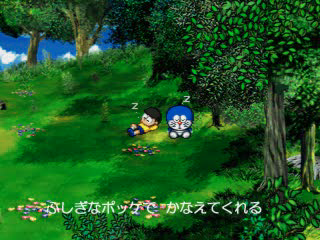
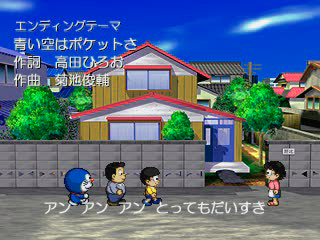
Nobita’s opening problem is unusually downbeat for such a familiar children’s character. He is yelled at by his teacher and mother, teased by friends, and upset that the girl he likes is spending time with someone else. His plea to Doraemon for somewhere to hide gives the adventure a small but believable emotional hook: he does not begin as a grand hero, just a kid desperate to get away.
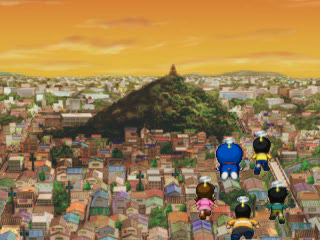
Doraemon finds that escape in a deep underground cave using one of his future tools, but the cave quickly stops being a refuge. Nobita and Doraemon uncover an ancient altar and accidentally release Bit, a strange but friendly creature. When the others return to the cave, an ancient demon kidnaps everyone except Nobita. The shift from hiding out to mounting a rescue is clean, direct, and well suited to a dungeon-by-dungeon structure.
The story’s strongest touch is how it makes finding friends matter beyond the cutscene premise. Each rescue advances Nobita’s goal and adds another playable character, tying narrative momentum to the act of pushing deeper into dangerous floors. Do not come expecting an elaborate fantasy epic; this is a straightforward Doraemon tale. But it has more urgency than a loose collection of cartoon references, and Nobita’s initial misery gives his eventual responsibility a nice contrast.
Overall Experience
Doraemon 3: Makai no Dungeon works because it does not treat its license as an excuse to flatten the genre. Its cute, recognizable cast is dropped into a form that rewards caution, spatial awareness, and a willingness to pause before committing to a move. The result can be more demanding than the Doraemon name suggests, especially once traps and enemy movement start punishing impatience.
If you already enjoy Chunsoft-style dungeon crawlers, the game’s structure will be immediately comfortable: randomized exploration, turn-by-turn danger, and useful finds that can change how you approach a floor. If you mainly want a relaxed cartoon game, it may feel slower and harsher than expected. That is not a flaw, but it does make this a game you should meet on its own terms.
For Doraemon fans, Nobita’s rescue mission and the chance to unlock his friends give the crawl extra warmth. For roguelike fans, it is a licensed take on a proven format rather than a radically different one. The payoff is worth it when you enjoy that steady cycle of scouting, making a calculated move, surviving the consequences, and pressing onward through another unknown dungeon.


Reviews
There are no reviews yet.