 Retro Replay Retro Gaming History, Reviews & Emulation
Retro Replay Review
Gameplay
You spend Seitokai no Ichizon Lv.2 Portable in a familiar visual-novel rhythm: read the dialogue, make a choice, and see how far the student council’s meeting slides off course. Ken Sugisaki is the sole male member, but he is hardly the captain of this ship. The other council members keep hijacking the conversation, so the pleasure comes from following the next comic tangent rather than working toward a major tactical goal.
Choices include ordinary selections as well as timed two-option decisions. A prompt can ask whether you indulge somebody’s suggestion or refuse it, and whether you answer through reason or instinct. That gives the conversations some welcome pressure without pretending they are action sequences. You are not building a party, fighting battles, or mastering a card system. You are deciding how deeply to lean into a joke and then returning later to see where a different answer leads.
Finishing ending chapters earns collectible cards tied to characters, situations, and items. Combine three cards and you open fantasy events, which gives repeat runs a concrete purpose beyond curiosity. That structure clicks if you enjoy poking at branches to uncover more sketches with the cast. It can feel like homework if the central humor does not work for you, because the game’s intentionally aimless meetings are the whole point, not a slow opening before a more focused adventure.
Graphics
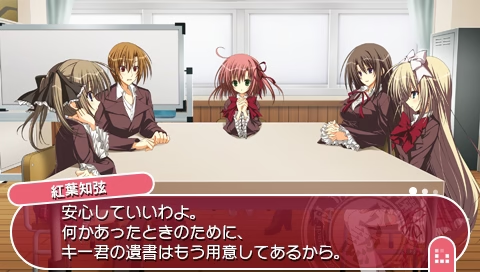
The active council-room scenes are clean, bright anime dialogue screens. Four girls in maroon school jackets and red bows sit with Ken around a large cream-colored table, framed by broad windows, a pale whiteboard, and brown wall panels. The pink-haired president’s big green eyes, the long light-haired member’s white bow, and Chizuru’s darker hair make it easy to tell the group apart at a glance.
The room itself is a modest, mostly static place to read conversation rather than a visually changing campus. Still, the crisp faces and strongly differentiated hair colors keep the familiar setup from becoming hard to parse during long exchanges.
Story
The premise is cheerfully meta: the student council wants to turn its own series into a video game. From there, the story follows meetings that keep getting pulled away from anything resembling an agenda. It is a comedy built around hanging out with an established cast, not a dramatic mystery or a straight climb toward a single big conflict.
That makes prior attachment valuable. Familiarity with the characters gives their interruptions, personality clashes, and running bits more weight, while newcomers may spend a while learning why everyone is acting so absurdly. The game is fully voiced in Japanese, and Japanese language ability is central to following its wordy humor and choices.
The tone also includes leering fan service. It is part of the comedy’s texture rather than an occasional side note, so you should not expect a purely cozy school-club hangout. If that style rubs you the wrong way, the branching structure will not rescue the story. If you can tolerate it and enjoy self-aware anime comedy, the repeated detours are the reason to stay.
Overall Experience
This is a narrow but sincere recommendation. Give it a chance if you can read Japanese, already enjoy the cast, and want a PSP visual adventure that treats a student council meeting as a launchpad for branching jokes. The payoff is not a dramatic finale that redefines everything. It is finding a new tangent, a different response, or a fantasy event that feels tailored to the group’s ongoing nonsense.
Do not come in expecting the “make a game” premise to become a management game. Suzumiya Haruhi no Tomadoi is the better comparison if you want a school-club adaptation that actually leans into project management and playable creations. Seitokai no Ichizon Lv.2 Portable keeps its attention on conversation branches and comic detours.
For fans, it is a pleasant excuse to spend more time with a chaotic council and chase alternate material. For everyone else, the language barrier, loose plotting, and fan-service humor are substantial obstacles, not small caveats. The original Kadokawa publisher page reflects its identity as a PSP original, and that standalone approach fits the game itself: a compact, character-first comedy that does not need to become anything more ambitious to know what it wants to be.


Reviews
There are no reviews yet.