 Retro Replay Retro Gaming History, Reviews & Emulation
Retro Replay Review
Gameplay
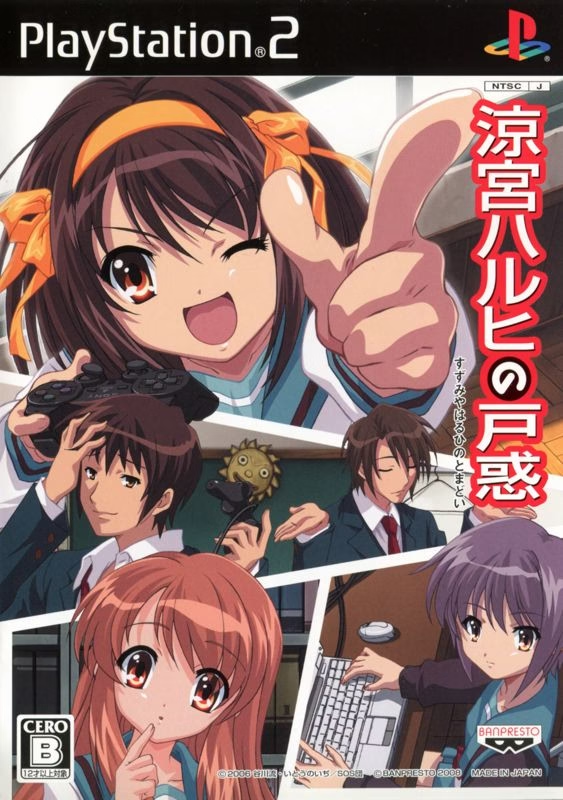
The first pull is immediate if you enjoy Haruhi’s particular brand of group-project mayhem. You experience the story through Kyon as the SOS Brigade works together to satisfy Haruhi’s latest demand, and that setup gives the conversations a practical purpose beyond simply revisiting favorite characters. This is an adventure built around their interactions, with game production serving as the joke, the objective, and the reason everyone has to stay in the same room.
The best twist is that the games made within the adventure are playable. You are not handed unrestricted development software. Instead, the premise branches into three compact game styles: an intentionally old-fashioned 8-bit RPG, a robot-tactics-style strategy game, and a character-raising simulation. That variety gives the central concept more payoff than a tie-in that only talks about making a game, while the constraints keep the focus on the brigade rather than turning it into a complicated design tool.
That distinction matters. If you want to build your own RPG from the ground up, RPG Maker on PlayStation is the better match because it is an actual construction toolkit. Tomadoi is a licensed adventure that borrows the fun of making games to create a playful frame for its characters. Its Japanese-only, conversation-heavy format will be the main obstacle for many imports, so this is easiest to recommend to fans who can follow the dialogue or are willing to work through it carefully.
Graphics
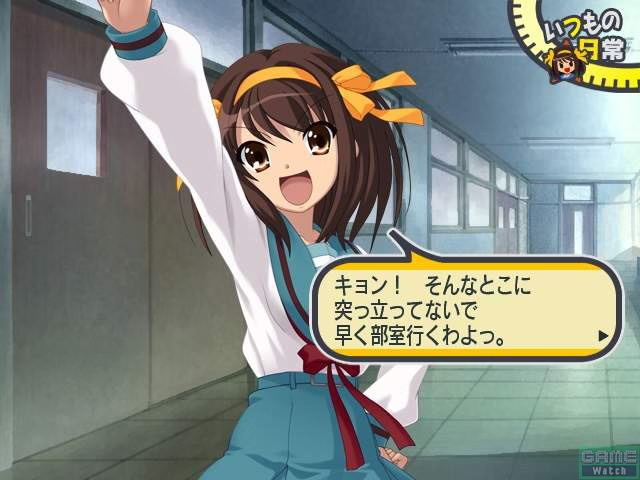
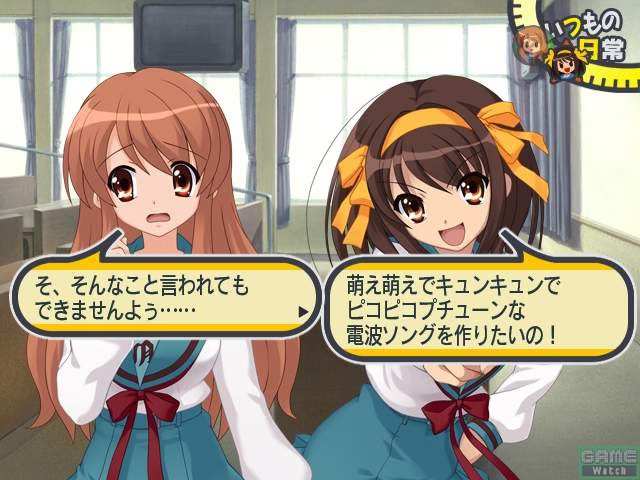
The narrative scenes use clean anime-style character art with large expressive faces, crisp outlines, and hair colors that make the central cast easy to pick out. Haruhi’s brown hair and yellow ribbons stand out in a cool gray-blue school hallway, while Mikuru’s auburn hair and Yuki’s short purple hair break up the white sailor uniforms, teal skirts, and red neck ribbons.
Its school settings are bright and familiar rather than flashy. A classroom scene has big windows, desks, pale walls, and a wall-mounted television, giving the conversations a recognizable everyday backdrop. The character designs carry the visuals more than the locations do, which suits a game centered on the brigade talking and working together.
Story
This is a premise that understands why Haruhi works: a simple request from her is never allowed to remain simple. Making a game becomes a group undertaking for the SOS Brigade, and Kyon’s perspective keeps the setup grounded in his role as the guy trying to keep up with everyone else’s enthusiasm. It is a natural vehicle for the cast’s back-and-forth instead of an excuse to recast Haruhi as a generic game hero.
The story’s strength is its cozy, self-referential setup. You get to watch characters from an anime and light-novel universe make their own little videogames, then try those creations yourself. That is a genuinely charming loop, especially for a fan who enjoys seeing the brigade bounce off one another in an ordinary school environment.
Language is inseparable from the experience. The adventure leans heavily on Japanese dialogue and character interaction, so the humor and relationships will land much better if you can read Japanese. If you cannot, the playable side projects still make the import more interesting than a purely text-based tie-in, but they cannot fully replace the conversations at the center.
Overall Experience
Suzumiya Haruhi no Tomadoi earns its place as a fan game because it turns a very Haruhi-like premise into something you can actually participate in. The playable internal games give the concept a welcome bit of follow-through, and Kyon’s point of view makes the club’s production effort feel like a story rather than a menu of disconnected minigames.
Its limits are also clear. This is not a broad game-development sandbox, and it is not an easy recommendation for someone who wants a mechanically deep RPG or strategy game on its own. The three styles work best as extensions of the larger adventure, little proof that the SOS Brigade’s project has taken shape.
For Haruhi fans with Japanese ability, this is an easy curiosity to justify and a surprisingly clever one at that. Everyone else should know exactly what they are importing: a dialogue-led character adventure with playable genre detours, not a universal game-making package. The publisher’s December 2007 newsletter captures the core promise well, and the finished PS2 game follows through on it with more charm than ambition.


Reviews
There are no reviews yet.