 Retro Replay Retro Gaming History, Reviews & Emulation


Retro Replay Review
Gameplay
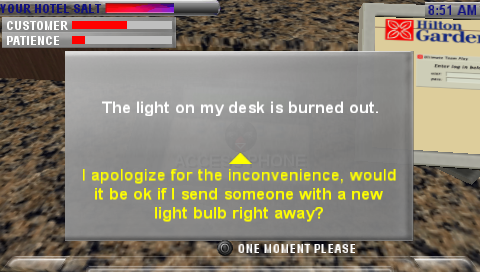
The first few minutes make the intent plain: pick a role at reception, take a task list, and learn the hotel floor by doing the job. The tutorial matters because The Hilton Family asks you to juggle procedures rather than simply tick off objectives. A task can be straightforward on paper, but the SALT rating adds pressure through customer patience, appreciation, dialogue choices, and completion time. You are not merely asked whether a job gets done; you are pushed to consider how it gets done.
Housekeeping is probably the clearest expression of that design. Cleaning rooms means attending to a chain of small details: put furniture back where it belongs, open curtains, vacuum carpets, clean the room, and remove extra hangers. That kind of methodical work will either click as a satisfying checklist or wear thin very quickly. It does at least make the training message hard to miss: overlooking minor standards can hurt the result.
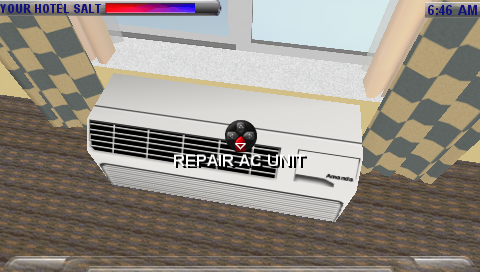
The food-and-beverage role sounds busier and likely has the strongest sense of urgency. You greet guests, take orders, use the computer for checks and receipts, collect dishes and coffee from the kitchen, and carry meals before they go cold. Guest service shifts the focus to check-ins, questions, bookings, restocking, and passing engineering issues along, while engineering handles faults from clogged toilets to AC units, televisions, bulbs, and remote batteries. The walkie-talkie and sudden calls give every department a reason to stay alert instead of treating the task list as a static chore.
Frustration is built into the premise. Time limits and branching customer responses mean a poor choice or slow route can drag down your rating, even when you understand the basic job. For training, that is fair: hotel work is full of interruptions and impatient people. For a conventional PSP game, though, the loop is rigid and procedural. You should play it only if the idea of learning service routines through simulation sounds more appealing than progression, discovery, or freeform play.
Graphics
The game puts you in a first-person recreation of a Hilton Garden Inn, moving between the reception desk, guest rooms, kitchen, dining areas, and maintenance problems. That viewpoint fits the subject well: you are looking at rooms to clean, items to carry, and appliances to repair from the worker’s position rather than overseeing the hotel from above.

Story
There is no grand plot pulling you from one chapter to the next. The Hilton Family treats the hotel itself as the setting for a series of workplace scenarios, with guests and their requests supplying the immediate stakes. That is appropriate for a training tool, but it also means there is little narrative reward waiting after a completed shift.
The closest thing to drama comes from customer patience and the dialogue branches. A greeting, answer, or delay can influence satisfaction, which gives ordinary interactions a small amount of tension. You are not building relationships or chasing twists; you are trying to prevent a service encounter from going wrong.
That stripped-down approach makes the game easier to judge on its own terms. It uses scenarios to reinforce behavior: be prompt, be accurate, communicate clearly, and solve the issue in front of you. Anyone expecting a fictional Hilton-family story will be disappointed, but the absence of one keeps the focus squarely on the training exercise.
Overall Experience
The Hilton Family is a remarkably specific piece of software. It was made for new Hilton Garden Inn employees, distributed in a limited run, and locked to a required memory stick alongside its UMD. That unusual context explains both its discipline and its limitations. This is not trying to entertain a broad PSP audience; it is trying to make hotel standards memorable through repetition and consequence.
Within that assignment, the game has a sensible structure. Four departments give the training some variety, and the SALT score turns service quality into a concrete target rather than a vague instruction to “do better.” The best moments are likely when several demands overlap and you have to decide whether speed, a careful response, or a quick trip to the right place will protect the guest experience.
Still, it is hard to recommend as recreational play. The chores are intentionally mundane, and the reward is mainly the satisfaction of executing a procedure correctly. If you are interested in occupational simulations, service-industry training, or oddball PSP releases, it is a fascinating glimpse at a corporate game built around real performance metrics. Everyone else can safely treat it as a historical curiosity rather than a lost handheld essential.


Reviews
There are no reviews yet.