 Retro Replay Retro Gaming History, Reviews & Emulation
Retro Replay Review
Gameplay
Blast Wind starts at full speed. You are immediately steering a ship through vertically scrolling danger, collecting bonuses for more firepower, and firing upward at robotic opposition. That directness is its strength. There is no need to wait for the game to reveal what it wants from you: stay alive, make your shots count, and deal with enemies before the screen becomes hostile.
The power-up loop is familiar, but it has the right kind of arcade pull. Building your firepower makes a tangible difference, especially when your modest craft is facing a huge boss. Two-player support also suits the design well. Bringing a second pilot turns the same pressure into a shared scramble, and it gives repeat runs a more social reason to happen.
What separates Blast Wind from a straightforward scrolling shooter is its in-stage switches. Activating them lets you take alternative routes, so a run is not locked to one sequence of locations and encounters. That is a meaningful reason to replay rather than simply chase a cleaner clear. If you know Technosoft through the horizontal action of Thunder Force III, Blast Wind is a useful reminder that the developer could bring a similarly immediate attack-first mindset to a vertical format.
Graphics
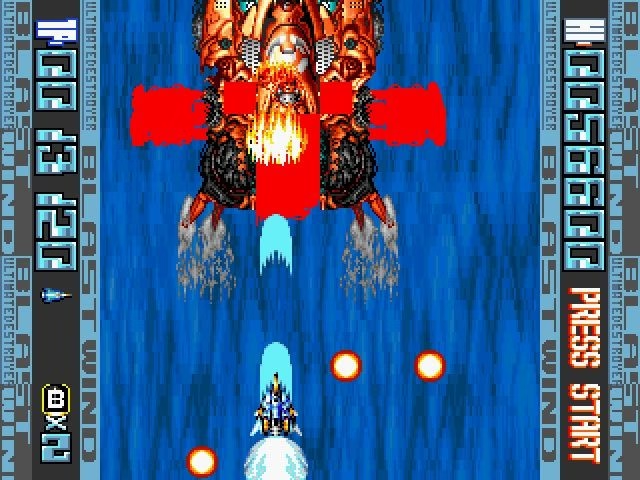
Blast Wind’s pixel art is bold and richly colored. A small silver-blue ship throws a wide pale-blue blast into a massive bronze-red mechanical boss, with orange bullets and red explosions punching hard against a blue backdrop. The scale contrast is excellent: your craft looks tiny and exposed, while the boss fills the fight with metal bulk.
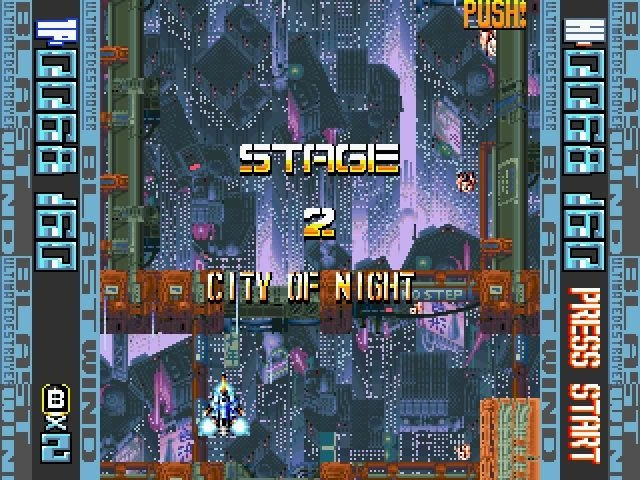
The city areas have their own appeal, packing purple and blue buildings behind orange industrial gantries. It is dense, colorful scenery that keeps the post-apocalyptic setting from becoming a generic stretch of gray ruins.
Story
The setup is clean arcade fiction. Kyo and Faun are artificial life forms fighting Gorn, a robotic force threatening humanity’s last remnants. It gives every blast a clear target and every mechanical enemy an obvious place in the conflict.
Do not come to Blast Wind expecting character drama. Kyo and Faun function as the two playable sides of the same resistance, and the story mainly exists to propel the action forward. For this kind of game, that is not a flaw so much as an honest priority.
The post-apocalyptic backdrop works best in the way it frames the stakes. You are not just shooting machines for the sake of a high score, even if score-driven survival remains the moment-to-moment focus. You are pushing back against an enemy that could erase what humanity has left.
Overall Experience
Blast Wind is a sharp, replayable arcade shooter with one especially welcome idea: your route can change because of what you do during a stage. That small bit of agency gives its otherwise classic structure a reason to keep drawing you back. The payoff is strongest if you enjoy learning a run, trying another path, and seeing whether better decisions can carry you farther.
Its limits are equally clear. The central experience is still built around familiar shooter fundamentals: collect firepower, clear enemies, confront bosses, and survive. If you need a shooter to constantly layer on elaborate systems, the more complex design of Radiant Silvergun makes an interesting contrast. Blast Wind is more interested in keeping you moving and firing.
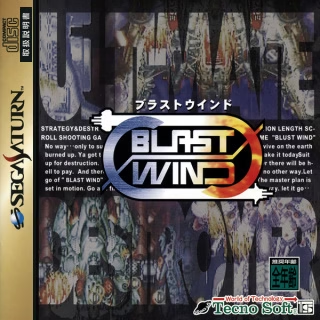
Give it a chance if colorful 2D action, large mechanical bosses, and branching stage routes sound like a good Saturday afternoon. The Saturn release remains an appealing Technosoft curiosity, and the Saturn game listing for Blast Wind is useful if you want to identify that edition. It may not radically reshape the shoot-’em-up formula, but it has enough route-based replay value and visual punch to make its straightforwardness feel purposeful.


Reviews
There are no reviews yet.