 Retro Replay Retro Gaming History, Reviews & Emulation

Retro Replay Review
Gameplay
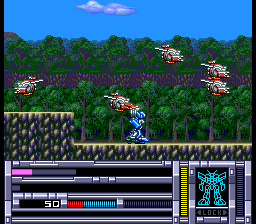
The opening hook is wonderfully direct: a young pilot inherits a Powered Gear after an Imperial attack and heads out looking for payback. Once you reach the hostile areas, Blood Gear plays less like a menu-heavy RPG and more like a side-scrolling action game with a robot you can steadily rebuild. You fight in real time, navigate platform-heavy stages, and decide whether the next useful find is a weapon, a repair kit, or simply more points toward a better machine.
Its strongest idea is the shared currency. Defeated enemies award the same points you use for buying gear, repairing damage, and upgrading your Powered Gear. That makes spending feel consequential. Blow a stash on a new rifle or laser gun and you may postpone a key body, arm, or leg upgrade; spend heavily on repairs and you might delay the extra strength or speed that would make the next area easier. It is a neat pressure system because there is no separate experience track quietly solving your problems in the background.
The factory upgrades give that pressure real flexibility. Body, arms, and legs each branch into further improvements affecting speed, strength, and other parameters, and the ability to reverse an upgrade and reclaim its points is a welcome mercy. You are encouraged to experiment instead of fearing every choice. A player who wants a different balance for a troublesome stretch can rework the machine rather than start over.
Frustration is most likely to arrive when your build or resources lag behind the enemies. Fortunately, respawning foes make grinding an intentional option: return to an area, fight again, and build up the points needed for supplies or upgrades. That can become repetitive, but it also gives you a clear route forward. If you enjoy action RPGs where a rough patch can be solved through persistence and smarter spending, the loop has real staying power.

Graphics
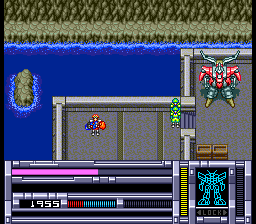
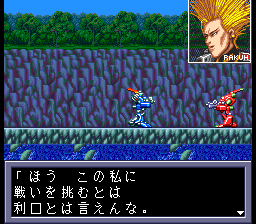
Towns use a top-down RPG view, while enemy territory switches to side-scrolling screens with platform structures. That division makes the two halves easy to parse: you explore settlements from above, then take your large combat robot into lateral combat spaces where jumps, enemies, and weapon fire are the focus.

Story
This is a blunt, effective revenge setup. The Deguna Empire’s Powered Gears attack a laboratory, a dying scientist passes the control device to his apprentice Aref, and Aref answers the loss by taking his own machine to war. You know exactly why he is fighting almost immediately, which suits a game more interested in sending you into combat than lingering on introductions.
The Empire is presented as a planet-terrorizing military force with an unbeaten robot army, so the conflict has a suitably oversized sci-fi target. Aref’s personal anger gives that larger war a human entry point. The story does not need a complicated premise to justify the journey; a young pilot in a newly acquired combat robot pushing back against a brutal empire is a sturdy reason to keep moving.
There is also room for allies who share Aref’s hatred of the Empire, which gives the adventure the potential to grow beyond a lone vendetta. Still, the central draw remains clear: this is a mecha revenge tale powered by forward momentum. Come for that straightforward drive, not for a premise built around ambiguity or political nuance.
Overall Experience
Blood Gear is at its best when you are weighing a practical choice after a hard fight: repair now, buy a weapon, or bank points for a major Powered Gear improvement. The action, platforming, shops, found equipment, and upgrade system all feed that decision. It creates a satisfying sense that your machine is yours, shaped by what you have earned and what you were willing to postpone.
The mixed structure also helps. Top-down town exploration breaks up the side-scrolling combat, and the hostile stages give the equipment system a concrete test instead of leaving it as abstract stat management. Weapons spanning melee options, pistols, assault rifles, and laser guns promise different ways to approach robot encounters, while repair kits keep survival tied to preparation as well as reflexes.
This is worth a look if you have a soft spot for 1990s action RPGs, giant robots, and games that let you grind your way past resistance without removing the cost of that choice. The repeated enemy farming will not charm everyone, and the shared-point economy can be demanding, but the ability to refund upgrades keeps experimentation from becoming punishing. For the right player, its tough-but-manageable progression is the payoff.


Reviews
There are no reviews yet.